3 Wheel Forklifts Vs 4 Wheel Forklifts: Which Is Right for Your Operation?
Choosing between 3 wheel forklifts vs 4 wheel forklifts is one of the biggest equipment decisions you make for a warehouse, dock, or yard. The choice comes down to space, stability, load, environment, and cost. Pick the wrong design and you end up with a machine that wastes aisle space, struggles on your floor, or falls short of the capacity your pallets demand. This guide shows you how each type works, where it fits, and which questions to answer before you buy. When you are ready to compare machines, browse our forklifts.
3 Wheel vs 4 Wheel Forklifts at a Glance
Here is how the two designs compare on the factors that matter most to your daily work.
| Factor | 3 Wheel Forklift | 4 Wheel Forklift |
|---|---|---|
| Turning radius | Tighter, built for tight spaces | Wider, needs more floor space to turn |
| Stability | Best on smooth, level floors | Better on uneven surfaces and at height |
| Load capacity | Lighter loads, generally 3,000 to 5,000 lbs | Heavier loads and heavy duty work |
| Best environment | Indoor warehouses, docks, narrow aisles | Outdoor yards, rough or sloped ground, mixed use |
| Upfront cost | Usually lower | Usually higher |
| Maintenance | Simpler design, simpler upkeep | Sturdier build made for harder duty |
| Typical power | Typically electric | Electric or internal combustion |
The short version: a 3 wheel truck wins on agility indoors, while a 4 wheel truck wins on strength and versatility.
What Is a 3 Wheel Forklift?
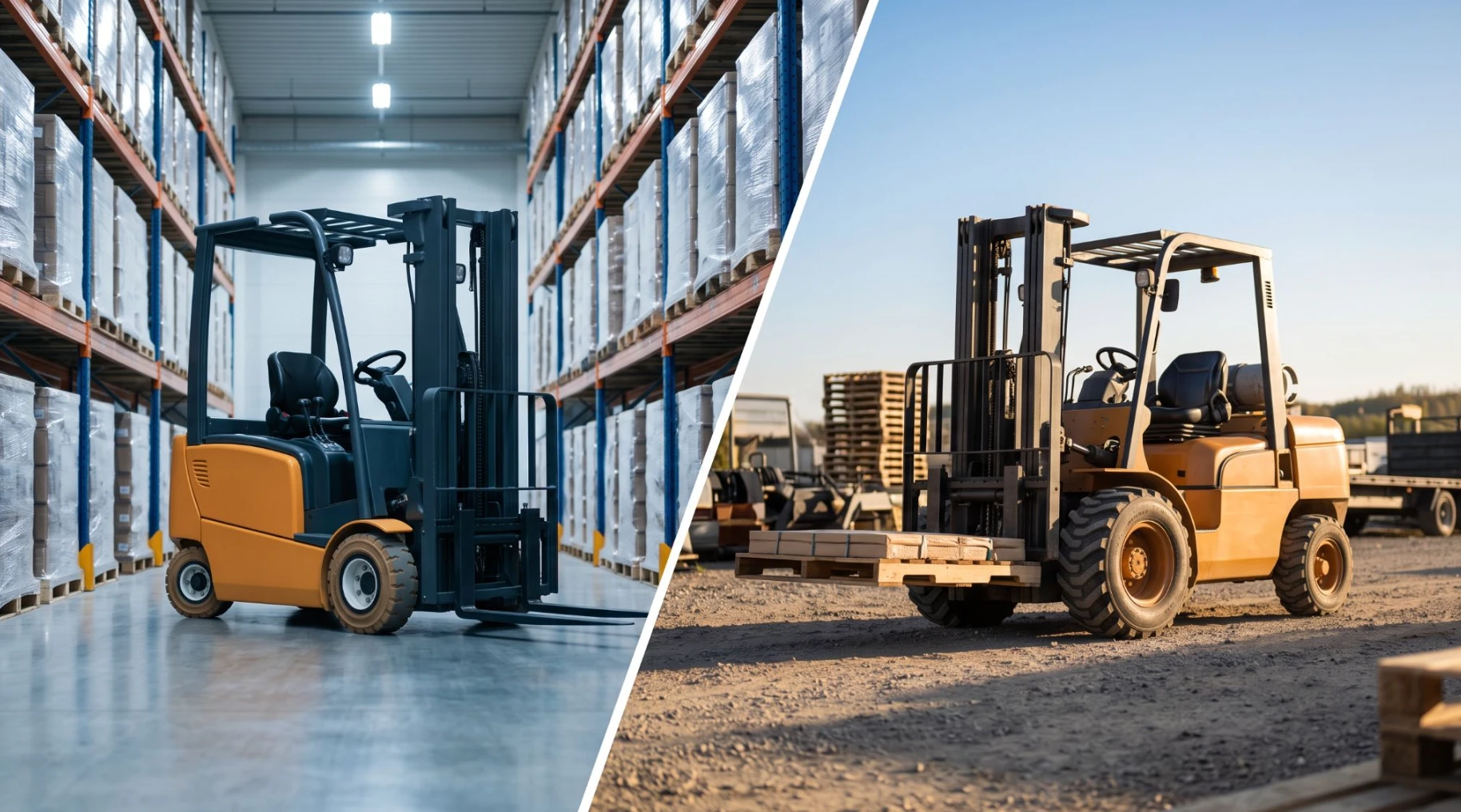
A 3 wheel forklift is a counterbalance lift truck with two drive wheels at the front and a single steer wheel at the rear. That rear wheel pivots sharply, which lets the truck rotate in a very small footprint. Most three wheel models are electric, powered by a battery rather than fuel.
Where 3 Wheel Forklifts Work Best
This design shines wherever space is tight. If your aisles are narrow, your storage is dense, or your trucks spend most of the shift working around a crowded dock, a three wheel machine gives you room to move. It handles indoor warehouses well, and it suits loading docks where you pick up and place pallets again and again. In high turnover operations, the quick maneuvers add up to real productivity over a full shift.
Limits of 3 Wheel Forklifts
The same compact design comes with tradeoffs you should weigh. Three wheel trucks generally handle lighter loads, so heavy pallets may exceed what they can safely lift. They are also less stable on uneven ground, and they are built mainly for indoor use on smooth floors. If your work takes you across cracked pavement or onto a yard, expect a poor fit.
What Is a 4 Wheel Forklift?
A 4 wheel forklift also uses two front drive wheels, but it adds two steer wheels at the rear. That spreads the weight of the machine and the load over four points of contact instead of three. You can find four wheel trucks in both electric and internal combustion versions, so you can match the power source to your site.
Where 4 Wheel Forklifts Work Best
Four wheel trucks are the stronger choice outside and on demanding surfaces. They work well in outdoor yards, on rough or sloped ground, and with heavier loads. They are also the practical pick if your day mixes indoor and outdoor work, such as moving pallets from a trailer in the yard to storage inside the building.
Limits of 4 Wheel Forklifts
The extra wheel and wider stance come with a cost. Four wheel trucks need a wider turning circle, which means more floor space to turn and less storage density. They also usually cost more than comparable three wheel models. If your building is tight and your loads are light, you may be paying for strength you never use.
Maneuverability and Turning Radius
A 3 wheel truck turns tighter because its single rear wheel can pivot far more sharply than a pair of rear wheels can. The truck can nearly spin around its own drive axle, which lets you work comfortably in tight spaces.
That has a direct effect on your layout. A tighter turn means you can run narrower aisles, and narrower aisles mean more rack positions in the same building. Three wheel trucks are a strong match for aisles under 10 feet wide. A four wheel truck needs extra room to swing its rear end through a turn. In a crowded warehouse, that lost space reduces storage density. In an open yard, it makes no difference at all.
Stability and Safety
Stability is the biggest practical difference between the two types. How a truck carries weight decides where it can work safely and how much margin you have when conditions are not perfect.
Weight Distribution and Tip Risk
Four points of contact create a wider, steadier base than three. A four wheel truck spreads weight across that wider footprint, which gives it better stability on uneven surfaces and makes it the safer choice for high lift operations. A three wheel truck concentrates its support in a triangle, and that is perfectly fine on smooth concrete but less forgiving on a bumpy or sloped surface.
Surface condition matters as much as wheel count. A 3 wheel truck on a clean, level floor can be safe and predictable, while the same truck crossing a dock plate lip or a patch of broken pavement faces a very different risk. Match the truck to the worst surface it will regularly cross, not the best one.
Operator Safety Practices
No design replaces good habits. Make sure every operator is properly trained and certified for the exact truck they drive. Slow down before turns, since speed and sharp steering are a poor mix on any lift truck, and three wheel models in particular respond quickly to steering input. Keep loads low while traveling, keep them centered on the forks, and never exceed the rated capacity on the data plate. Treat the data plate as the final word on what a truck can lift.
Load Capacity and Lift Height
Capacity is where the two types separate clearly. Three wheel forklifts generally handle lighter loads, typically in the range of 3,000 to 5,000 lbs. Four wheel forklifts are preferred for heavy duty applications and carry heavier loads with more confidence.
Rated capacity is not a single fixed number, though. Forklift capacities drop as you raise the load higher, because the load's center of gravity moves farther from the truck. A truck that safely lifts a full pallet at low height may be rated for much less at the top of the mast. This is why four wheel trucks are favored for high lift work, where extra stability counts. Before you buy, confirm the rated capacity at the lift height you actually need, not just the headline number on the spec sheet.
Indoor vs Outdoor Use
Where you operate narrows the choice quickly, and two details settle most of the decision: what the truck rides on and what powers it.
Tire Types and Surfaces
Tires and surfaces go hand in hand. Cushion tires are solid and low to the ground, which suits smooth concrete floors inside a building. Pneumatic tires are air filled and tougher, which gives them the traction and shock absorption to handle gravel, rough ground, and sloped areas. Three wheel trucks are optimized for smooth indoor surfaces, so they usually pair with cushion tires. Four wheel trucks handle uneven surfaces and minor outdoor transitions better, and they are available with pneumatic tires for rougher work.
If your yard has loose gravel or rough terrain, a pneumatic tire four wheel truck is the more suitable machine.
Power Type and Ventilation
Electric forklifts produce zero emissions indoors and run quieter than internal combustion models, which makes them the natural choice for indoor warehouses where air quality and noise matter. A single charge can carry an electric truck through an extended shift, depending on the battery and the workload.
IC forklifts, which run on propane, gas, or diesel, are preferred for outdoor heavy duty applications. They give you strong power and quick refueling for long days in the yard. Keep them out of poorly ventilated spaces, because exhaust builds up fast in an enclosed building.
Cost, Maintenance, and Total Cost of Ownership
Upfront price is only part of what a forklift costs you. A 3 wheel truck usually costs less to buy, and its simpler design generally means simpler upkeep. A 4 wheel truck usually costs more, but you are paying for durability and capacity, which can be good value if your work is demanding enough to use both.
Power source changes the math too. With electric trucks, think about the battery and the charger. You need a place to charge, enough charging capacity for your shifts, and a plan for battery care and eventual replacement. With IC trucks, you budget for fuel and engine maintenance instead. Count every one of these costs over the full life of the truck, then compare. Ask for current pricing instead of guessing, since cost varies widely by capacity, condition, and configuration.
New vs Used 3 Wheel and 4 Wheel Forklifts
Used trucks can be a smart fit for light duty and low hour operations, where a machine will not run around the clock. If you only move a few pallets per day, there is little reason to pay new prices.
Inspect carefully before you buy. Look over the mast and chains for wear, check the forks for bends or cracks, test the hydraulics, and confirm that the steering and brakes respond smoothly. Check the tires, and for electric trucks, ask about the battery's condition and age. Review service records if they exist and confirm the data plate matches the capacity you need. You can browse used forklifts from PS Janitorial to compare options.
How to Choose Between a 3 Wheel and a 4 Wheel Forklift
A few key questions will point you to the right forklift. Answer these six, and the choice usually becomes clear.
- What load weight and size do you handle?
- How high do you lift?
- How narrow are your aisles?
- Indoor, outdoor, or both?
- How many hours and shifts per day will the truck run?
- What is your budget, new or used?
Your answers to the first four usually decide the wheel count, and the last two decide the power type, condition, and price.
Quick Recommendations by Application
Use these shortcuts when you want a fast answer based on how you work.
- Choose a 3 wheel forklift if you work indoors on smooth concrete, run narrow aisles, handle lighter pallets, and need to turn quickly around docks and racks.
- Choose a 4 wheel forklift if you work outdoors or move between inside and outside, deal with rough or sloped ground, lift heavier loads, or need stability at height.
- Consider a different truck type, such as a reach truck or another narrow aisle truck, if your aisles are tighter than a standard counterbalance truck can handle or you need to stack very high in dense storage.
3 Wheel vs 4 Wheel Forklift FAQs
Is a 3 wheel forklift less stable than a 4 wheel forklift?
On uneven ground, yes. A four wheel truck rests on four points of contact, which gives it a wider base and better stability on rough surfaces and at height. A three wheel truck is stable on smooth, level floors but less forgiving anywhere else.
Can a 3 wheel forklift be used outdoors?
It is possible in limited cases, such as crossing a smooth, level transition between a dock and a lot. Three wheel trucks are built mainly for indoor use, though. For regular outdoor work on rough or sloped ground, a four wheel truck is the safer and more capable choice.
Which forklift has a smaller turning radius?
The 3 wheel forklift has the tighter turning radius. Its single rear steer wheel pivots sharply, which lets it work in narrow aisles and crowded areas where a four wheel truck would need more room.
Which is cheaper, a 3 wheel or 4 wheel forklift?
A 3 wheel forklift usually costs less to buy, and its simpler design tends to keep upkeep simpler too. A 4 wheel forklift usually costs more, but you get added capacity and durability for heavier or outdoor work.
Are 3 wheel forklifts electric?
Most are. Three wheel trucks are typically electric, which suits indoor work because they produce zero emissions and run quietly. Four wheel trucks come in both electric and internal combustion versions.
Which type is better for a small warehouse?
A 3 wheel forklift is usually the better fit for a small indoor warehouse. Its tight turning radius lets you run narrower aisles and fit more storage into limited floor space, as long as your loads stay within its capacity.
Find the Right Forklift at PS Janitorial
Ready to find your machine? Shop our forklifts to see what is available for your operation. If you want help choosing between a 3 wheel and a 4 wheel truck, contact us and our team will help you match the right forklift to your space, loads, and budget.