Telehandler vs Forklift: Which One Does Your Job Site Need?
Telehandler vs forklift is one of the first questions to settle before you buy, rent, or assign equipment. Both machines lift and move loads, but they are built for different jobs. One is a specialist for pallets on firm floors, like the machines in our forklifts category. The other is a versatile outdoor machine with serious reach. In this guide, you will learn the key differences, when to choose each machine, how cost and safety compare, and how to work through a simple selection checklist.
Telehandler vs Forklift: The Quick Answer
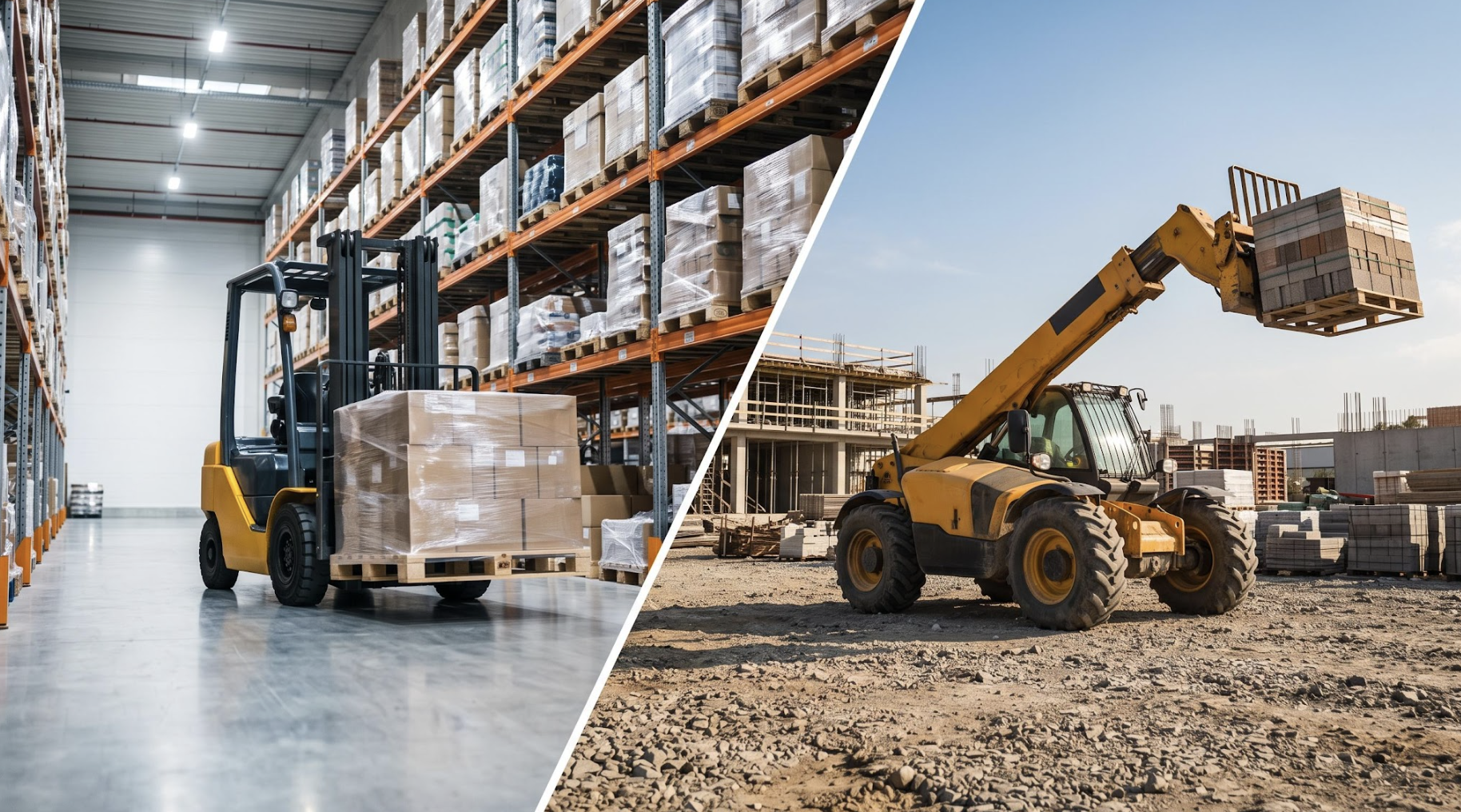
Forklifts suit indoor, smooth floor pallet handling. Telehandlers suit outdoor work, height, forward reach, and uneven ground. If your loads travel from a dock to a rack on a paved floor, a forklift does the job faster and for less money. If your loads must be placed over obstacles or at upper levels, a telehandler is the better fit.
- Choose a forklift for indoor, flat, pallet focused work.
- Choose a telehandler for reach, height, rough ground, and varied attachments.
What Is a Forklift?
A forklift is a powered industrial truck with a fixed vertical mast and forks that lifts loads straight up and down. It is equipped with front forks designed for lifting, and a counterweight at the rear keeps the machine balanced. That simple design is why forklifts are the standard choice for stacking pallets and moving inventory.
Common Types of Forklifts
The most common types fall into three groups. Electric forklifts run on batteries and suit indoor operations where exhaust and noise matter. Internal combustion forklifts run on fuels such as propane or diesel and handle mixed indoor and outdoor routes or heavier duty cycles. Rough terrain forklifts are built with larger tires and more ground clearance for yards and unpaved surfaces. Within these groups, you will find sit down riders, stand up models, and narrow aisle designs for tight rack layouts.
Where Forklifts Perform Best
Forklifts excel in warehouses, factories, distribution centers, loading docks, and storage yards. They are designed for moving pallets over short distances efficiently, and they handle fast, repetitive lifting tasks on smooth ground. Their compact footprint lets them turn in tight aisles and work around racking. They are also generally easier to learn, operate, and maintain than a boom machine, which keeps daily operations simple.
What Is a Telehandler?
A telehandler, also called a telescopic handler, is a machine with an extendable boom that reaches up, out, and at an angle. It is often described as a mix of a forklift and a crane. Instead of lifting straight up a fixed mast, the boom lets an operator place a load well beyond the front of the machine.
How the Telescopic Boom Works
The telescopic boom is a set of nested sections that slide out through hydraulic power. Boom extension adds forward reach and lift height, so you can set a load on a roof edge, across a trench, or onto an upper floor. There is a trade off, though. As the boom extends, the load moves farther from the machine, and lifting capacity drops. Every telehandler comes with a load chart that shows how much weight it can safely carry at each boom angle and extension. Reading that chart correctly is central to safe operation.
Common Telehandler Attachments
Telehandlers support multiple attachments for various tasks. Pallet forks are the everyday tool, but you can also fit buckets for loose material, grapples for bundled or irregular loads, truss booms for setting structural members, and work platforms for lifting people to height when the machine and attachment are rated for it. Operators can switch between attachments quickly, which is why one machine can replace several on a busy site.
Where Telehandlers Perform Best
Telehandlers handle heavy loads across wide exterior job sites thanks to high ground clearance and four wheel drive. You will see them at construction sites delivering materials to elevated building floors, on farms moving hay bales and feed, in outdoor yards, and on maintenance jobs that require work at height. They are a strong choice when job site conditions change often.
Is a Telehandler Considered a Forklift?
In practice, yes and no. Telehandlers share the material handling purpose of a forklift and fall under powered industrial trucks. They are often classified as rough terrain forklift trucks (Class VII), yet they are a distinct machine with a boom instead of a fixed mast. Operator training requirements apply to both, and telehandlers can call for extra training on boom operation, load charts, and stability. Always confirm the classification and training rules that apply to your site before assigning anyone to the machine.
Telehandler vs Forklift Comparison Table
| Feature | Forklift | Telehandler |
|---|---|---|
| Lift Direction and Reach | Vertical lift, no forward reach | Extendable boom with forward and upward reach |
| Lift Height | Low to medium for most models | Very high for most models |
| Terrain | Best on smooth, flat surfaces | Built for uneven and rough ground |
| Indoor Use | Preferred for aisles and warehouses | Limited by size and turning space |
| Attachments | Mostly forks, some clamps | Forks, buckets, grapples, platforms, truss booms |
| Load Capacity Behavior | Consistent vertical capacity | Capacity drops as the boom extends |
| Operator Training | Standard powered industrial truck training | Same base training plus boom, load chart, and stability topics |
| Typical Cost | Generally lower | Generally higher |
Key Differences Between Telehandlers and Forklifts
The table gives you the overview. The sections below explain what each difference means on a real job.
Lift Height and Reach
A forklift lifts along a fixed mast, so it can only place a load directly in front of it. A telehandler is distinguished from a forklift by its ability to reach over obstacles. Standard telehandlers lift 30 to 40 feet, high reach models lift 55 to 75 feet, and rotating telehandlers can reach 70 to 100 feet or more. Compact telehandlers sit at the low end, with a reach height of 15 to 20 feet. If you need to stack at height or set loads beyond a wall, trench, or pile, extended reach is the deciding factor.
Load Capacity and Load Charts
A forklift carries a rated capacity that stays consistent while the load is lifted straight up. A telehandler works differently. Its lifting capacity changes with boom angle and extension, so the same machine can safely carry far less at full reach than when the boom is retracted. Many models handle loads up to 12,000 lbs depending on the model, and heavy duty machines fall in the 10,000 to 20,000 lb range, but those figures apply at specific positions. Operators must read the load chart accurately before every lift.
Terrain and Stability
Forklifts are best suited for flat and paved surfaces. Telehandlers excel on uneven ground with four wheel drive, and many include stabilizers or outriggers that add support when the boom is working. Stability considerations never go away, though. Soft soil, slopes, and loose fill all change how a machine behaves, so operators should assess ground conditions before lifting anything.
Maneuverability and Indoor Use
Forklifts are typically more maneuverable in tight spaces. Their compact footprint and tight turning radius suit narrow aisles, racking, and finished surfaces. Telehandlers are larger, heavier, and harder to turn in confined areas, which limits indoor use. Electric telehandlers are designed for indoor operations, but even those need more room than a standard forklift.
Attachments and Versatility
Forklifts are primarily restricted to standard forks and a limited set of clamps and similar tools. That makes them a specialist pallet mover, and a very good one. Telehandlers accept a wider range of attachments, so one machine can lift pallets in the morning, move bulk material at noon, and raise a work platform in the afternoon.
When to Choose a Forklift vs a Telehandler
Use these checklists to match the machine to the work you actually do every day.
Choose a Forklift If
- You mainly move pallets.
- Your work is indoors on smooth, paved floors.
- You need fast, precise handling in tight aisles.
- Budget is a major factor.
Choose a Telehandler If
- You lift to upper levels or over obstacles.
- You work outdoors or on uneven ground.
- You need several attachments.
- You need long forward reach.
When You May Need Both
Many facilities run an indoor warehouse and an outdoor yard or loading area. In that case, a forklift handles the aisles and the dock, while a telehandler covers unloading trucks in the yard, moving materials across rough ground, and any lifting at height. Sharing the work this way keeps each machine in the environment it was designed for.
Safety and Operator Training Differences
Both machines demand trained operators, but the telehandler adds extra skills. Operators must read complex load charts accurately and understand how stability changes with an extended load. The boom also creates blind spots, so visibility is a unique challenge compared to a forklift with a clear mast view. Attachment changes require care, since each tool changes how the machine behaves and what it can carry. Ground assessment matters before every job. OSHA powered industrial truck training rules apply to both machines, and employers should confirm what applies to their site and their specific equipment. For a refresher on certification and daily inspections, read our guide on how to operate a forklift.
Cost Considerations: New, Used, and Rental
Forklifts generally have lower operating and acquisition costs than telehandlers. Exact numbers depend on capacity, power type, age, and condition, so request current quotes instead of relying on averages.
Purchase Price and Ownership Costs
Look beyond the sticker price. Ownership costs include fuel or charging, routine maintenance, replacement parts, tires, and operator training. A boom machine has more moving parts and attachments to maintain, which adds to its running costs. A simple forklift working one shift a day on a clean floor is usually the cheaper machine to own. Knowing the common causes of starting trouble also helps you keep downtime low, and our guide to a forklift that won't start walks through the usual fixes.
Why Used Forklifts Are a Smart Budget Option
If your work is warehouse based, used forklifts can deliver the lifting capability you need at a lower purchase cost than new. A well inspected used unit handles pallet work, dock loading, and stacking just as well, and it frees budget for batteries, training, and the equipment around it. When you shop used, check mast and chain wear, tire condition, hydraulic function, brakes, and service history. Review the warranty policy before you buy, and consider financing options if you prefer to spread the cost over time.
Rent or Buy
Renting makes sense for short term outdoor projects, such as a single construction phase or a seasonal peak, where you need reach for a few weeks. Buying makes sense when the machine works every day. If you use a forklift daily for pallet handling, ownership usually wins over time.
Indoor vs Outdoor Operation: Why Power Source Matters
For indoor use, electric forklifts are the usual choice because they produce no exhaust at the point of use and run quieter. Internal combustion forklifts can work indoors when ventilation is strong, but exhaust gases need to be managed carefully, so many facilities keep them for docks, open bays, and yards. Outdoor work changes the choice again. Rain, gravel, and rough ground favor larger tires and engines built for sustained duty, and a rough terrain forklift or telehandler may be the better fit. Match the power source to the air you work in and the surface you drive on.
How to Choose: A Six Question Checklist
- Where will the machine work, indoors or outdoors?
- What is the ground surface like?
- How high and how far must loads be placed?
- What is the heaviest load, and at what reach?
- Which attachments will you need?
- What is your budget, including training and maintenance?
Shop Forklifts at PS Janitorial
If your answers point to a forklift, browse the PS Janitorial forklifts to compare capacity, mast height, and power type. Not sure which machine fits your aisles and loads? Send us your load weight, lift height, and aisle width, and our team can help match a machine to the job through our contact page.
Keep Warehouse Floors Clean Around Your Equipment
Forklift traffic leaves debris and tire marks behind, and a dirty floor is a safety problem for operators and pedestrians. PS Janitorial floor scrubbers and floor sweepers keep warehouse floors clean and safe, so your equipment and your people can move with confidence. If you want to save on cleaning equipment, explore our refurbished floor cleaning machines as well.
Telehandler vs Forklift FAQ
Is a telehandler a forklift?
A telehandler shares a forklift's material handling purpose and is often classified as a rough terrain forklift truck, but it is a distinct machine with a telescopic boom instead of a fixed mast.
Can a telehandler be used indoors?
Yes, in some cases. Electric telehandlers are designed for indoor operations, but their size and turning space make them less practical than a forklift in tight aisles.
Is a telehandler safer than a forklift?
Neither is safer by default. Each is safe when matched to the job and run by a trained operator. Telehandlers add risks tied to load charts, boom visibility, and ground conditions.
Do you need a separate certification to operate a telehandler?
Training requirements apply to both machines, and telehandlers can require additional training on the boom, load charts, and stability. Confirm what applies to your site under OSHA rules.
Which is cheaper, a telehandler or a forklift?
A forklift is generally cheaper to buy, run, and maintain. Telehandlers cost more but can replace several machines on a varied job site.
Telehandler vs Forklift: Making the Right Call for Your Site
The decision rule is simple. Pick a forklift for indoor, flat, pallet focused work where speed and budget matter. Pick a telehandler when you need reach, height, rough ground performance, and a choice of attachments. When you weigh telehandler vs forklift for your own operation, start with where the machine works and what it lifts, then check training and total cost. Ready to equip your warehouse? Browse our forklifts and find the right machine for your floor.