Sit Down Forklifts Vs Stand Up Forklifts: Which Is Right for Your Operation?
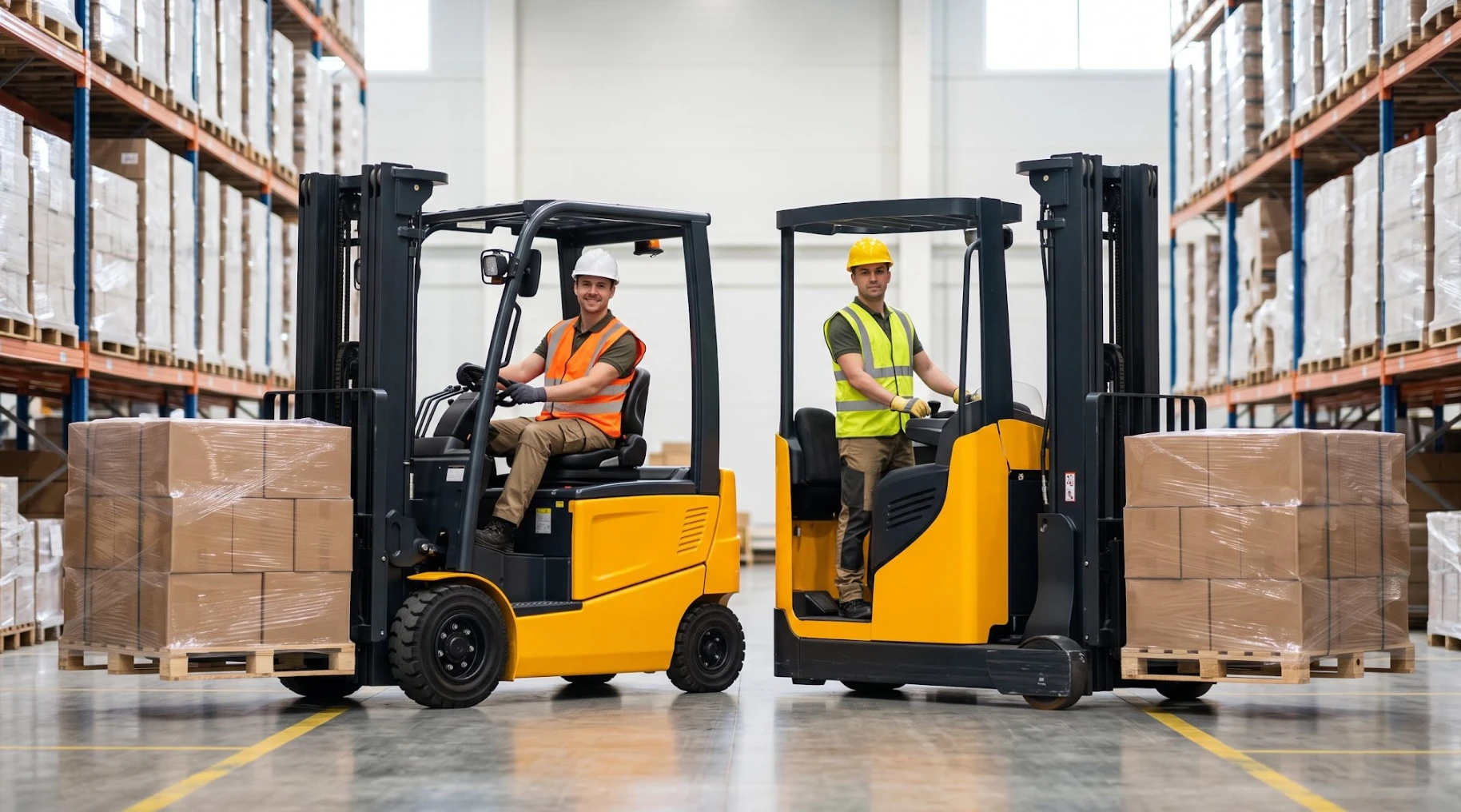
Choosing between sit down forklifts vs stand up forklifts affects safety, productivity, and cost in your operation every shift. The right truck keeps your operators protected and your loads moving, while the wrong one slows your floor and inflates your budget. This guide compares both designs side by side, then gives you a clear checklist to decide.
Sit Down vs Stand Up Forklifts: The Quick Answer
A stand up forklift is the better fit for narrow aisles, frequent on and off, and short runs. A sit down forklift is the better fit for long travel, heavier loads, outdoor use, and rough surfaces. If your day mixes both, the details below will help you weigh each factor.
- Choose stand up for tight spaces, lots of stops, frequent direction changes, and indoor work on smooth floors.
- Choose sit down for long travel distances, heavy loads, outdoor yards, and uneven surfaces.
- Expect a price gap: stand up trucks commonly cost more at similar specs.
What Is a Sit Down Forklift?
A sit down forklift is a lift truck where the operator sits facing forward and drives with a steering wheel and foot pedals. You will also hear it called a counterbalance forklift, because a heavy rear section offsets the weight of the load on the forks. It is the most common type of forklift, and it feels familiar to anyone who has driven a car.
Common Types of Sit Down Forklifts
- Cushion tire internal combustion models: Best for indoor work on smooth surfaces where you need a compact turning radius and engine power.
- Pneumatic tire internal combustion models: Best for outdoor yards, rough pavement, and uneven surfaces.
- 3 wheel electric models: Best for tighter indoor spaces, since the third wheel allows sharper turns.
- 4 wheel electric models: Best for indoor and covered outdoor work that needs more stability and capacity.
What Is a Stand Up Forklift?
A stand up forklift places the operator in a standing position, sideways to the direction of travel, inside a compact operator compartment. These trucks are battery powered, built for indoor use, and do not use internal combustion. You may also see them called a stand up rider or a stand on forklift. Their compact design is why they dominate narrow aisle applications and busy warehouse zones.
Stand Up Counterbalance Forklifts vs Reach Trucks
Searchers often mix up two different stand up designs. A stand up counterbalance forklift carries its load out front, balanced by weight at the rear, much like a sit down truck. A reach truck extends its forks into racking, so the truck itself can stay in the aisle while the forks reach the pallet. Both let the operator stand, but a reach truck is built specifically for high racking and narrow aisle storage.
Sit Down vs Stand Up Forklift Comparison Chart
Use this chart for a fast side by side view. Capacity ranges vary by source and by model, so treat them as general guidance and confirm against the data plate of any truck you consider.
| Feature | Sit Down Forklift | Stand Up Forklift |
|---|---|---|
| Operator position | Seated, facing forward | Standing, sideways to travel |
| Power source | Internal combustion or electric | Electric only |
| Typical capacity range | Roughly 3,000 lbs. to 150,000 lbs., depending on the source | Roughly 2,000 lbs. to 5,500 lbs., depending on the source |
| Maneuverability | Good, with a larger turning radius | Excellent, with a tighter turning radius |
| Travel speed | Generally higher | Generally lower over distance |
| Indoor or outdoor use | Both, depending on tire type | Mainly indoor on smooth floors |
| Learning curve | Gentle, similar to driving a car | Steeper, with unique controls |
| Seat belt | Yes | No seat belt, with a different restraint approach |
| Relative price | Lower at similar specs | Generally higher at similar specs |
Key Differences Between Sit Down and Stand Up Forklifts
Safety and Operator Protection
Safety comes first in any forklift selection, and both designs can be operated safely with the right training. Sit down trucks are equipped with a seat belt, and you should wear it every time. If the truck begins to tip over, the rule is to stay in the seat, hold on, and lean away from the direction of the fall. A sit down model also provides better protection in side impacts, because the operator is held inside the frame under the overhead guard.
Stand up trucks work on the opposite principle. There is no seat belt, so in a tip over the operator is trained to step off quickly and away from the fall. That quick exit is also an advantage in an emergency, since you can leave the truck in a second. Neither approach is automatically safer. The safer truck is the one that matches your environment and is paired with trained operators.
Maneuverability and Aisle Width
Wheelbase and turning radius decide how much room a truck needs. Stand up models typically have a shorter wheelbase and a tighter turning radius, so they work well in tight aisles and small spaces. One comparison of the right angle stack measurement lists about 68.8 inches for a stand up truck and about 72.1 inches for a sit down truck, though your numbers will depend on the model and load. Stand up trucks can often operate in aisles 12 to 24 inches narrower than sit down models. A 3 wheel electric sit down truck narrows that gap, so test both before you assume you need to stand.
Operator On and Off Frequency
Think about what happens every time your operator leaves the truck. On a sit down model, the operator unbuckles the seat belt, climbs down, and buckles up again on return. On a stand up model, the operator simply steps on and off. For order picking and other frequent stop work, those seconds add up across a full shift, and stand up trucks allow quicker entry and exit. If your operators rarely leave the truck, this advantage matters much less.
Operator Comfort and Ergonomics
Comfort works differently in each design. Sit down forklifts offer high comfort for long shifts and extended periods of travel, and they reduce fatigue when the truck is moving most of the day. The tradeoff is reversing, because sit down operators twist their bodies to see behind them.
Stand up operators simply turn their heads to see behind, which is easier on the back when you change direction constantly. The tradeoff is that standing for an entire shift can cause operator fatigue, especially on long runs. Operator preference also counts, since a comfortable operator is usually a more productive one.
Travel Speed and Performance
Sit down trucks generally offer higher travel speed and longer run times, which pays off across big facilities. If you are considering electric models, lithium ion batteries are worth a look, since they can deliver consistent power through a shift and support quick charging between breaks. Stand up trucks perform best in short bursts, where acceleration and responsiveness matter more than top speed.
Lifting Capacity and Lift Height
Sit down forklifts cover a much wider range of lifting capacities. Sources commonly cite 3,000 lbs. on the low end and up to 150,000 lbs. for the largest trucks, and sit down trucks are generally the better choice for heavy loads, often exceeding 5,000 lbs. Stand up forklifts typically sit in a range from about 2,000 lbs. to 5,500 lbs. They still perform well at height, since their compact footprint lets them retrieve loads from high racking in high density storage environments. Always verify capacity against the truck's data plate and your attachment.
Operating Environment and Surfaces
Your floor and your doors matter as much as your loads. Sit down forklifts are versatile for both indoor and outdoor operations, and pneumatic tires handle slopes, debris, and uneven surfaces in outdoor yards. Stand up forklifts are designed primarily for indoor use with smooth floors, so slippery floors, loose debris, and rough pavement are poor matches. Also measure your overhead clearance. The overhead guard and mast height must clear every doorway and overhead obstruction along your route.
Controls and Learning Curve
Sit down controls use a steering wheel and pedals, so most new operators feel at home quickly. It feels more like driving a car than operating machinery. Stand up forklift controls are different. They typically use a multifunction handle or joystick to manage steering, direction, and hydraulic functions, often with the operator's feet handling braking and a presence pedal. Experienced operators love the precision, but beginners need more practice. Some operators compare the learning curve to picking up a video game controller for the first time.
Operator Training and OSHA Certification
OSHA requires that forklift operators be trained and evaluated before operating a powered industrial truck. Training is tied to the type of truck, so an operator certified on a sit down model needs separate training for a stand up model. If you expect staff turnover, budget for training in each new hire's cycle. A mixed fleet raises that cost, since you may need to train for more than one truck type. Check the current OSHA rules or your safety consultant for the details that apply to your facility.
Cost: Purchase Price, Batteries, and Total Cost of Ownership
Stand up trucks generally cost more at similar specs, though real quotes vary by brand, capacity, and options. The best way to compare is to request quotes for both types based on your actual loads, aisles, and shift patterns.
The purchase price is only part of the picture. Electric trucks need a battery and charger, so confirm whether they are included in any quote you receive. Maintenance costs are generally similar for both types. A smarter way to compare is total cost of ownership: purchase price, batteries, charging setup, training, maintenance, and the productivity gains each truck brings to your workflow.
How to Choose Between a Sit Down and Stand Up Forklift
When a Sit Down Forklift Is the Better Choice
- You cover long travel distances between receiving, storage, and shipping.
- You handle heavy or bulky loads that push past stand up capacity.
- You work outdoors or on uneven surfaces.
- You have low overhead clearance, such as short doorways or trailers.
- You run a mixed fleet with less experienced operators who benefit from familiar controls.
When a Stand Up Forklift Is the Better Choice
- You work in narrow aisles and small spaces.
- Your operators get on and off the truck all shift.
- Your work involves lots of reversing and frequent direction changes.
- You stack high in racking and need a compact truck.
- Your work is indoor only on smooth floors.
Questions to Ask Before You Decide
- How far does the truck travel on a typical run?
- How often does the operator get on and off during a shift?
- How many direction changes happen on each trip?
- What is the narrowest aisle, and how much space do you have to turn?
- Are your surfaces smooth and dry, or uneven, sloped, or outdoors?
- What is the heaviest load, and how high will you lift it?
- How experienced are your operators, and how long are their shifts?
- What is your budget for the truck, batteries, and training?
Once you have your answers, test a truck on site and ask your operators what they think. The people who use the equipment every day will notice problems a spec sheet never shows.
New, Used, Leased, or Rented: How to Acquire Your Forklift
Once you know the type, decide how to acquire it. Buying new gives you the latest features, a full warranty, and predictable condition. Buying used lowers your upfront cost, but inspect the mast, tires, hydraulics, and battery health carefully. For example, you can review a 2013 UniCarriers 4,000 lb LP forklift with side shift to see the kind of detail a used listing should include.
Leasing and financing spread the cost over time and can keep cash free for other equipment, and PS Janitorial offers equipment financing to help with that decision. Renting works well for seasonal peaks or as a trial before you commit, so you can see how a truck performs in your own aisles. When you are ready to compare options, start with the full forklift lineup.
Battery and Maintenance Basics for Both Types
Whichever truck you pick, a consistent routine keeps it productive. For electric trucks, follow the manufacturer's charging guidance, avoid draining batteries completely, and keep terminals clean. Give batteries time to cool and rest if your manual recommends it. If you use lithium ion packs, follow the maker's charging instructions, as the routine differs from traditional batteries.
For every truck, have operators complete a quick pre shift inspection that covers forks, tires, brakes, steering, lights, horn, and the overhead guard. Then schedule regular maintenance with a qualified technician, and fix small issues before they turn into downtime.
Find the Right Forklift at PS Janitorial
The best truck is the one that fits your aisles, your loads, and your people. Explore the PS Janitorial forklifts page to see what is available. If you are still weighing sit down against stand up, contact our team and tell us about your facility. We will help you match a truck to your operation.
Sit Down vs Stand Up Forklift FAQs
Which Is Safer, a Sit Down or Stand Up Forklift?
Neither is automatically safer. Sit down trucks use a seat belt and offer better protection in side impacts, and the rule in a tip over is to stay seated. Stand up trucks let operators step off quickly in an emergency. Safety depends on the right truck for your environment and well trained operators.
Do Stand Up Forklift Operators Need Separate Certification?
Yes, in practice. OSHA ties operator training to the type of truck, so an operator trained on a sit down model needs training for a stand up model before operating one.
Can You Use a Stand Up Forklift Outdoors?
Generally not. Stand up forklifts are designed primarily for indoor use with smooth floors. Outdoor yards with rough pavement, slopes, or debris are better suited to a sit down truck with pneumatic tires.
Are Stand Up Forklifts More Expensive Than Sit Down Forklifts?
Generally yes at similar specs, and electric trucks also need a battery and charger. Compare total cost of ownership rather than purchase price alone, and request quotes for both types.
How Much Can a Stand Up Forklift Lift Compared to a Sit Down?
Stand up trucks typically lift about 2,000 lbs. to 5,500 lbs., while sit down trucks range from about 3,000 lbs. up to 150,000 lbs. Exact capacity depends on the model, so check the data plate.
What Is a Stand Up Forklift Also Called?
A stand up forklift is also called a stand up rider or a stand on forklift. Some people use the term to include reach trucks, which are a related stand up design.