Automatic Floor Scrubber vs Semi Automatic Floor Scrubber: What Is the Difference and Which One Should You Buy?
What Is a Semi Automatic Floor Scrubber?
A semi automatic floor scrubber is a powered cleaning machine that uses rotating brushes or pads along with water and detergent to scrub hard floors. What sets it apart from a fully automatic unit is that the operator handles key functions manually: controlling how much cleaning solution is dispensed, guiding the machine across the floor, and in some models, managing dirty water recovery separately from the scrubbing pass.
It is worth noting that in day to day industry language, the word "floor scrubber" often refers to this category by default. Semi automatic machines represent the most common entry point for commercial facilities moving away from mop and bucket cleaning. They clean faster, reduce bacteria spread, and leave floors in better condition than traditional mopping methods, while keeping equipment costs and mechanical complexity relatively low.
This article breaks down how both machine types work, where each one performs best, and how to choose the right unit for your facility.
How a Semi Automatic Floor Scrubber Works
The operator walks behind the machine and guides it across the floor. A scrubbing head fitted with either a disk pad, cylindrical brush, or orbital pad rotates against the surface while the operator activates the scrubbing mechanism and controls how cleaning solution flows from the onboard solution tank. Depending on the model, dirty water is either collected into a recovery tank or left on the floor for a separate pickup step.
Because the operator is managing machine direction, solution output, and sometimes squeegee positioning, semi automatic scrubbers demand more attention per square foot than fully automatic machines. That said, they are faster and more hygienic than mopping by a significant margin.
Common Types of Semi Automatic Floor Scrubbers
Walk behind floor scrubbers are the most widely used configuration in smaller commercial operations. They are compact enough to navigate tight corridors, narrow aisles, and spaces where maneuverability matters more than speed.
Power source options split into two categories: corded electric models work well in fixed, indoor environments where outlet access is reliable; battery powered units offer more flexibility for facilities without convenient outlet placement or for operators who need to cover the full floor without stopping.
Scrubbing head styles vary by application. Disk scrubbers are versatile across tile, vinyl, and sealed concrete. Cylindrical scrubbers sweep up debris while they clean, eliminating the need for a separate sweeping pass. Orbital scrubbers are lower aggression options better suited for sensitive floor finishes.
What Is an Automatic Floor Scrubber?
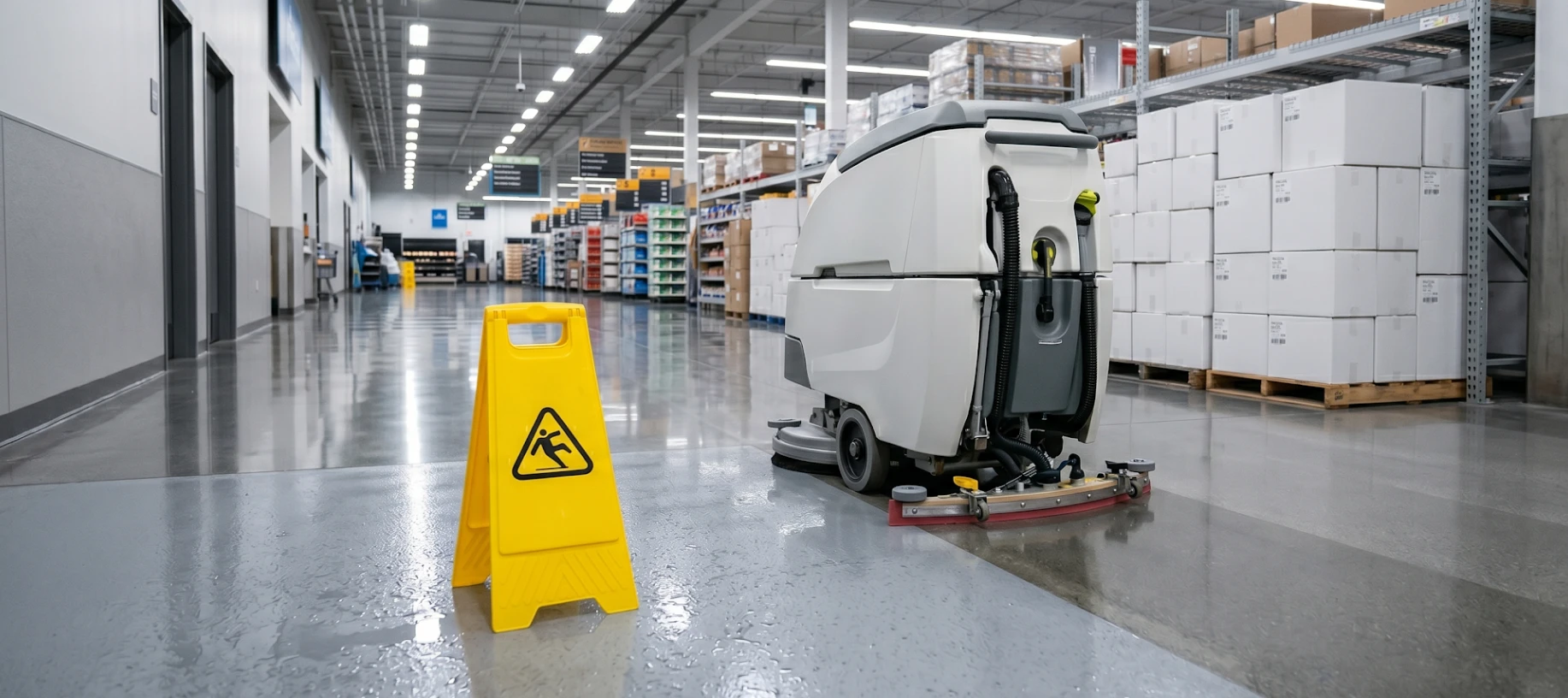
An automatic floor scrubber, commonly called an auto scrubber, is a self contained machine that dispenses cleaning solution, scrubs the floor, and vacuums up dirty water all in a single pass. The operator steers the machine, but nearly every other function is automated. These machines represent the higher automation tier of the commercial floor scrubber category.
Auto scrubbers are standard equipment in hospitals, schools, airports, large retail stores, and warehouses where high foot traffic demands frequent, consistent cleaning. The productivity gains over semi automatic models become especially pronounced in facilities above 15,000 square feet.
How an Automatic Floor Scrubber Works
The one pass cleaning cycle works as follows: the solution tank releases diluted detergent ahead of the scrubbing head, the brushes or pads agitate and loosen soil from the floor surface, a trailing squeegee blade channels the resulting dirty water toward an integrated vacuum, and the vacuum deposits that water into a separate recovery tank.
The clean solution tank and the recovery tank never interact. Dirty water goes directly into recovery and stays there. This dual tank design is a core hygiene advantage over mop and bucket methods, where the mop recirculates contaminated water across the floor on every pass. It also addresses a common limitation of semi automatic models that lack sealed recovery systems.
Key Features Found on Automatic Floor Scrubbers
The technology gap between semi automatic and automatic machines comes down to several key features. Onboard electronic controls and digital displays let operators monitor solution levels, brush pressure, and battery status in real time. Programmable solution flow and brush pressure settings allow the machine to be configured for different floor types without guesswork. The integrated squeegee and vacuum system handles dirty water recovery automatically without a second pass or separate equipment.
Many auto scrubbers include quiet operation modes designed for use in occupied facilities during business hours. Larger walk behind models and ride on auto scrubbers are self propelled, reducing operator fatigue across high square footage jobs. Ride on units extend this further for distribution centers and large warehouses where covering ground quickly is the primary variable.
Automatic vs Semi Automatic Floor Scrubber: Key Differences
Both machine types clean hard floors more effectively than a mop and bucket. The right choice depends on your facility size, cleaning frequency, staffing situation, and budget. The differences fall across four dimensions.
Operator Involvement and Labor Efficiency
Semi automatic scrubbers put the operator in control of solution flow and machine movement for the duration of every cleaning session. That hands on requirement limits how much floor one person can cover per shift.
Auto scrubbers automate those functions, which has a direct effect on output. According to ISSA cleaning time data, a 20 inch walk behind auto scrubber can clean up to 16,000 square feet per hour. Manual mopping covers roughly 1,700 square feet per hour under the same conditions. That productivity gap widens as facility size increases. For cleaning staff managing larger areas, the difference between semi automatic and automatic operation directly affects how many hours per shift are spent on floor care.
Cleaning Performance and Hygiene
Semi automatic scrubbers deliver a real improvement over mopping in both cleaning effectiveness and hygiene. However, because the operator controls solution delivery manually, there is more variability in how consistently the floor gets cleaned across a full shift.
Auto scrubbers maintain consistent brush pressure, solution delivery, and water recovery on every pass by design. The dual tank system means dirty water collected from one section of the floor is never put back down on the next section. Models without sealed recovery systems, including some semi automatic configurations, do not offer that same guarantee.
Drying Time and Facility Safety
Semi automatic scrubbers that lack integrated vacuum recovery leave the floor wetter after cleaning. Wet floors mean longer downtime before the area can be safely reopened and a higher risk of slip and fall incidents during that period.
Automatic scrubbers with built in squeegee and vacuum systems leave floors nearly dry after a single pass. For facilities with continuous foot traffic or strict safety protocols such as healthcare settings or food processing plants, shorter dry times are not a convenience. They are an operational requirement.
Cost, Maintenance, and Complexity
Semi automatic scrubbers carry a lower purchase price. Their mechanical components are simpler, replacement parts are more affordable, and most facilities can handle routine maintenance in house without specialized service contracts.
Automatic floor scrubbers cost more upfront and more to maintain. Vacuum motors, electronic sensors, battery management systems, and sealed recovery components all add to total cost of ownership. The honest tradeoff is this: if your facility runs cleaning several days a week at high volume, the labor savings from automation will typically offset the higher equipment cost over the life of the machine. If you clean twice a week in a smaller space, those savings may never materialize.
Which Floor Scrubber Is Right for Your Facility?
There is no universal right answer. The correct machine is the one that matches your specific combination of facility size, cleaning frequency, staffing capacity, and budget. Below are two facility profiles to help you decide.
When a Semi Automatic Floor Scrubber Makes Sense
A semi automatic model is the right fit if you are working with square footage under roughly 10,000 to 15,000 square feet, a cleaning schedule of two to three sessions per week or less, a limited maintenance budget or a small team without the capacity to manage more complex equipment, and a floor plan with tight corridors, narrow aisles, or irregular layouts where a compact footprint and easy maneuverability matter more than automation.
Facilities that commonly fit this profile include small retail shops, medical or dental offices, classrooms, and light commercial kitchens where the cleaning job is manageable in scope and the floor plan works against larger equipment. A walk behind floor scrubber is typically the right starting point for these environments.
When an Automatic Floor Scrubber Makes Sense
A fully automatic machine is justified when you are cleaning a facility over 15,000 square feet, running daily or multi shift cleaning schedules, operating with lean staffing where labor efficiency is a critical variable, or working in an environment with hygiene or safety requirements that make consistent, verifiable cleaning outcomes non negotiable.
Hospitals, food processing plants, large retail stores, schools, and distribution centers fall into this category. If your facility is large enough that walk behind auto scrubbers still take too long, ride on floor scrubbers extend the same automation to very high square footage applications.
Questions to Ask Before You Buy
Before committing to a machine, work through this checklist:
- How many square feet do you need to clean per session?
- How many days per week does cleaning happen?
- How many operators will be running the machine across shifts?
- What is your total budget, including estimated maintenance costs over three to five years?
- Does your floor plan include tight spaces, obstacles, or corners that require a compact machine?
- What floor types are you cleaning: sealed concrete, ceramic tile, epoxy coatings, vinyl composite tile, or stone?
- Are there safety or hygiene standards you need the machine to meet consistently?
Your answers to these questions will narrow the field quickly. Browse the full selection of commercial floor scrubbers at PS Janitorial or contact the team directly for a recommendation matched to your facility.
Floor Types Compatible with Both Machines
Both automatic and semi automatic scrubbers are designed for hard floor surfaces. With the correct pad or brush selection, either machine type can handle sealed concrete, ceramic and porcelain tile, epoxy coated floors, vinyl composite tile, stone, and terrazzo. Neither machine type is appropriate for carpet.
Brush and pad selection matters as much as the machine itself when it comes to protecting floor finishes and cleaning grout lines effectively. A cylindrical brush gets into grout lines that a flat disk pad will ride over. An aggressive pad on a soft stone floor can cause permanent surface damage. Matching the scrubbing head to the floor type is part of getting full value from your equipment. If you are unsure which configuration is right for your surfaces, the team at PS Janitorial can help you identify the correct brushes and pads for your specific floors.
Automatic Floor Scrubber vs Semi Automatic Floor Scrubber: Side by Side Summary
The table below gives you a fast reference across the key decision variables.
| Feature | Semi Automatic | Automatic |
|---|---|---|
| Operator effort | High: manual solution and direction control | Low: operator steers, machine handles the rest |
| Cleaning coverage per hour | Lower, varies by model and operator | Up to 16,000 sq ft per hour (20 in walk behind) |
| Drying time | Longer without integrated vacuum recovery | Near dry after one pass |
| Upfront cost | Lower | Higher |
| Maintenance complexity | Simple, in house friendly | Moderate to high, more components |
| Best facility size | Under 10,000 to 15,000 sq ft | 15,000 sq ft and above |
| Ideal use case | Offices, small retail, clinics, classrooms | Hospitals, warehouses, schools, large retail |
Frequently Asked Questions
Is an auto scrubber worth the cost for a small facility?
For most small facilities cleaning two to three times per week, the answer is usually no. The labor savings that justify the higher cost of automatic machines require enough square footage and cleaning frequency to accumulate over time. A semi automatic walk behind scrubber will outperform a mop in a small facility without the added cost and maintenance complexity of a full auto scrubber.
Can a semi automatic scrubber replace mopping entirely?
Yes, in most commercial hard floor applications. Semi automatic scrubbers clean faster, reduce cross contamination compared to a mop and bucket, and produce more consistent results. The main exception is corners and edges where the scrubbing head cannot reach, which may still require manual spot cleaning with a mop.
What is the difference between a walk behind scrubber and a ride on scrubber?
Walk behind scrubbers, both semi automatic and automatic, are operated on foot. The operator walks at the pace of the machine. Ride on scrubbers are larger automatic machines where the operator sits on the unit. Ride on models are built for very large square footage applications, typically above 50,000 square feet, where a walk behind pace is not efficient enough.
How often should you empty the recovery tank?
Most operators empty the recovery tank at the end of each cleaning session as a baseline. In high soil environments, you may need to empty it mid session to maintain suction performance. Most models will show a reduction in vacuum effectiveness before the tank is completely full, which serves as a practical indicator.
Do you need special cleaning chemicals for a floor scrubber?
You do not need proprietary chemicals, but you do need low foam formulas designed for use in floor scrubbers. High foam cleaning agents create excess suds in the recovery system, reduce vacuum effectiveness, and can damage internal components over time. Most commercial floor care chemical manufacturers produce scrubber compatible formulas. Always check the dilution ratio specified by your machine manufacturer before filling the solution tank. For more guidance on selecting the right floor scrubber for your facility, the PS Janitorial team is available to help.