What Is The Typical Battery Life And Runtime Of A Ride On Floor Scrubber?
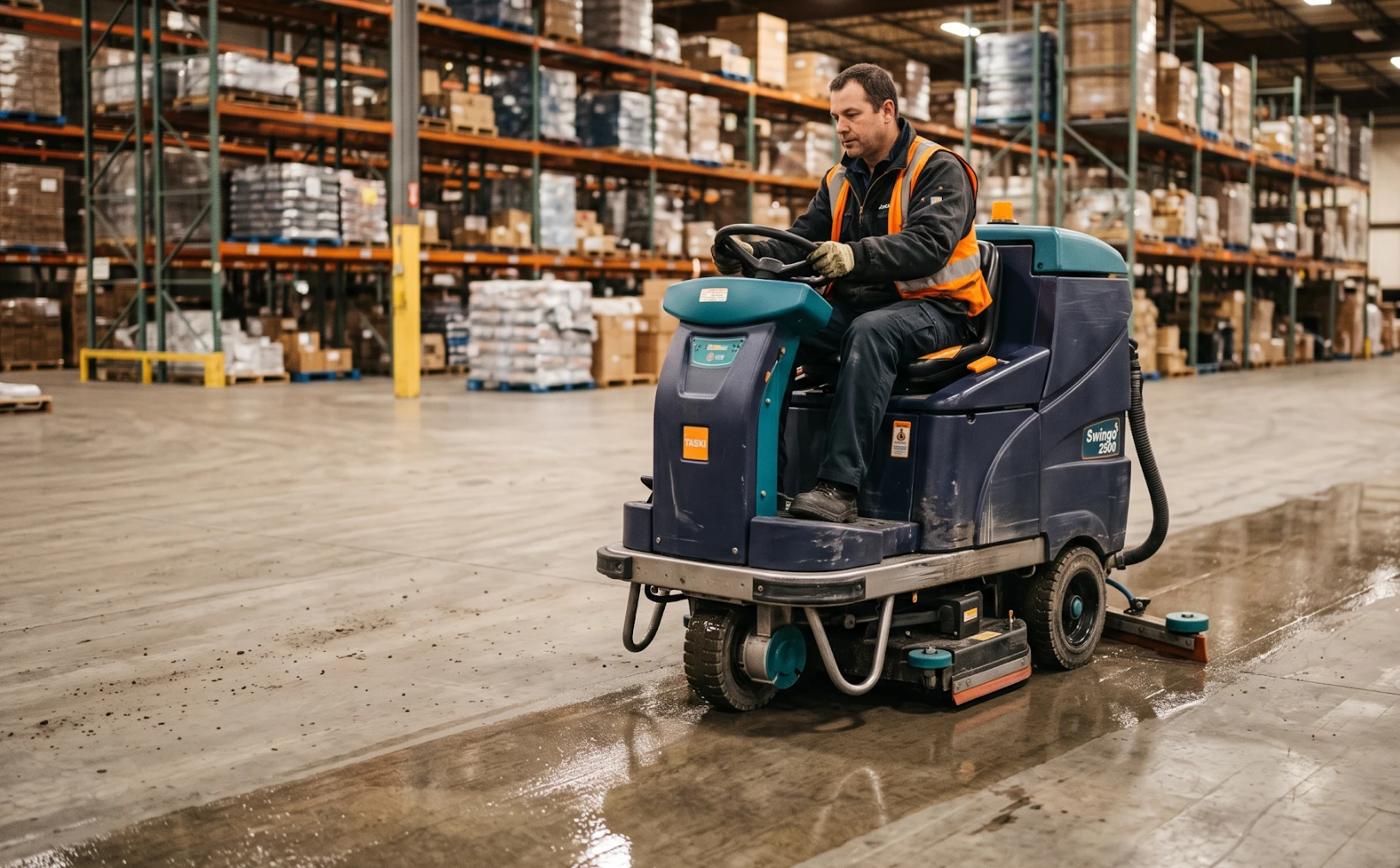
A ride on floor scrubber typically runs for 3 to 4 hours per charge, with some models reaching 6 to 8 hours when equipped with lithium ion batteries. Lead acid batteries generally last 2 to 5 years in commercial use, while lithium batteries can last 6 to 10 years. If you are asking what is the typical battery life and runtime of a ride on floor scrubber, those two numbers, hours per charge and years of service, are the ones that matter most before you buy.
Why Battery Life and Runtime Matter for Ride On Scrubbers
When a battery underperforms, the effects show up fast on your cleaning schedule. Shorter runtime means more mid shift charging stops, which cuts into the square footage you can cover before your team clocks out. A crew that has to pause a floor scrubber to recharge is doing manual cleaning on the areas that get skipped, which defeats the purpose of owning the machine. Costly downtime adds up in labor hours, and if the battery is nearing the end of its lifespan, you may also be facing replacement costs sooner than expected. Facility managers who evaluate battery life and runtime before purchasing a battery powered floor scrubber avoid these surprises. Once the machine is on your floor, you are locked into whatever battery chemistry it shipped with, so this is a decision worth getting right upfront.
Average Runtime Per Charge by Battery Type
Runtime varies significantly depending on battery chemistry. The three most common battery types you will find in ride on scrubbers are flooded lead acid, AGM, and lithium ion, and each one behaves differently once you put it to work on a full shift.
Lead Acid Battery Runtime
Flooded lead acid batteries typically deliver 3 to 4 hours of runtime per charge in a ride on scrubber. Runtime drops as the battery discharges due to voltage sag, so the last stretch of a shift often feels noticeably weaker than the first hour. This is normal for the chemistry, but it means you should plan your cleaning route around the strongest portion of the discharge cycle rather than assuming flat performance the whole time.
AGM Battery Runtime
AGM batteries sit close to flooded lead acid in terms of runtime, usually landing in the same 3 to 4 hour window per charge. The advantage with AGM is consistency and lower maintenance, since there is no water to check or top off. If you want lead acid style runtime without the upkeep, AGM is the middle ground option.
Lithium (LiFePO4) Battery Runtime
Lithium batteries can push runtime up to 6 to 8 hours on some ride on scrubbers, and advanced models with high capacity lithium ion packs can still deliver strong performance even at 4.5 hours under heavier loads. Lithium delivers more usable runtime per rated Ah because it allows a deeper safe discharge and holds a more stable voltage output throughout the cycle, so you are not losing power the way lead acid does near the end of a charge.
Average Battery Lifespan by Chemistry
Runtime per charge and total lifespan are two different numbers, and buyers often confuse them. Runtime tells you how long the machine runs today. Lifespan tells you how many years or cycles you get before the battery needs to be replaced entirely.
Lead Acid Lifespan in Years and Cycles
Flooded lead acid batteries typically last 2 to 5 years in commercial ride on scrubber use, delivering roughly 300 to 1,000 charge cycles depending on how well they are maintained. Notably, 87 percent of lead acid users report runtime degradation after just 18 months, which underscores how much maintenance habits affect real world lifespan.
AGM Lifespan in Years and Cycles
AGM batteries typically last 4 to 6 years, sometimes cited closer to 1.5 to 3 years depending on duty cycle and charging discipline. Compared to flooded lead acid, AGM tends to hold up more consistently because there is no water loss to manage, which removes one common source of premature failure.
Lithium Lifespan in Years and Cycles
Lithium batteries typically last 6 to 10 years and deliver 1,500 to 3,500 charge cycles, several times the cycle life of lead acid. Many lithium packs retain a high percentage of their original capacity even after several years of daily use, which is a major reason lithium has become the preferred option for facilities running continuous operation across multiple shifts.
Factors That Affect Ride On Scrubber Battery Runtime
The runtime numbers above are averages. Real world runtime depends on several variables that can push your actual results higher or lower than the published range.
Facility Size and Square Footage Cleaned Per Shift
Larger facilities with longer continuous run times drain the battery faster. If you are cleaning a large manufacturing facility or a big box retail floor, you need to match tank size and battery runtime to your actual square footage rather than assuming a standard machine will keep pace.
Floor Type and Soil Level
Heavily soiled floors or rough textured flooring increase brush motor load, which reduces runtime compared to lightly soiled smooth floors. Floor type is one of the biggest hidden variables in cleaning performance, since two identical machines can post very different runtimes depending on what they are cleaning.
Brush or Pad Pressure and Water Flow Settings
Higher brush pressure and higher solution flow settings draw more power and shorten runtime, while lighter settings extend it. If you only need light maintenance cleaning, dialing back these settings is an easy way to stretch a charge further without sacrificing effective cleaning where it counts.
Tank Size and Solution Capacity
On some machines, the solution tank becomes the limiting factor before the battery does. It is worth considering runtime and tank capacity together, since a machine with excellent battery life but a small tank may still need frequent stops just to refill cleaning solution.
Operator Habits and Charging Discipline
Operator habits like deep discharging or skipping charges between shifts directly shorten both runtime and overall battery lifespan. Operator training on proper charging discipline is one of the most cost effective ways to protect your investment, since the machine itself can only perform as well as the person running it allows.
Ambient Temperature and Storage Conditions
Cold environments can reduce battery runtime by 30 to 40 percent, and both cold storage and hot environments reduce usable capacity temporarily or permanently depending on the chemistry. If your facility experiences seasonal temperature swings, this is worth factoring into your battery choice from the start.
How Much Square Footage Can a Ride On Scrubber Clean Per Charge?
Translating runtime into square footage gives you a more practical number to plan around. A ride on scrubber can typically clean anywhere from 2,000 to 6,000 square meters per hour depending on scrub path width and cleaning speed. With a 3 to 4 hour lead acid or AGM runtime, that puts a realistic range of coverage per charge well within what most single shift operations need, while lithium powered scrubbers with 6 to 8 hour runtimes can cover proportionally more before a recharge is required. Wider cleaning paths on ride on units are part of why they outperform walk behind scrubbers for large facilities, since fewer passes are needed to cover the same square footage.
Charging Time Comparison: Lead Acid vs Lithium
Lead acid batteries typically take 8 to 12 hours for a full charge, which usually means charging overnight between shifts. Lithium batteries charge in 3 to 5 hours and tolerate opportunity charging without a lifespan penalty, meaning you can plug in during a break without damaging the battery. This difference matters most for facilities running multiple shifts. If your operation cannot afford an 8 to 12 hour charging window between uses, a lithium battery powered scrubber removes that constraint, while a lead acid setup may require a spare battery on hand to keep the machine running around the clock.
How to Extend the Runtime and Lifespan of Your Ride On Scrubber Battery
Proper charging habits and maintenance can add real years to a battery's service life. These practices apply across chemistries, though a few are specific to flooded lead acid.
Avoid Deep Discharging the Battery
Running the battery to zero shortens lifespan considerably. For lead acid batteries, the recommended point to recharge is around 20 to 30 percent capacity remaining, well before the battery is fully depleted.
Use Opportunity Charging Correctly for Your Battery Type
Lithium tolerates partial charges well, so topping off during a break is a fine habit. Lead acid needs full charge cycles to stay healthy, so plugging in for a quick partial charge and then unplugging repeatedly can actually work against the battery over time.
Use the Correct Charger for Your Battery Chemistry
Using a mismatched charger, especially a lead acid charger on a lithium battery, can cause serious damage. Matching the charger to the battery chemistry protects your investment and helps you avoid a premature and unnecessary replacement.
Keep Terminals Clean and Check Water Levels (Flooded Lead Acid)
For flooded lead acid batteries, clean the terminals monthly to prevent corrosion, since corrosion on battery terminals increases resistance and reduces efficiency. Check water levels every 5 to 10 charge cycles and top off with distilled water only, never tap water, to avoid introducing minerals that shorten battery life.
Store the Machine Properly During Downtime
Charge the battery fully before storing the machine during seasonal downtime, and store it in a temperature controlled environment whenever possible. Avoiding extreme cold during storage helps prevent both temporary and permanent capacity loss.
Train Operators on Charging and Battery Care
Operator training is the single biggest variable in real world battery lifespan. A short training session should cover proper charging discipline, avoiding deep discharges, recognizing signs of physical damage, and following the correct storage routine for your specific battery type.
Lead Acid vs Lithium Ride On Scrubber Battery: Which Runs Longer?
| Category | Lead Acid | Lithium (LiFePO4) |
|---|---|---|
| Runtime Per Charge | 3 to 4 hours | 6 to 8 hours |
| Full Charge Time | 8 to 12 hours | 3 to 5 hours |
| Cycle Life | 300 to 1,000 cycles | 1,500 to 3,500 cycles |
| Calendar Life | 2 to 5 years | 6 to 10 years |
| Maintenance Needs | Water top offs, terminal cleaning | Maintenance free |
| Upfront Cost | Lower upfront cost | Higher upfront cost |
Lithium wins on runtime, charge speed, cycle life, and total cost of ownership over time, while lead acid remains the lower upfront cost option for facilities with lighter usage or tighter budgets.
How to Choose the Right Battery Runtime for Your Facility
Start with your cleaning frequency. If your team runs the machine daily across multiple shifts, lithium's faster charging and higher cycle count will pay for itself in reduced downtime and replacement costs. If you clean a smaller facility a few times a week, a lead acid or AGM battery may cover your needs at a lower upfront cost. Factor in facility size and shift count together. Large facilities with continuous operation across two or three shifts benefit most from lithium's opportunity charging tolerance, while single shift operations in smaller spaces have more flexibility to choose based on budget rather than runtime pressure alone.
Ride On Scrubbers From PS Janitorial Built for All Day Runtime
PS Janitorial carries ride on floor scrubbers across lead acid, AGM, and lithium battery options, so you can match runtime and lifespan to your facility rather than settling for whatever a single manufacturer offers. Whether you need a budget friendly lead acid model for a smaller space or a lithium powered scrubber built for continuous operation across long shifts, our team can help you compare runtime, tank capacity, and cleaning path width side by side. Browse our full lineup of ride on floor scrubbers to find the right fit for your square footage and cleaning schedule.
Frequently Asked Questions
How long does a ride on floor scrubber battery last per charge?
Most ride on scrubbers run 3 to 4 hours per charge on lead acid or AGM batteries, while lithium powered models can reach 6 to 8 hours.
How many years does a ride on scrubber battery last?
Lead acid batteries typically last 2 to 5 years, AGM batteries last 4 to 6 years, and lithium batteries last 6 to 10 years with proper care.
Can I run a ride on scrubber for a full 8 hour shift on one charge?
Lead acid and AGM batteries generally cannot cover a full 8 hour shift on one charge and will need a mid shift top off or a spare battery. Lithium batteries come closer, and their fast charge time makes a quick top off during a break a realistic option.
Does cold storage reduce ride on scrubber battery runtime?
Yes. Cold environments can reduce runtime by 30 to 40 percent, so storing the machine in a temperature controlled space helps protect both runtime and long term capacity.
Is it better to charge a ride on scrubber every night?
For lead acid batteries, yes, since they need full charge cycles to stay healthy. Lithium batteries handle partial or opportunity charging well, so charging every night is helpful but not strictly required.
Can I upgrade my ride on scrubber from lead acid to lithium?
It depends on whether your machine's motor controller and battery management system support lithium. Reach out to PS Janitorial for a recommendation based on your specific model.
Final Thoughts on Ride On Scrubber Battery Life and Runtime
Battery life and runtime come down to two numbers: how many hours you get per charge, and how many years the battery lasts before it needs replacing. Lead acid and AGM offer lower upfront cost with shorter runtime and lifespan, while lithium offers longer runtime, faster charging, and years of additional service life at a higher initial price. Browse our full lineup of ride on scrubbers or reach out to our team for a personalized recommendation based on your facility size and cleaning schedule.