Reach Truck vs Order Picker: Which One Does Your Warehouse Need?
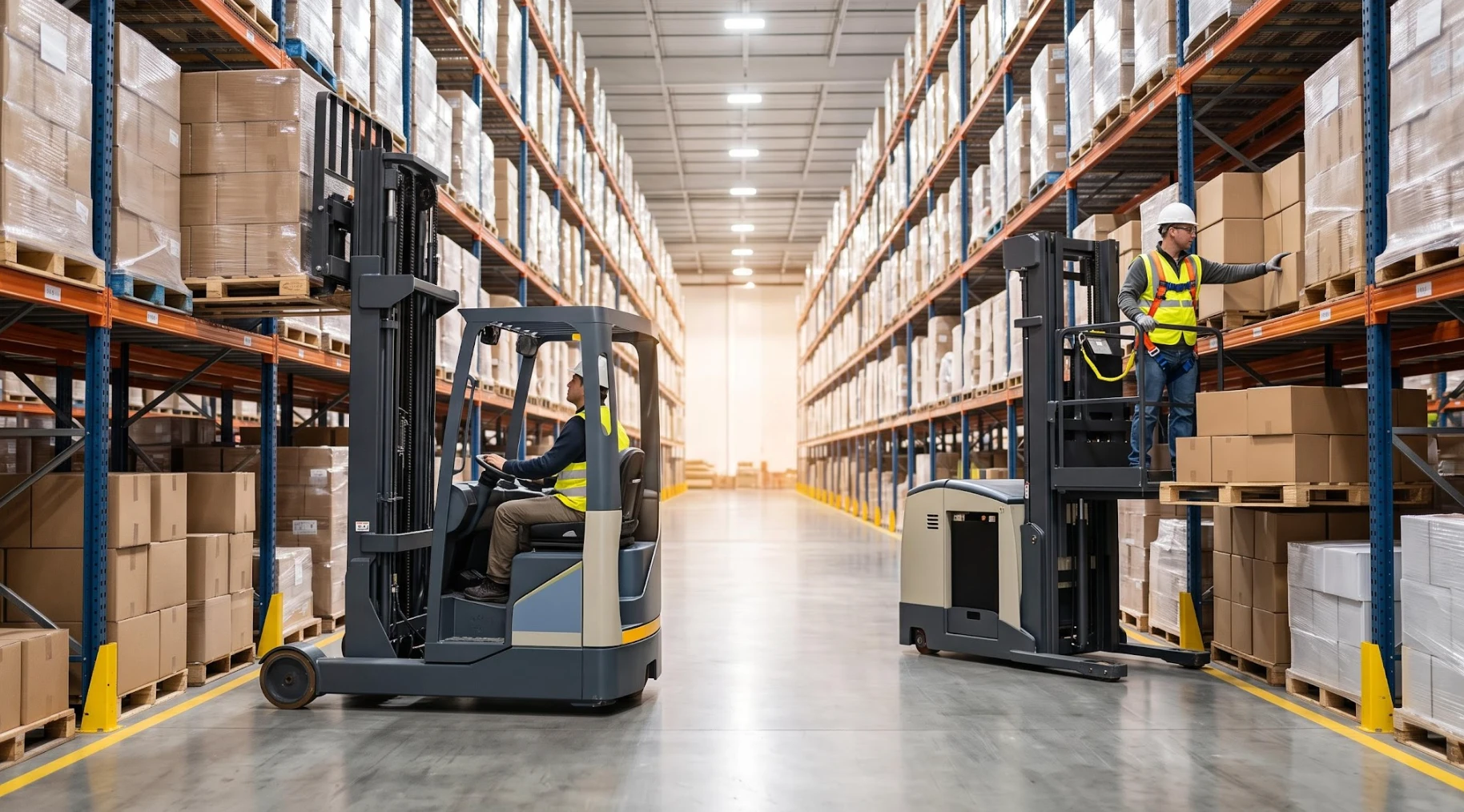
Choosing between a reach truck vs order picker comes down to one question: are you moving pallets or picking items? Reach trucks move full pallets into high racking, while order pickers lift the operator to pick individual cases or items at the shelf face. Both work in narrow aisles and help you use vertical storage, but they solve different problems. This guide compares them so you can match the right machine to your racking, your orders, and your budget, and shows where the forklifts at PS Janitorial fit if neither one is the answer.
Reach Truck vs Order Picker at a Glance
Here is how the two machines compare on the factors that matter most. These are typical ranges, so confirm the numbers against the spec sheet for any model you consider.
| Factor | Reach Truck | Order Picker |
|---|---|---|
| Load handled | Full pallets | Individual cases or items |
| Operator position | Seated or standing at floor level | Elevated on a platform that rises with the forks (high level models) |
| Lift height | Up to 40 feet or more on high reach models | Varies by model, with some high level models reaching about 30 feet |
| Aisle width | Typically 8 to 10 feet | Narrow aisle, set by model and rack layout |
| Capacity | Commonly 3,000 to 5,000 pounds, reduced at height | Commonly around 3,000 pounds on high level models |
| Best use | Pallet storage, retrieval, and replenishment | Case and piece picking, mixed SKU orders |
| Power source | Electric battery | Electric battery |
| Training | Truck specific operator training | Truck specific operator training plus fall protection practices |
What Is a Reach Truck?
A reach truck is a narrow aisle lift truck built for high racking. Instead of a heavy counterweight at the back, it uses stabilizing legs that straddle the pallet. That keeps the machine compact enough to work in aisles as narrow as 8 feet. Distribution centers and warehouses in various industries use reach trucks to maximize vertical storage, since narrower aisles leave room for more racking on the same floor.
How a Reach Truck Works
On a standard model, a pantograph mechanism extends the forks forward into the rack, so the truck stays in the aisle while the pallet moves in or out. On a moving mast reach truck, the mast itself travels forward with the forks.
The operator compartment faces sideways, so you can look in the direction of travel without twisting around. Controls typically include a steering wheel or tiller, accelerator and brake pedals, and a deadman pedal that stops the truck if the operator leaves position. Truck models come in seated and stand up setups, and the best choice depends on how often operators get on and off during a shift.
Types of Reach Trucks
Single reach trucks are compact and ideal for small and medium sized warehouses with single deep racking. A tight turning radius helps them work in tight spaces. One example from our inventory is the Noblelift RT44SP lithium stand up pantograph reach truck.
Double deep reach trucks use an extended fork extension to retrieve pallets stored two pallets deep, which suits high density storage. The Noblelift RT33SP lithium reach truck is offered in single or double reach configurations.
Moving mast reach trucks carry the mast forward with the load and suit single deep racking and general pallet handling.
A multidirectional reach truck travels forward and sideways, which makes it a strong fit for long loads and standard pallets in the same narrow aisles.
What Is an Order Picker?
An order picker is a lift truck that raises the operator together with the load, so items can be picked at the shelf face. You will find them in fulfillment centers and parts warehouses, where customers order a few cases or pieces rather than whole pallets. They streamline customer order fulfillment and improve picking accuracy on mixed SKU orders, because the operator handles each item directly.
How an Order Picker Works
The operator steps onto the platform, drives to the pick location, and raises the platform and forks together. At the rack, you pick cases or items from the shelf and place them on the pallet riding on the forks. When the pick is done, you lower the platform and move to the next location until the pallet is built.
Types of Order Pickers
Low level order pickers are built for the floor and lower rack levels, and they keep the operator at or close to ground level while the forks lift the load to a comfortable picking height. High level order pickers raise the operator platform to upper rack levels, and some models are rated to about 30 feet. Medium level models sit between the two. Rated heights and capacities vary by manufacturer, so check the spec sheet against your racking. For lighter picking tasks, PS Janitorial carries the Noblelift OP8.5 lithium order picker.
Reach Truck vs Order Picker: Key Differences
The two machines look similar in a warehouse setting, since both are electric narrow aisle trucks with a mast. Each one solves a different material handling problem, and the factors below show where they separate.
Load Handling: Full Pallets vs Individual Items
This is the core difference. Reach trucks store and retrieve whole pallets. Order pickers let the operator pull individual cases or pieces. A simple rule of thumb: if your work is measured in pallets, you need a reach truck, and if it is measured in picks, you need an order picker.
Operator Position and Platform
On a reach truck, the operator stays at floor level in the operator compartment while the forks do the climbing. Operator visibility at height comes from the mast design and, on some models, a tilting cab or camera system. On an order picker, you ride the platform up to the pick face, so you see the shelf directly and handle items by hand.
Lift Height
Reach trucks are known for height, and manufacturer specifications show models that lift loads above 40 feet. High level order pickers also reach upper racks, with some models rated to about 30 feet. A typical counterbalance forklift tops out much lower, often around 20 feet. Whichever you choose, match the lift height to your highest beam plus clearance, and check the load chart at that height.
Aisle Width and Maneuverability
Reach trucks work efficiently in aisles about 8 to 10 feet wide (roughly 2.4 to 3.0 meters), while a counterbalance forklift needs noticeably wider aisles. Order pickers also run in narrow aisles, and the exact aisle space depends on the model and pallet size. For your layout, narrow aisle warehouses can add storage positions, but only if you measure your narrowest aisle first and choose a truck whose working aisle width fits it.
Load Capacity
Most reach trucks carry 3,000 to 5,000 pounds, and rated capacity drops as the forks go higher, so load weight at height matters more than the nameplate number. High level order pickers are commonly rated around 3,000 pounds, which suits a pallet built from picked cases. Pallet loads and picked cases call for different machines because one moves a single heavy unit and the other builds a mixed load piece by piece.
Speed and Picking Productivity
Order pickers suit high pick volume because the operator rides with the pallet and picks at the shelf face, which cuts trips between racking and staging. Reach trucks suit pallet moves, where productivity depends on how quickly you can retrieve pallets and put them away. Using the wrong machine slows both tasks.
Safety and Operator Fall Protection
Reach trucks rely on stabilizing legs, a protected operator compartment, and operator presence controls such as the deadman pedal. Because they lift loads so high, load charts, rack condition, and pallet quality all matter.
Order pickers add a fall hazard, since the operator is elevated. OSHA's walking working surfaces rules, updated in 2017, call for a fall protection system on trucks that lift personnel: either a guardrail system or personal fall protection such as a full body harness with a lanyard attached to the truck's anchor point. A body belt no longer qualifies. Follow the manufacturer's instructions for your model and confirm current OSHA guidance before setting your policy.
Operator Training Requirements
Under OSHA's powered industrial truck standard, 29 CFR 1910.178(l), employers must train operators, evaluate their performance, and certify that both were done. Training has to match the truck the operator will use, so a reach truck operator needs reach truck training and an order picker operator needs order picker training. OSHA does not issue operator licenses, so certification comes from your company, and evaluations are required at least every three years. For a refresher on pre shift checks and controls, read our step by step guide to operating a forklift.
Power Source and Operating Environment
Both machines are electric, which keeps them quiet and emission free for indoor use. Plan your batteries and charging around your duty cycle: a single shift may run on one battery, while multi shift use usually calls for spares or fast charging. Both are designed for smooth indoor floors, since cracked concrete, ramps, and wet surfaces limit stability and performance. Keeping aisles clear of debris also helps, and a commercial floor sweeper is a simple way to protect wheels and keep narrow aisles clean.
When to Choose a Reach Truck
A reach truck fits when your work is built around pallets:
- Pallet storage and retrieval in tall racking
- High density racking, including double deep layouts
- Replenishment of pick locations from reserve storage
- Loading dock work, where the right truck models can move pallets between trailers and racking
- Cold storage or food facilities, as long as the model is rated for those conditions
If most inventory moves on full pallets and floor space is tight, a reach truck is the ideal solution. If you prefer a walkie style truck, take a look at the Noblelift PSR30 lithium walkie reach truck.
When to Choose an Order Picker
An order picker fits when your work is built around picks:
- Case and piece picking from rack locations
- Ecommerce and parts fulfillment, where orders contain many small lines
- High pick volume, where cutting walking and handling time adds up quickly
- Mixed SKU orders that need to be built on a single pallet
They are a natural match for ecommerce fulfillment centers and parts warehouses, where accuracy and speed on small orders drive the business.
Can You Use a Reach Truck and an Order Picker Together?
Yes, and many operations do. Reach trucks replenish pallets into the racking, and order pickers handle the active picking from those locations. A few planning tips keep the pairing safe and efficient:
- Schedule replenishment during slower pick periods, or assign separate aisles to each task
- Set one way traffic in narrow aisles where trucks cannot pass each other
- Keep pedestrians out of aisles with elevated operators
- Place battery charging away from active pick faces
Reach Truck vs Order Picker Cost Comparison
Cost varies widely by model, lift height, capacity, and options, so this section covers what drives total cost of ownership.
Upfront cost. Taller masts, higher capacities, and added features raise the investment on both machines.
Battery and charger costs. Both machines are electric, so the battery and charger are part of ownership. Lithium ion and lead acid batteries differ in upfront investment and charging downtime, so the best choice depends on your shifts.
Maintenance. Plan for regular inspection of masts, chains, forks, hydraulics, and tires. Order pickers also need checks of the platform, gate, and fall protection anchor points.
Labor cost per pick. This is where the machines differ most. An order picker can lower labor cost per pick on high volume piece picking, while a reach truck lowers the labor cost of each pallet move.
New, used, or rented. Buying new gives you current features and full warranty coverage. Buying used lowers the upfront investment and works well when you know exactly what you need. Renting suits seasonal peaks and short projects, though long rentals can add up.
How to Choose Between a Reach Truck and an Order Picker
Work through this checklist to find the right reach truck or order picker for your operation:
- Rack height. Measure your highest beam plus clearance, then check lift height and rated capacity at that height.
- Aisle width. Measure your narrowest aisle and compare it with the working aisle width on each spec sheet.
- Order profile. Look at how many lines and units your typical order contains.
- Pallet versus piece picking. Mostly full pallets points to a reach truck, and mostly cases or pieces points to an order picker.
- Daily volume. Estimate pallet moves or picks per shift and how many trucks that requires.
- Budget. Include the battery, charger, maintenance, and training, then compare buying new, buying used, and renting.
- Floor conditions. Confirm your floors are smooth and level enough for indoor use.
Where Counterbalance Forklifts Fit In
If your needs go beyond narrow aisle racking, a counterbalance forklift may be the better tool. These trucks use a counterweight instead of stabilizing legs, so they handle outdoor use, uneven surfaces, heavier loads, and attachments. Power options include diesel, gasoline, liquefied petroleum gas, and electric, and heavy duty models can handle well over 25,000 pounds. The tradeoff is wider aisles.
PS Janitorial carries options across this range. For rugged outdoor capable work, see this 6,000 pound diesel pneumatic tire forklift. For propane power, look at this UniCarriers LP forklift with side shift. And if you only need to move pallets at floor level, a Noblelift lithium electric pallet truck may be all you need.
Reach Truck vs Order Picker FAQs
Is an order picker a type of forklift?
Yes. Order pickers belong to the broader family of powered industrial trucks, often grouped with warehouse forklifts. They differ from a standard forklift because the operator rides up with the load to pick items by hand.
Can a reach truck be used for order picking?
Partly. A reach truck can retrieve a pallet and bring it down for picking at ground level, but it cannot place the operator at the pick face. For picking at height, you need an order picker.
Which is more expensive, a reach truck or an order picker?
It depends on the model, lift height, and options. Neither is always cheaper, so see the cost comparison above and compare specific models side by side.
Which one lifts higher?
Both are available for high racking. Reach trucks include models that lift above 40 feet, while high level order pickers reach about 30 feet on some models. The right choice depends on the specific model and your rack height.
Do reach trucks and order pickers require different training?
Yes. Operators need training and evaluation on the specific truck type they will use, and order picker operators also need training on fall protection.
Can a reach truck or order picker be used outdoors?
Both are designed mainly for indoor, smooth floor use. For outdoor work, choose a counterbalance forklift.
Find Forklifts at PS Janitorial
Ready to compare options for your warehouse? Explore our forklifts category and our used forklifts category, then contact the PS Janitorial team with questions about the right machine for your racking, aisles, and budget.