Reach Truck vs Forklift: Key Differences and How to Choose the Right One
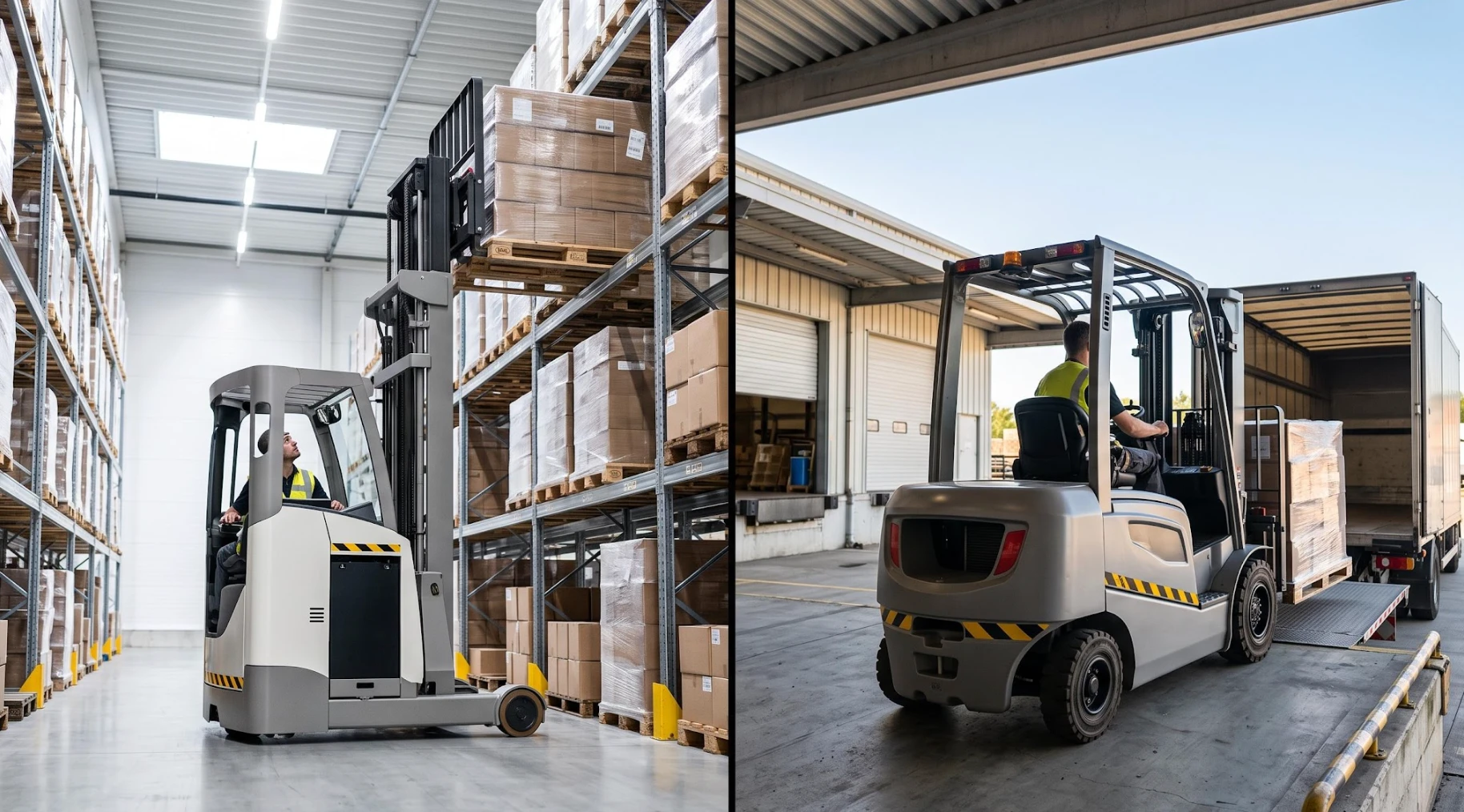
Reach truck vs forklift comes down to where you work and what you lift. A reach truck is a narrow aisle electric forklift built for high racking indoors, while a counterbalance forklift is the general purpose option for heavier loads, loading docks, and outdoor work. This guide covers the key differences, other similar lift trucks, and how to choose the right one, and when you are ready to shop, you can browse PS Janitorial's forklifts and reach trucks.
Reach Truck vs Forklift at a Glance
Here are the five biggest differences you will notice between the two trucks.
- Aisle width: A reach truck works in aisles roughly 8 to 10 feet wide, while counterbalance forklifts typically need about 11 to 14 feet or more.
- Lift height: Reach trucks commonly lift about 30 to 40 feet, while standard counterbalance forklifts typically reach about 15 to 20 feet.
- Load capacity: Reach trucks generally handle 3,000 to 4,500 lbs, while counterbalance forklifts handle much heavier loads.
- Power source: Reach trucks are electric only, while counterbalance forklifts run on electric, LPG, diesel, or gasoline.
- Indoor or outdoor use: Reach trucks suit smooth indoor floors, while counterbalance forklifts work indoors and outdoors depending on tires.
What Is a Reach Truck?
A reach truck is a powered industrial truck whose forks extend horizontally into racking. It is a type of forklift, specifically a Class II electric narrow aisle truck. You will find reach trucks most often in warehouses and distribution centers where vertical storage matters more than raw lifting power.
How a Reach Truck Works
The defining feature is the pantograph mechanism, a scissor style assembly that extends and retracts the forks. When the operator reaches for a pallet, the pantograph extends the forks into the rack while the truck body stays put. Instead of a rear counterweight, a reach truck uses base legs that straddle the pallet and carry the load wheels, which keeps the truck stable. The drive wheel sits under the operator compartment, which gives the truck a tight turning radius and lets you swing into tight aisles without much room to spare. Hydraulic controls raise the mast, tilt the forks, and extend the pantograph, so a skilled operator can place pallets at height with precision.
Types of Reach Trucks
Single reach trucks pick and place one pallet position deep, which makes them the standard choice for most pallet racking. Double deep reach trucks extend farther to access pallets stored two positions deep, which raises storage density. A model like the NOBLELIFT RT33SP lithium stand up pantograph reach truck is available in single or double reach configurations. Moving mast trucks slide the mast forward with the load, a good fit when you need extra stability for heavier pallets or lower rack heights. Multidirectional trucks can travel in four directions and handle long or wide loads, such as lumber or pipe, in narrow aisle warehouses.
What Is a Counterbalance Forklift?
A counterbalance forklift is the traditional forklift most people picture, with forks on the front and a heavy rear counterweight that offsets the load. Because it needs no base legs or special rack geometry, it is the most versatile lift truck for general material handling.
Common Forklift Power Types
Counterbalance forklifts come in electric, LPG, diesel, and gasoline versions. Power usually connects to tire type: cushion tires suit smooth indoor floors, while pneumatic tires handle outdoor yards and rough surfaces. That range of options is one reason forklifts and reach trucks end up serving different parts of the same operation.
Reach Truck vs Forklift: The Main Differences
Each difference below affects which truck fits your facility, so read them against your own layout and loads.
Design and How the Load Is Balanced
A reach truck balances the load with base legs and a forward battery position, which means no heavy counterweight is needed. A forklift relies on its rear counterweight to keep the load from tipping it forward. Without that extra mass behind the operator, a reach truck can have a shorter body, which is what lets it turn in tighter spaces.
Aisle Width and Maneuverability
A reach truck can work in narrower aisles, which means more rack space in the same building. Expect roughly 8 to 10 feet for a reach truck and about 11 to 14 feet or more for a counterbalance forklift. Published figures vary by source, so treat these as ranges and confirm the exact number for the model you plan to buy.
Lift Height
Reach trucks are built for high racking and generally lift higher than counterbalance forklifts. A reasonable range is about 30 to 40 feet for reach trucks and about 15 to 20 feet for standard counterbalance models. Taller masts exist on some units, but actual lift heights depend on the model, capacity, and your floor and rack conditions.
Load Capacity
Reach trucks generally handle roughly 3,000 to 4,500 lbs. Counterbalance forklifts cover a far wider range, and some heavy duty models exceed 35,000 pounds. If your loads are heavy or oversized, a counterbalance forklift is the safer fit, and a higher capacity model like the NOBLELIFT FE4P175N pneumatic tire lithium forklift shows how far the range extends. Always check the capacity plate for the load weight and load center.
Power Source
Reach trucks are electric only. Counterbalance forklifts offer electric, LPG, diesel, and gasoline options. Your choice affects indoor air quality, runtime, and how well the truck handles inclines, so match it to where the truck will spend most of its shift.
Indoor and Outdoor Use
Most reach trucks are designed for smooth, level indoor floors. Counterbalance forklifts can handle indoor and outdoor work depending on their tires. There is one exception: some indoor and outdoor reach truck models exist for limited outdoor use, but they are not a replacement for a yard truck.
Operator Position and Controls
A reach truck operator typically stands or faces sideways, using a joystick or hydraulic controls, a steering wheel, and a deadman pedal. A forklift operator usually sits facing forward, and the truck feels more like driving a car. Forklifts offer better visibility when reversing, while reach trucks come with a learning curve before new operators work comfortably at height.
Attachments
Reach trucks mostly stay with forks and a sideshifter. Counterbalance forklifts can take clamps, paper roll clamps, multiple pallet handlers, and other specialty attachments. If your work depends on handling unusual loads, that flexibility matters.
Cost and Maintenance
Reach trucks tend to cost more up front, but the storage density and space savings can offset that over time. Forklifts are generally more affordable to acquire. Both need regular inspection, battery care where electric, and scheduled service, so budget for upkeep either way.
Reach Truck vs Forklift Comparison Table
This table puts the main points side by side using the same ranges covered above.
| Feature | Reach Truck | Counterbalance Forklift |
|---|---|---|
| Primary use | High racking and narrow aisle storage | General material handling, docks, and yards |
| Aisle width | Roughly 8 to 10 feet | About 11 to 14 feet or more |
| Lift height | About 30 to 40 feet | About 15 to 20 feet for standard models |
| Load capacity | Roughly 3,000 to 4,500 lbs | Wider and much heavier range |
| Power source | Electric only | Electric, LPG, diesel, or gasoline |
| Stability | Base legs | Rear counterweight |
| Indoor or outdoor use | Mostly indoor, smooth floors | Indoor and outdoor, depending on tires |
| Operator position | Standing or sideways | Seated, facing forward |
| Attachments | Forks and sideshifter | Clamps, multiple pallet handlers, and more |
Reach Truck vs Other Types of Lift Trucks
Several lift trucks are easy to confuse with reach trucks, and each comparison below clears up one of them.
Reach Truck vs Stand Up Counterbalance Forklift
Both are operated standing, but a stand up counterbalance forklift has no pantograph and uses a counterweight instead of base legs. It drives into the rack face rather than extending the forks into it. A Crown RC5530C electric stand up forklift is one example of this style.
Reach Truck vs Order Picker
A reach truck raises the load while the operator stays in the compartment. Order pickers, like the NOBLELIFT OP8.5 lithium order picker, lift the operator along with the mast so they can pick items by hand from storage.
Reach Truck vs Stacker
Stackers are smaller, usually walk behind or walkie units controlled with a tiller arm. A walkie reach truck, such as the NOBLELIFT PSR30 lithium walkie reach truck, combines a stacker's control style with a pantograph.
Reach Truck vs Articulated Narrow Aisle Forklift
Both work in tight aisles, but an articulated forklift is a counterbalance truck whose mast pivots to the side, as on the TAILIFT 17N articulated VNA forklift. A reach truck extends its forks forward instead.
When to Use a Reach Truck vs a Forklift
The right choice depends on your space, loads, and environment.
Best Uses for a Reach Truck
- High rack storage where every foot of height counts
- Narrow aisle warehouses that need more storage space
- Cold storage with smooth indoor floors
- Retail distribution centers moving lighter palletized loads
- Operations that need precise pallet placement
Best Uses for a Counterbalance Forklift
Choose a counterbalance forklift for loading docks and unloading trucks, heavy or oversized loads, outdoor yards, manufacturing floors, and jobs that need specialty attachments. It is also the better pick when your facility has wider aisles and mixed surfaces.
How to Choose: A Quick Checklist
- How wide are your aisles?
- How high is your rack?
- What is the heaviest load you will lift?
- Will the truck work indoors, outdoors, or both?
- Do you prefer electric power or an engine?
- What is your budget, including upkeep?
- Will your operators be comfortable with the controls?
Can You Use Both in One Facility?
Yes, and many warehouses do. Counterbalance forklifts typically handle the dock and yard, while reach trucks work the racking aisles. Pallets move between the two zones, so each truck does the job it is best at.
New vs Used Reach Trucks and Forklifts
Buying used can make sense when your budget is limited, your need is seasonal, or you want a backup unit. Before you buy, inspect these items:
- Mast and chains
- Forks
- Tires
- Battery condition
- Hour meter
- Service records
If you are shopping for a lift truck, PS Janitorial also carries new, used, and refurbished forklifts and reach trucks alongside its commercial floor cleaning equipment.
Battery and Maintenance Considerations for Electric Lift Trucks
Because reach trucks are electric only, the battery drives your uptime. Know your battery type, set a consistent charging routine, and keep up with daily inspections before each shift. Check the forks, chains, tires, and controls as part of that routine, and schedule regular service so small problems do not turn into downtime.
Operator Training and OSHA Requirements
Operators must be trained and certified before using either truck.
Does a Forklift License Cover a Reach Truck?
No. OSHA requires training specific to the type of truck, so a counterbalance certification does not cover a reach truck. The requirement sits in OSHA 1910.178(l), and operators need additional training before they switch trucks.
What Operator Training Includes
- Formal instruction, such as classroom or online lessons
- Hands on practice with evaluation on the actual truck
- Employer certification that the operator is competent
Reach Truck vs Forklift FAQs
Is a reach truck a forklift?
Yes. A reach truck is a Class II electric forklift built for narrow aisle warehouse work.
What is the main difference between a reach truck and a forklift?
Reach trucks extend the forks into racking and use base legs for stability. Counterbalance forklifts use a rear counterweight and suit heavier loads and wider aisles.
Can a reach truck be used outside?
Most cannot, because they are designed for smooth indoor floors. Some indoor and outdoor models exist for limited outdoor use.
How high can a reach truck lift?
Common models lift about 30 to 40 feet, though some go higher. The exact height depends on the model, capacity, and base leg configuration, so check the specifications of the truck you are considering.
What aisle width does a reach truck need?
Plan on roughly 8 to 10 feet. Load size and truck configuration change the exact figure.
Which is cheaper, a reach truck or a forklift?
Reach trucks generally cost more up front. The answer depends on your facility, since better space use can offset the price over time.
Choosing Between a Reach Truck vs Forklift for Your Warehouse
Choose a reach truck for narrow aisles and high racking, and a counterbalance forklift for heavier loads, docks, and outdoor work. Many facilities benefit from running both. When you are ready to compare options, browse PS Janitorial's current inventory to find the right fit for your operation or contact our forklift specialists for guidance.