Best Floor Scrubbers For Airport Terminals
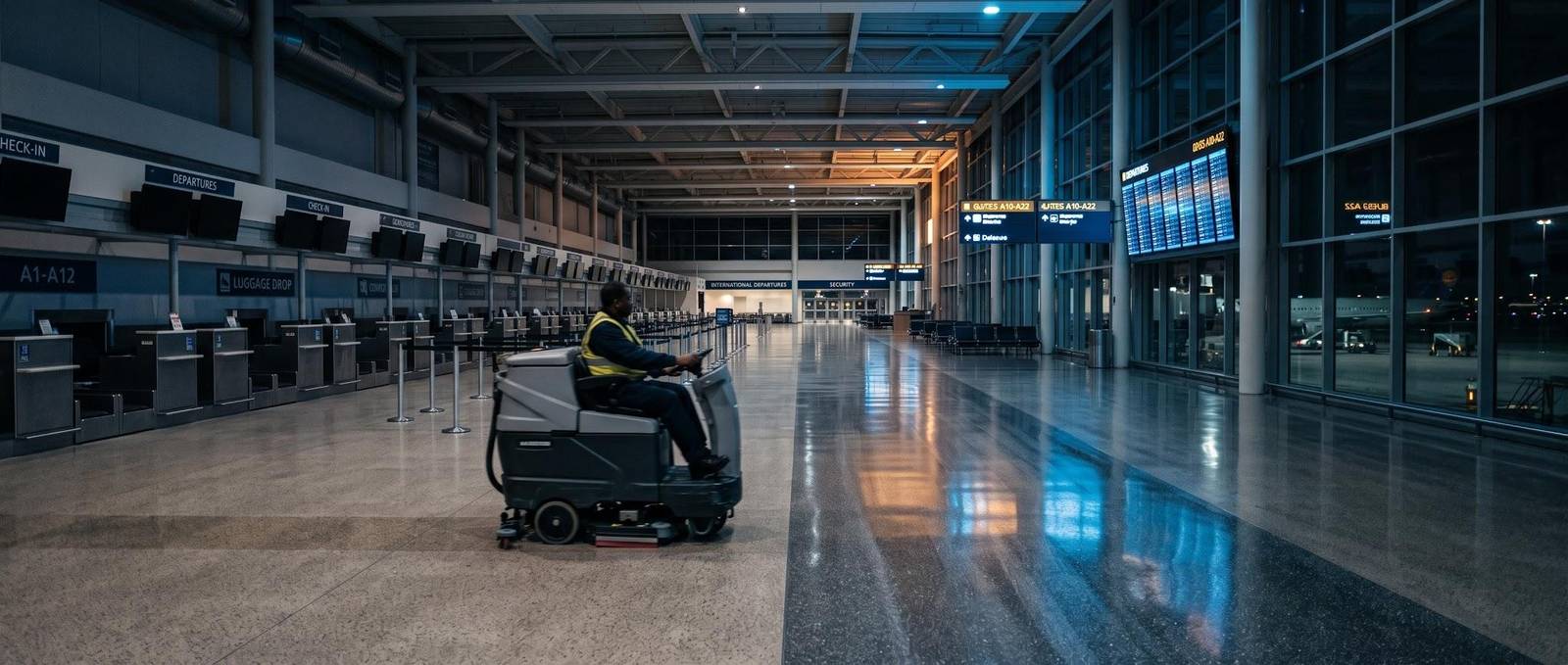
An airport terminal is hundreds of thousands or even millions of square feet of mixed flooring inside a building that never closes. Your crew works around passengers, bag drop staff, and overnight construction in a four to six hour window, and whatever is left unfinished is visible to every traveler at 6 AM.
That constraint drives everything. The best floor scrubbers for airport terminals are not one machine or one brand: they are a fleet matched to zones, floor surfaces, and the length of your cleaning window.
This guide gives you a sizing method with real numbers, a spec checklist you can lift straight into an RFP, machine recommendations for nine terminal zones, and battery guidance for round the clock operations.
PS Janitorial specs commercial floor cleaning equipment for high traffic facilities every day, and the reasoning below is the same reasoning we use on a terminal walkthrough.
Why Airport Terminals Are Harder on Floor Scrubbers Than Almost Any Other Facility
The Cleaning Window Is Short and Foot Traffic Never Fully Stops
Terminals rarely go dark. Even at a domestic airport with a curfew, your operators are working around early bag drop crews, red eye arrivals, and contractors doing overnight work behind hoarding. The practical result is a compressed machine window, often 11 PM to 5 AM, and your equipment has to finish the route inside it.
That is why productivity rate in square feet per hour matters far more here than in a distribution center where the crew has all night. In a warehouse, a slow machine finishes late. In a terminal, a slow machine simply does not finish, and the gap gets covered by manual cleaning at overtime rates.
One Terminal Contains Five or More Different Floor Surfaces
Walk a single concourse route and count what you cross: terrazzo in the main hall, porcelain and ceramic tiles in restrooms, polished or sealed concrete at ramp level, resilient flooring or LVT in back of house corridors, rubber safety surfacing at escalator landings, natural stone or marble in a premium club, and carpet in gate seating.
A floor scrubber with fixed brush pressure and one pad type will either underclean the terrazzo or damage the resilient flooring. There is no single pad that is the right choice for all of it, which is why adjustable down pressure belongs on your spec sheet rather than on your wish list.
Noise Limits Are a Hard Spec, Not a Preference
This is the constraint most competing articles skip. Work in occupied terminal space generally requires machines at or below roughly 70 dB(A), and anything running near gate podiums, PA announcements, or passengers sleeping through a delay should target the mid 60s or lower. The quietest commercial units on the market operate below 58 dB.
What drives the number is vacuum motor design, brush type, and whether the machine has a dedicated quiet or night mode. Ask for the dB(A) rating on the spec sheet in writing. A vendor telling you a machine is quiet is not a number you can put in a bid.
Slip and Fall Exposure Makes Recovery Performance Non Negotiable
Treat this as a liability line item. One wet streak left behind a squeegee in a concourse, where passengers walk fast while looking at phones and pulling luggage, is a claim waiting to be filed.
The equipment implication is direct: recovery vacuum performance and squeegee design matter more in a terminal than raw scrubbing power, because the floor has to be walkable immediately behind the machine. Scrubber dryers wash and dry in one pass, which is exactly why heavy mopping is being phased out of terminal programs.
Wet cleaning that leaves a film behind trades one problem for a worse one.
Airside and Secure Area Access Adds Rules No Other Facility Has
Operators working inside the secure perimeter need badging and background checks, so you cannot swap in temporary staff on short notice the way you can in retail stores or offices.
Machines and charging stations either live inside the secure area or get screened every time they cross, which turns storage footprint and charger location into part of the buying decision. Chemical selection can be restricted near aircraft and jet bridges.
Equipment size has to clear service elevators and secure doorways, and that single measurement caps how large a ride on machine can be for your airside zones no matter what the coverage math says.
How to Size a Floor Scrubber for Your Terminal
The Sizing Formula: Square Footage, Cleaning Window, and Realistic Productivity
The math is simple enough to run on a napkin. Take the total square footage you need to scrub, divide it by your available cleaning hours, then divide again by a realistic productivity factor. The result is the square feet per hour your machine or fleet has to deliver.
Work an example. You have a 400,000 square foot concourse and a five hour window. On paper that is 80,000 square feet per hour.
Apply a 65 percent real world efficiency factor and the true requirement climbs to roughly 123,000 square feet per hour, which points to either one large rider or two mid size units running parallel cleaning paths. That single calculation is what tells you whether you need one machine or a fleet.
Most overspending in this category happens because nobody ran it, and most missed cleaning windows happen for the same reason.
Deck Width and Theoretical Versus Actual Coverage Rates
Manufacturer coverage figures assume an open floor at full speed with no turns. Large ride on floor scrubbers are rated as high as 8,500 to 9,200 square meters per hour, roughly 91,000 to 99,000 square feet, and you will never see that in a terminal.
Real routes run at about 55 to 75 percent of rated productivity because of seating rows, stanchions, trash receptacles, charging towers, retail kiosks, and constant yielding to pedestrians. Spec against the realistic column, never the brochure column.
| Deck Width | Typical Rated Coverage (sq ft per hour) | Realistic Terminal Coverage (sq ft per hour) |
|---|---|---|
| 17 inch | 18,000 | 9,900 to 13,500 |
| 20 inch | 22,000 | 12,100 to 16,500 |
| 26 inch | 32,000 | 17,600 to 24,000 |
| 32 inch | 45,000 | 24,750 to 33,750 |
| 40 inch and wider | 70,000 to 99,000 | 38,500 to 74,250 |
Solution and Recovery Tank Capacity Versus Refill Downtime
Here is the second piece of math. Solution tank gallons divided by flow rate in gallons per minute equals minutes of scrubbing before a refill. A 30 gallon tank at half a gallon per minute gives you an hour.
Now add the terminal reality: your fill and dump station is often several hundred feet and one service elevator ride from the zone being cleaned, so every refill trip costs ten to fifteen minutes. Two or three trips in a five hour shift eats a fifth of your cleaning window.
Larger tanks and eco flow settings that stretch a tank are worth real money here in a way they are not in a building with a janitor closet on every wall.
Runtime Requirements for a Full Shift
Runtime has to cover the full route plus contingency. Advertised figures are usually measured in eco mode on a smooth open floor, so a machine rated at four hours may deliver closer to two and a half at full brush pressure with the vacuum on high.
Size battery runtime to at least 1.5 times the length of your scrubbing route. That margin is what keeps a dead pack from stranding a machine and a wet floor in the middle of a concourse at 3 AM.
In terminals running multiple shifts, expect the equipment to perform for 12 hours of continuous duty without a failure.
What to Look For in an Airport Terminal Floor Scrubber
Sound Rating in dB(A)
In a building full of hard reflective surfaces, the difference between 68 dB(A) and 62 dB(A) is the difference between a machine you can run near a gate at 9 PM and one you cannot.
Ask the vendor: what is the measured dB(A) rating at the operator position, and does the machine have a reduced noise mode. Then ask a follow up, because quiet mode usually trades vacuum power. What is recovery performance in that mode?
Low decibel ratings are what make daytime cleaning possible without disturbing passengers.
Squeegee Design and Vacuum Recovery That Leaves Floors Dry in One Pass
Compare trailing squeegee and parabolic designs, ask about blade material and how often blades need rotating or replacing, and weight edge to edge recovery above the peak water lift number on the spec sheet.
A machine that recovers well while turning is worth more in a terminal than one that only performs in a straight line, because concourse cleaning paths are full of turns around seating and columns. Ask for a demo on your actual terminal floor, on a turn, not a straight run down an empty hall.
Brush Pressure, Pad Type, and Floor Compatibility
Adjustable down pressure lets one machine handle a mixed surface route. Disc systems are the general purpose default, cylindrical decks combine sweeping and scrubbing so they pick up light debris while they clean, and orbital heads deliver aggressive soil removal with lower water use.
Cylindrical is a strong choice in food courts and gate areas where small litter is constant. Ask the vendor which pad and brush combinations they recommend for each floor type in your building, by name.
Water and Chemical Efficiency
Look for flow control that meters solution to travel speed and dosing systems that mix chemistry on demand rather than pre diluting a full tank.
Automatic flow adjustment can cut water and chemical use by up to 50 percent, which means fewer refill trips, less dirty water to dump, and less slip risk behind the machine. Reduced chemical use also feeds airport sustainability reporting, which increasingly carries weight in vendor scoring on terminal contracts.
Ask for gallons of water and ounces of chemical used per 1,000 square feet.
Maneuverability, Turning Radius, and Operator Sight Lines
A machine that cannot get between gate seating rows leaves those small areas to mops, which defeats the point of buying it.
Check turning radius, deck overhang for cleaning close to walls and under seating, and forward visibility on ride on units, which matters in a building where people walk into machine paths without looking up.
The practical test costs you ten minutes: measure the narrowest gap on your route and the smallest doorway the machine must clear, then compare both against the spec sheet before the demo is scheduled.
Serviceability, Parts Availability, and Service Response Time
Weight this heavily rather than treating it as an afterthought. A scrubber waiting three weeks for an imported part is a scrubber that is not cleaning your terminal.
Confirm parts availability in the United States, whether a local service technician covers your region, typical turnaround on a service call, and whether loaner equipment is offered during repairs. Ask for the stocked parts list and the average response time for your region, in writing.
Consumables and wear parts should be easy to source, which is why our own floor scrubber parts inventory covers pads, brushes, squeegee blades, batteries, and chargers for the major brands.
Telemetry and Fleet Management
For a multi machine operation, fleet tracking delivers four things that matter: run hours per machine, confirmation that a route was actually completed, battery health trends, and maintenance alerts before something fails mid shift. If you are a contract cleaner proving service delivery to an airport authority, that completion data is your evidence.
Ask whether telemetry is included or sold as a subscription, and whether the data exports cleanly for monthly reporting.
Best Floor Scrubbers for Airport Terminals by Zone
Ticketing and Check In Halls: Large Ride On Scrubbers
Wide open floor with long uninterrupted runs, heavy soil tracked in from outside, and wheel marks from thousands of rolling bags. These are hard reflective surfaces judged by every arriving passenger. Use large ride on floor scrubbers with 32 inch and wider decks and high capacity tanks. Priority spec is coverage rate.
Concourses and Connectors: Mid Size Ride On or Large Walk Behind
Long linear routes broken up by kiosks, seating, and retail frontage. Depending on how obstructed your route is, choose mid size riders or large walk behind floor scrubbers in the 26 to 32 inch range.
A self propelled 32 inch unit like the Tennant T600e 32 inch disc walk behind pairs a wide cleaning path with 32 gallon solution and 37 gallon recovery capacity, which is the balance most connector routes need. Priority spec is recovery performance on turns, because these are the highest traffic walking surfaces in the building.
Gate Hold Rooms and Seating Areas: Compact Walk Behind
Tight aisles between fixed seating, charging towers, and carry on bags, with passengers present at almost all hours. Use compact machines in the 17 to 20 inch range with a low profile deck that reaches under seating. Our 20 inch floor scrubbers sit right at this sweet spot.
Priority spec is noise rating, since this is where travelers are most likely to be resting or listening for a boarding call.
Security Checkpoint and Queue Lines: Compact Walk Behind and Orbital Machines
Heavily soiled from sock traffic and shoe removal, cluttered with stanchions and rolling barriers, and available only in narrow windows when lanes close. Use compact walk behind or orbital machines that scrub aggressively in a small footprint.
Priority spec is soil removal in a single pass, because the window is short and you will not get a second attempt before the lanes reopen.
Restrooms and Companion Care Rooms: Small Walk Behind Scrubbers
Small tiled areas with grout lines, high hygiene expectations, and constant pressure to reopen. Use small walk behind or micro units sized to fit through a standard stall entry. Cylindrical and orbital scrubbing both outperform disc on grouted tile because they reach into the profile rather than riding over it.
A machine like the Comac Igea 14 inch scrubber handles these small spaces on lithium ion power. Priority spec is footprint and edge cleaning.
Food Courts and Concessions: Walk Behind Scrubbers With Grease Handling
Grease, sugary spills, dropped food, and packaging debris on tile that turns into a slip hazard the moment it is missed. Use walk behind machines paired with degreasing chemistry and cylindrical decks that lift debris while they scrub.
Priority spec is chemical compatibility and the ability to recover heavier soil loads without clogging the recovery hose.
Baggage Handling Areas and Ramp Level: Heavy Duty Scrubbers and Scrubber Sweeper Combos
Concrete, conveyor belt dust, rubber marks, oil stains, hydraulic fluid, and tug traffic, with far fewer aesthetic requirements and far more abrasive ground material. Use heavy duty industrial floor scrubbers or combination machines that sweep and wash in one pass. Where debris volume is the bigger problem, pair the program with dedicated floor sweepers.
Priority spec is durability and debris handling rather than noise, since the cargo area is already loud.
Back of House Corridors and Employee Areas: Mid Size Walk Behind
Resilient flooring and LVT, high cart and pallet jack traffic, and no passenger visibility, which means these floors get skipped when the window tightens. Use mid size walk behind units in the 20 to 26 inch range that clear a standard corridor door.
Priority spec is finish compatibility, because aggressive pads and the wrong chemistry destroy resilient flooring faster than traffic does.
Jet Bridges, Elevators, and Tight Transitions: Micro Scrubbers
Narrow, sloped, and often the dirtiest square footage per square foot in the building, because every single passenger crosses it. Use micro scrubbers and compact walk behind units light enough to handle a slope and narrow enough to clear the bridge width.
Priority spec is size and weight, plus enough battery life to cover multiple bridges without a return trip to the charger.
Airport Zone to Machine Type Quick Reference Table
| Zone | Recommended Machine Type | Deck Width Range | Priority Spec | Best Time to Clean |
|---|---|---|---|---|
| Ticketing and check in halls | Large ride on scrubber | 32 inch and wider | Coverage rate | Overnight |
| Concourses and connectors | Mid size ride on or large walk behind | 26 to 32 inch | Recovery on turns | Overnight |
| Gate hold rooms and seating | Compact walk behind | 17 to 20 inch | Noise rating in dB(A) | Between departure banks |
| Security checkpoint and queues | Compact walk behind or orbital | 17 to 20 inch | Single pass soil removal | Lane closure windows |
| Restrooms and companion care | Small walk behind, cylindrical or orbital | 14 to 17 inch | Footprint and edge cleaning | Rolling closures, all day |
| Food courts and concessions | Walk behind with cylindrical deck | 20 to 26 inch | Grease and debris handling | Post close and interim |
| Baggage handling and ramp level | Heavy duty rider or sweeper scrubber | 32 inch and wider | Durability and debris capacity | Any shift |
| Back of house corridors | Mid size walk behind | 20 to 26 inch | Finish compatibility | Off peak hours |
| Jet bridges and tight transitions | Micro scrubber | 11 to 14 inch | Size, weight, battery life | Between turns |
Walk Behind Versus Ride On Versus Robotic Scrubbers for Airports
Walk Behind Scrubbers: Where They Belong in a Terminal
Walk behind floor scrubbers cost less per unit, reach into tight spaces a rider cannot enter, train faster, and store in less space. The limits are operator fatigue on long routes and a lower coverage rate.
Position them as the detail and tight zone workhorses your fleet cannot function without, not as a budget substitute for a rider. A terminal with only walk behind machines will miss its window. A terminal with only riders will leave a third of its square footage to manual cleaning.
Ride On Scrubbers: Coverage for Open Halls and Long Concourses
Ride on scrubbers deliver the coverage rate, the larger tanks that mean fewer refill trips, and the reduced operator fatigue that carries a person through a full overnight shift. The tradeoffs are purchase price, storage footprint, turning radius, and the extra training and badging that come with putting a larger machine into passenger space.
Above a certain square footage they are the backbone of the fleet, and battery powered rider scrubber dryers are the default choice for terminal work because they run clean and quiet indoors.
Robotic and Autonomous Scrubbers: What They Actually Do Well in Terminals
Autonomous machines perform genuinely well on fixed repeatable routes in open concourse areas during low traffic hours, and they free your staff for detail and edge work that machines cannot do. Be clear eyed about the rest.
Somebody still has to fill tanks, dump recovery water, clean the squeegee, and handle exceptions, and these units typically need manual intervention in crowded or highly obstructed spaces. Treat them as a supplement to a staffed fleet rather than a replacement, and pilot one on a single concourse before you commit to a fleet.
Combination Sweeper Scrubbers for Debris Heavy Zones
The logic is one pass instead of two. A combination unit sweeps loose debris and scrubs the surface in one go, which collapses two crew passes into one. That makes them a strong fit for baggage handling, ramp level, loading docks, and parking structures where both litter and film are present.
The tradeoff is added size, weight, and more maintenance points to inspect, so keep them out of zones where a plain scrubber will do.
Battery and Power Options for 24 Hour Terminal Operations
Lithium Ion: Opportunity Charging and Multi Shift Use
Lithium packs charge fast, tolerate topping up during breaks without damage, and hold consistent power through the full discharge curve instead of sagging at the end. Cycle life is longer, and there is no watering or dedicated ventilation to manage.
The upfront cost is higher, so judge it on cost per cycle across the life of the machine rather than on the invoice. If your terminal runs more than one shift, lithium is the default recommendation.
AGM and Gel: Maintenance Free Middle Ground
Sealed and maintenance free, no watering, moderate cost, reasonable cycle life. The limits are slower charging and no meaningful opportunity charging, which means the machine is parked while the pack recovers rather than back on the floor.
That makes AGM and gel a reasonable fit for a single shift operation on a predictable route where the machine has all day to charge.
Wet Lead Acid: Lowest Upfront Cost, Highest Upkeep
The purchase price is the lowest available and the real costs sit behind it: watering schedules, terminal cleaning, a ventilated charging area, and voltage sag late in the discharge cycle that quietly reduces scrubbing performance on the last section of your route. Be honest about your own operation.
In a facility where nobody has time to water batteries, these packs fail early and the savings evaporate.
| Battery Type | Upfront Cost | Cycle Life | Charge Time | Opportunity Charging | Ventilation Needed | Maintenance Burden |
|---|---|---|---|---|---|---|
| Lithium ion | Highest | Longest | Fastest | Yes, no damage | No | None |
| AGM and gel | Moderate | Moderate | Slower | Not recommended | No | Low |
| Wet lead acid | Lowest | Shortest if neglected | Slowest | No | Yes | High, watering required |
Charging Infrastructure and Where to Locate It in a Terminal
Chargers need to live inside the secure area if the machines do, and close enough to the route that operators are not burning shift time in transit. Confirm circuit capacity and ventilation for the battery type you have chosen.
On board chargers reduce infrastructure requirements, while off board units can serve several machines from one location and keep weight off the machine.
Talk to airport facilities about available electrical capacity before you place the equipment order, because discovering a panel is maxed out after delivery is one of the most common causes of delay on a terminal rollout.
Matching Floor Scrubbers to Common Terminal Floor Surfaces
Terrazzo
The signature terminal surface and the one almost nobody writes about. Aggressive pads and high alkaline chemistry dull the finish over time, so daily cleaning belongs at neutral pH with softer pads and moderate down pressure. Restore appearance through periodic polishing rather than repeated stripping, which removes material you cannot put back.
Polished and Sealed Concrete
Common at ramp level, in baggage areas, and throughout newer terminal builds. Use neutral cleaners to protect the densified surface, because high alkaline products degrade the polish cycle after cycle.
Choose pads that clean without hazing, and resist the urge to reach for something more aggressive on a stain that will come out with a second pass.
Porcelain and Ceramic Tile
Restrooms and food courts. Disc machines skate over grout lines, so cylindrical or orbital scrubbing is the better choice where grout is the actual soil reservoir. Textured slip resistant tile needs stiffer brushes that reach into the profile rather than pads that ride the high points.
Natural Stone and Marble
Premium halls, clubs, and lounges. Marble and other calcium based stone is acid sensitive, and many standard commercial cleaners are simply unsafe on it. Use soft pads, lower brush pressure, and stone safe chemistry, and verify the product before the first pass rather than after the etching shows up under the terminal lighting.
Resilient Flooring, LVT, and Rubber Safety Surfaces
Back of house corridors, escalator landings, and stair nosings. Check finish compatibility, avoid solvent heavy chemistry that softens the surface, and use brushes rather than pads on textured rubber so the bristles reach into the profile where the dirt actually sits.
Carpet and Hard Surface Transitions
Gate seating, clubs, and jet bridge entries. Scrubbers do not clean carpet, and the real issue is the transition. Solution carried onto a carpet edge wicks, holds odor, and stays damp long enough to become a slip and trip problem.
Shut solution off before every transition and pair the scrubber program with extraction equipment for the carpeted zones.
Building the Cleaning Program Around the Equipment
Nightly Scrubbing Routes and Sequencing
Map routes so a machine never crosses its own wet floor twice, and sequence from cleanest to dirtiest zones so soil does not get tracked back into finished areas. Coordinate with overnight construction and retail restocking before the shift, not during it. A documented route also gives telemetry something to verify completion against.
Daytime Interim Cleaning Without Disrupting Passengers
Keep compact quiet machines available for spot response. Use wet floor signage and a spotter whenever equipment runs in passenger space. Interim scrubbing on the highest soil zones, checkpoints and food courts especially, pulls work out of the overnight window and makes the nightly route achievable.
Restorative and Periodic Deep Cleaning
Above daily scrubbing sits the periodic layer: deep restorative passes on terrazzo and stone, grout restoration in restrooms, and pad or brush changes for aggressive work. Schedule these around seasonal traffic lows rather than fighting for floor space during peak travel periods.
Operator Training and Machine Care Between Shifts
The end of shift routine decides whether a scrubber lasts two years or eight. Dump and rinse the recovery tank, wipe and inspect the squeegee, rotate or replace blades on schedule, remove and rinse pads or brushes, prop the tank lid so it dries without odor, then put the machine on charge.
Quality floor cleaning machines can exceed 12,000 hours of service life. Most premature failure in high volume facilities is an end of shift discipline problem, not an equipment quality problem.
Total Cost of Ownership Beyond the Purchase Price
Consumables: Pads, Brushes, Squeegees, and Chemicals
Consumable spend across a machine's life adds up to a meaningful share of what you paid for it, and a machine that requires proprietary or hard to source consumables carries a hidden premium you will pay every month.
Price a full year of pads, brushes, squeegee blades, and chemistry while you are still comparing quotes, and check that the parts are stocked domestically.
Labor Cost per Square Foot Cleaned
Labor dominates the cost of any cleaning program, which means a machine that covers more square feet per labor hour pays back faster than a cheaper machine that does not. Automated scrubbing typically cuts floor cleaning time by around 40 percent against manual cleaning on comparable square footage.
Run that against the sizing formula earlier in this article and the right choice usually stops being a close call.
Service Contracts, Downtime, and Spare Parts
Price preventive maintenance agreements alongside the machine, and put a number on what an idle machine costs during your cleaning window. Locally stocked parts are worth paying for.
When a scrubber goes down in a terminal, the gap gets covered by overtime mopping, which is the most expensive cleaning method in the building and the one most likely to generate a slip complaint.
Buy, Lease, or Finance
Capital purchase makes sense for long term fleets on stable routes inside a facility you will hold for years. Leasing fits when your contract term is shorter than the equipment life, which is the common situation for contract cleaners holding a multi year airport account.
Terms vary by supplier, so compare total cost across the full term rather than the monthly figure.
Common Mistakes Airports and Contract Cleaners Make When Buying Floor Scrubbers
Buying one large machine instead of a right sized fleet. A single rider cannot reach gate seating, restrooms, or jet bridges, and those areas end up cleaned by hand.
Ignoring dB(A) ratings until the first passenger complaint. Noise is a spec you can require in a bid, and it is much cheaper to require it than to redeploy a machine after a complaint.
Sizing to building square footage instead of to the cleaning window. Two buildings of identical size need different fleets if one has a five hour window and the other has three.
Overlooking storage and charging space inside the secure area. Machines that have to be screened every night lose cleaning time to logistics.
Choosing brush and pad type without checking the floor specification. The wrong pad on terrazzo or marble causes damage that costs more to correct than the machine did.
Weighting purchase price above parts availability and service response. A cheaper machine with a four week parts lead time is more expensive than the quote suggests.
Skipping the on site demo on the actual terminal floor. A demo in an empty showroom tells you nothing about recovery on a turn around a stanchion.
Forgetting that carpeted gate areas need their own plan. Scrubbers stop at the carpet edge, so budget extraction equipment in the same cycle.
Frequently Asked Questions About Airport Floor Scrubbers
What size floor scrubber does an airport terminal need?
It depends on your cleaning window, not your building size. Divide the square footage you scrub by available cleaning hours, then divide by a realistic efficiency factor of about 65 percent.
A 400,000 square foot concourse with a five hour window needs roughly 123,000 square feet per hour, which means one large rider or two mid size machines running parallel routes.
How loud can a floor scrubber be for use in an occupied terminal?
Aim for 70 dB(A) or lower for general occupied terminal work, and the mid 60s or below near gates, podiums, and rest areas. The quietest commercial machines operate below 58 dB.
Always request the measured dB(A) rating at the operator position in writing, and ask what recovery performance drops to when the machine runs in quiet mode.
Are ride on or walk behind floor scrubbers better for airports?
Neither alone. Ride on scrubbers deliver the coverage rate that check in halls and long concourses require, while walk behind machines reach gate seating, restrooms, checkpoints, and jet bridges that a rider cannot enter.
Terminals that hit their cleaning window run both, sized so the two classes cover the full route without leaving square footage to mops.
Can floor scrubbers be used on terrazzo?
Yes, and scrubbing is the preferred method for terrazzo when the setup is right. Use softer pads, moderate down pressure, and neutral pH chemistry for daily cleaning. Aggressive pads and high alkaline products dull the finish over time.
Restore appearance with periodic polishing rather than repeated stripping, which removes surface material permanently.
How long do commercial floor scrubber batteries last on one charge?
Expect two to five hours depending on battery type, deck size, and settings. Advertised runtimes are measured in eco mode on open floor, so a machine rated at four hours may deliver two and a half at full brush pressure with the vacuum on high. Size runtime to at least 1.5 times your scrubbing route length.
Do robotic floor scrubbers work in airport terminals?
Yes, on fixed repeatable routes in open concourse areas during lower traffic hours. They still need staff to fill tanks, dump recovery water, clean squeegees, and handle exceptions, and they usually need manual intervention in crowded or obstructed zones.
Use them to supplement a staffed fleet, and pilot one concourse before committing to multiple units.
How many floor scrubbers does an airport terminal need?
Run the sizing formula per zone rather than for the whole building.
Most single terminal operations end up with one or two large riders for open halls and concourses, two to four compact walk behind units for gates, checkpoints, and restrooms, and one micro scrubber for jet bridges and elevators. Larger facilities scale each class proportionally.
What is the difference between a floor scrubber and a floor sweeper in airport use?
A floor sweeper collects dry dust and debris with rotating brushes, while a floor scrubber applies solution, agitates soil, and vacuums the dirty water so the surface is dry behind it. Terminals need both.
Combination sweeper scrubber machines handle debris heavy zones like baggage areas and ramp level in one pass.
Get Help Specifying Floor Scrubbers for Your Terminal
Send us three things and we will send back a machine and fleet recommendation: total square footage by zone, the length of your cleaning window, and the floor types on your route.
We will run the sizing math, flag where noise limits or doorway clearances constrain your options, and tell you where a mid size machine beats a larger one.
Start with our full range of commercial floor scrubbers, compare ride on scrubbers against the Tennant T600e 32 inch walk behind, or call our sales team at 319-774-9983 and describe your terminal.