Lumberyard Forklifts: A Guide to Choosing the Right Yard Truck
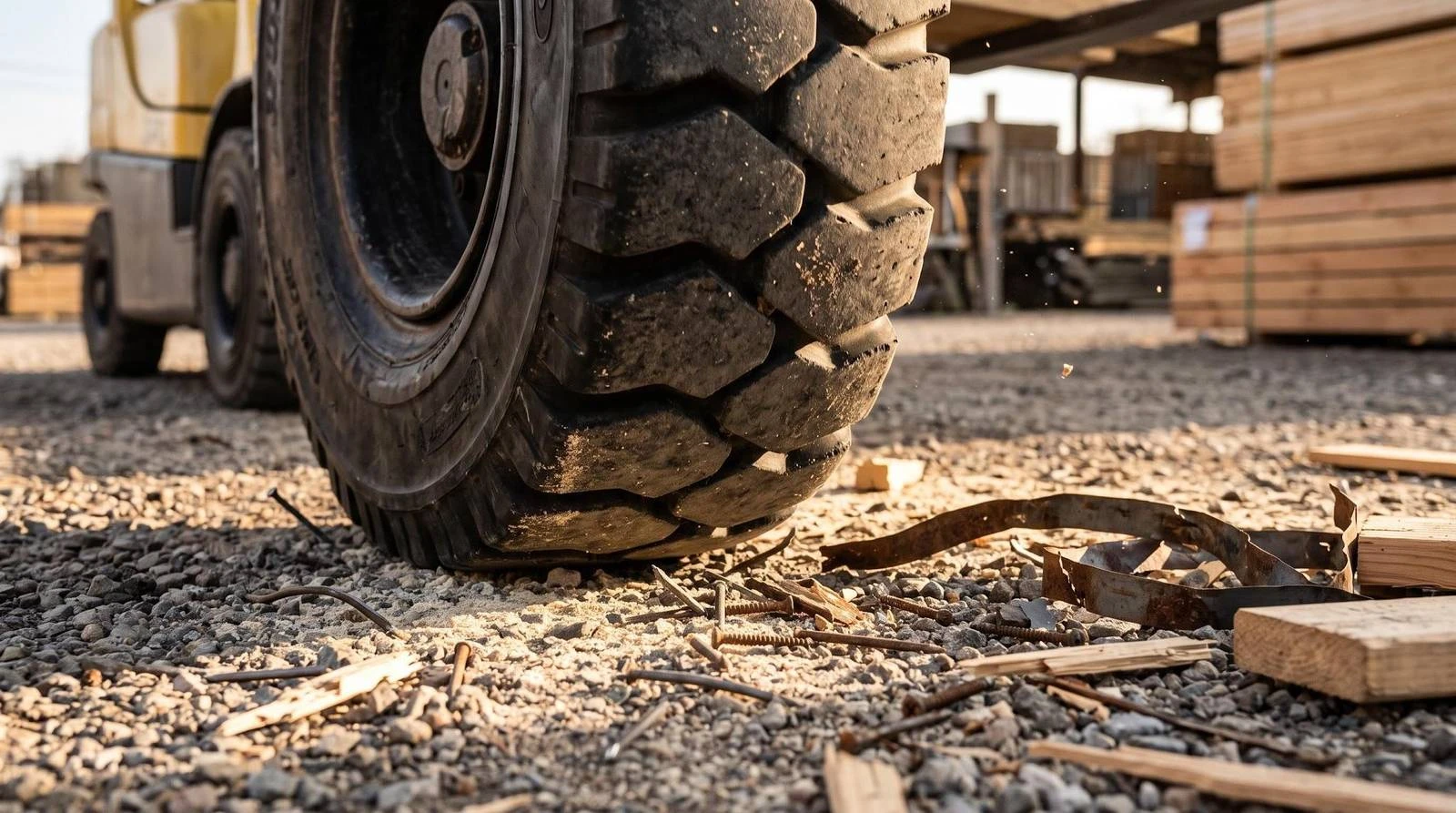
Lumberyard forklifts do one of the toughest jobs in material handling. A truck built for smooth concrete and neat pallets runs into trouble quickly in a lumber yard, where loads are long and flexible, the ground is gravel, mud, and broken asphalt, and sawdust and stray nails cover every lane.
The wrong machine sags bundles, hangs up on ruts, overheats, and spends too much time in the shop. This guide walks you through choosing the right forklift for yard work: truck types, capacity sizing, mast options, tires, fuel, forks and attachments, safety, maintenance, and whether to buy new or used.
Quick Specs Summary for Lumberyard Forklifts
If you only have a minute, start with these essentials.
- Capacity: many lumber yard models are built in the 8,000 to 12,000 lb range, with high capacity models above that.
- Tires: pneumatic tires only for outdoor yards, with solid pneumatics preferred where nails are common.
- Fuel: diesel and LPG lead outdoors, while electric fits paved or covered operations.
- Forks: longer than standard warehouse forks, sized to support most of the bundle length.
- Attachments: side shifters and fork positioners are the first upgrades to consider.
- Ground clearance: enough to clear ruts, drainage ridges, and uneven shed approaches.
Why Lumberyards Need Specialized Forklifts
A lumber yard stacks three problems on top of each other that a warehouse truck was never designed to solve: long loads, rough surfaces, and constant debris. Each one affects a different part of the machine, so it helps to look at them separately.
Long, Flexible Loads
Unit lumber does not behave like a pallet. When a long bundle rides on a narrow carriage or short forks, the ends droop and bounce with every bump. That flexing warps boards, snaps bands, and turns premium stock into downgraded product.
It also shifts the center of gravity during turns, which makes the load unstable and the truck easier to tip. Long loads are a safety issue and a margin issue at the same time, because every damaged bundle is money lost before the truck arrives at the customer.
Rough, Unpaved Yard Surfaces
Most outdoor yards mix compacted gravel, mud after rain, deep ruts, drainage ridges, and uneven approaches to sheds and trailers. A truck with low ground clearance hangs up on these driving surfaces, scraping its frame or stalling halfway through a move. Traction matters just as much.
Carrying heavy loads across uneven terrain on wet or loose ground raises the risk of sliding and tipping, so the tires and drive system have to keep the truck planted.
Sawdust, Nails, and Debris
Fine sawdust settles into radiators, air filters, and engine compartments, where it blocks airflow and causes overheating. Nails, screws, wood shards, and banding scrap puncture tires and leave trucks parked when you need them.
Sealed components and heavy duty filtration keep debris out of the systems that fail first, which is the most direct way to eliminate costly downtime in a dusty yard.
Types of Forklifts Used in Lumberyards
Each truck type fits a different part of the yard, and many operations run more than one.
| Truck Type | Best Use | Surface | Strengths | Limitations |
|---|---|---|---|---|
| Pneumatic tire counterbalance forklift | Moving unit lumber, loading trucks | Asphalt, compacted gravel | Versatile, fast, widely available | Struggles in deep mud and tight lanes with very long loads |
| Rough terrain forklift | Unimproved yards and grades | Mud, soft ground, slopes | High ground clearance, large tires, strong traction | Larger footprint, less nimble in sheds |
| Side loader or multidirectional forklift | Long lumber, beams, rack storage | Paved or firm surfaces | Carries long loads lengthwise in narrow lanes | Less suited to soft or rough ground |
| Telehandler | Reaching across stacks and flatbeds | Rough or firm ground | Forward reach and lift height | Slower for short shuttle moves |
Pneumatic Tire Counterbalance Forklifts
The pneumatic tire internal combustion counterbalance truck is the everyday workhorse for unit lumber in most yards. It performs well on asphalt and compacted gravel, handling the bulk of daily work: loading trucks, moving bundles between stacks, and feeding covered storage.
Heavy counterweights give it the stability to lift dense bundles, and pneumatic tire forklifts are available across a wide range of capacities. Where it starts to struggle is with very long loads in tight lanes and in deep mud, where a specialized truck takes over.
Rough Terrain Forklifts
If your yard has steep grades, soft ground, standing mud, or unimproved surfaces, a rough terrain forklift is the safer choice. These trucks are built for unpaved, muddy, or hilly ground, with four wheel drive, high ground clearance, and large deep tread tires that grip where a standard counterbalance truck spins.
They make sense for yards that expand onto raw land, operations that store lumber in open fields, and any site where rain turns lanes into ruts for weeks at a time. They are less nimble inside sheds, so many yards pair one with a counterbalance truck.
Side Loaders and Multidirectional Forklifts
Side loaders and multidirectional forklifts carry long material lengthwise along the truck rather than across the front. That layout lets them travel through narrower lanes and keeps long loads stable because the bundle rests along the truck's body.
Operations that move high volumes of long lumber, engineered beams, or trusses benefit most, especially those with covered rack storage where aisle space is limited. These trucks also support better layout decisions, since narrower lanes free up room for more stock under the same roof.
Telehandlers
Telehandlers extend forward and upward, so they earn their place when reach matters more than straight vertical lift. They are useful for loading flatbed trailers from one side, reaching across a row of stacks to pull a bundle from the back, and double stacking bundles in the yard.
Their boom lets you place loads where a mast truck cannot get close. For short shuttle moves between stacks, though, a standard forklift is usually faster and easier to maneuver, so telehandlers tend to complement a fleet rather than replace it.
How to Size Capacity for Lumber Loads
The most common and most dangerous mistake is buying a truck for the average load instead of the heaviest one. A forklift that handles most bundles comfortably can still be overloaded by a single wet, treated, or oversized lift. Sizing correctly takes three steps.
Estimating Bundle Weight
Bundle weight changes with wood species, moisture content, pressure treatment, bundle dimensions, and product type. Green lumber carries far more water than kiln dried stock, treated lumber adds chemical and moisture weight, and engineered products such as beams can be much denser than dimensional lumber.
Rather than relying on general charts, use a practical method: identify your heaviest products, weigh several representative bundles of each on a certified scale, and record the results. Use the heaviest result as your sizing baseline, and repeat the exercise when you add new products or suppliers.
Load Center and Capacity Derating
The load center is the distance from the face of the forks to the center of gravity of the load. Forklift capacity is rated at a standard load center, and lift capacity drops as the load center moves farther out.
Wide, deep lumber bundles push the center of gravity forward, which means the truck can safely carry less than the number on the brochure. Before buying, check the data plate and the manufacturer's load chart at your real load center and your real lift height, not just the headline rating.
Building in a Capacity Buffer
Choose a truck with extra load capacity above your heaviest expected bundle. Running a forklift at its limit all day strains the hydraulics, wears the mast and tires faster, and leaves little stability margin when lifting at height or turning on uneven ground.
A buffer keeps the truck working within its comfort zone, which lowers operating costs over time and gives you room for heavier products later.
Mast Height and Free Lift for Yard and Shed Storage
A two stage mast has two telescoping sections and offers good visibility with a simple design, which suits yards that mostly load trucks and stack at moderate heights. A three stage mast adds another section, reaching higher from a similar lowered height, which is why it is common on outdoor lumber trucks.
A quad mast adds a fourth section for maximum height when space is limited. Free lift is how high the forks can rise before the mast itself starts to extend upward.
That matters inside covered sheds with low beams, because good free lift lets you raise a bundle off a bottom rack without the mast striking the roof structure. When comparing trucks, ask for three separate numbers: lowered height, maximum lift height, and free lift. Also check mast visibility.
A mast with wide channels or bulky hoses can block your view when carrying tall bundles, so sit in the seat and look through it before you commit.
Choosing Tires for Lumberyard Forklifts
Cushion tires are built for smooth concrete and fail quickly on gravel, dirt, and debris covered asphalt. They offer little traction, almost no ground clearance, and no tolerance for ruts. For outdoor yards, pneumatic tires are the only realistic option, and the real decision is which type.
Air Filled vs Solid Pneumatic Tires
| Tire Type | Advantages | Drawbacks |
|---|---|---|
| Air filled pneumatic | Softer ride, lower upfront cost | Can go flat from nails and banding scrap |
| Solid pneumatic | Puncture resistance, consistent traction | Stiffer ride, higher upfront cost |
Many yards switch to solid pneumatic tires once they count the hours lost to flats. A single puncture during a busy loading window can delay several shipments, so the higher upfront cost usually pays for itself.
When to Consider Dual Front Tires
Dual front tires spread the truck's weight across a wider footprint, which helps on soft ground where single tires sink. The wider stance also adds lateral stability when carrying long bundles on uneven or sloped surfaces, reducing the chance of a sideways tip.
Diesel, LPG, or Electric: Picking a Power Source
The right power source depends on yard size, load weight, shift length, and how much time you spend indoors.
| Power Source | Torque | Run Time | Refueling or Charging | Emissions and Noise | Maintenance | Best Fit |
|---|---|---|---|---|---|---|
| Diesel | Highest | Long shifts | Quick refueling | Highest | Engine service required | Large yards, heavy bundles, grades |
| LPG | Strong | Full shift per tank set | Quick tank swaps | Lower than diesel | Engine service required | Smaller yards, indoor and outdoor work |
| Electric pneumatic | Strong and instant | Depends on battery and charging | Charging infrastructure needed | None at the truck, quiet | Fewer engine items | Paved yards, covered operations |
Diesel
Diesel suits large yards, heavy bundles, long shifts, and pulling loads up grades. It delivers strong lifting power and torque at low speeds, which helps when climbing out of a rut with a full load.
Refueling takes minutes, so the truck can keep running without waiting on a charger, and diesel engines start and perform well in cold weather. The TAILIFT PFD36 8,000 lb pneumatic tire diesel forklift is one example, pairing diesel power with solid pneumatic tires and a three stage mast.
Emissions rules in some states may limit diesel choices or require newer engine standards, so check your local requirements before you buy.
LPG
LPG is a natural fit for smaller building materials suppliers and operations that move between indoor and outdoor areas, such as a yard with an attached retail warehouse. Tank swaps take only a few minutes, and LPG runs cleaner than diesel, which makes it easier to justify inside covered storage with good ventilation.
For lighter bundles and mixed indoor and outdoor work, the TAILIFT PFG30 6,000 lb pneumatic tire LPG forklift runs on solid pneumatic tires. The tradeoff is performance under sustained heavy loads, where diesel usually holds up better.
Electric Pneumatic Forklifts
High voltage electric pneumatic forklifts are now built for outdoor work, and high capacity electric models are a viable option for many lumber operations. They run quietly, produce no emissions at the truck, and eliminate many engine maintenance items such as oil changes and radiator service.
Modern units use lithium ion batteries that support opportunity charging during breaks and shift changes, which keeps them working without battery swaps. The requirement is reliable charging infrastructure in the yard. Without convenient power at the right locations, run time becomes the limiting factor. Electric trucks work best on paved yards and covered operations.
Forks, Carriages, and Attachments for Lumber Handling
The equipment at the front of the truck decides whether lumber arrives flat and undamaged. A powerful truck with the wrong forks still sags bundles and gouges wood.
Fork Length and Lumber Forks
Standard warehouse forks are sized for pallets and are too short for unit lumber. Forks should support most of the load length so the weight is not concentrated on the fork tips, where it bends steel and lets bundle ends droop.
Lumber forks are specialized forks that are thinner, wider, and tapered, so they slide between tightly stacked bundles without gouging wood or catching bands. Fork extensions can help with occasional long loads, but they are not a replacement for proper forks on a truck that handles long loads every shift.
Wide Carriages
Wide carriages support long bundles across more of their width. That reduces sag and bounce during travel, protects banding, and improves stability in turns because the load cannot rock as easily on the forks.
Side Shifters and Fork Positioners
Side shifters let the operator line up with a bundle without repositioning the whole truck, which saves time in tight lanes. Fork positioners adjust fork spacing from the seat, so operators can switch between narrow and wide bundles without climbing down.
Together they speed up handling, reduce damage to bundles and banding, and prevent injuries from manually sliding heavy forks along the carriage.
Lumber Clamps and Specialty Attachments
Bundle clamps grip loads from the sides, holding loose or unbanded lumber securely during travel. Carpet poles and booms handle long items that do not sit well on forks, such as pipe, posts, or rolled material.
One safety point applies to every attachment: each one adds weight and moves the load center forward, which reduces the truck's effective capacity. After installation, the data plate must be updated to reflect the new rated capacity.
Lumberyard Forklift Safety Essentials
Lumber yards mix heavy truck traffic, pedestrians, uneven ground, and loads that block the view, so safety rules need to be specific to the yard. Build your program around these practices:
- Keep long loads low and centered during travel, raising them only at the stack or trailer.
- Slow down on uneven ground, wet surfaces, and slopes, where long loads shift the center of gravity and raise the risk of a lateral tip.
- Require seatbelts on every truck, every shift.
- When bundles block the operator's view, use trained spotters, cameras, or travel in reverse when it is safe to do so.
- Separate pedestrian walkways from forklift lanes with marked paths, barriers, and clear crossing points.
- Never exceed the capacity on the data plate, including any derating from attachments.
- Complete a pre shift inspection on every truck, including a check of the tires for embedded nails and damage.
Before each shift, operators should also check yard conditions such as gravel washouts, mud, and ice, since surfaces can change overnight. OSHA requires forklift operator training, evaluation, and certification for each type of truck an operator uses, so keep training records current and refresh them when operators move to a new truck type.
Our guide on how to operate a forklift step by step covers the fundamentals every operator should know.
Maintenance Tips for Forklifts in Dusty Yards
Sawdust and debris shorten the life of every system on a yard truck, so your routine should run more often than a warehouse schedule.
Daily tasks:
- Blow out the engine compartment and radiator with compressed air.
- Check tires for embedded nails, cuts, and chunking.
- Check engine oil, coolant, and hydraulic fluid levels.
- Look for hydraulic leaks around the mast, cylinders, and hoses.
Periodic tasks:
- Replace air filters more often than the standard interval in dusty conditions.
- Inspect hydraulic seals and hoses for wear, cracking, and abrasion.
- Grease pivot points and mast rollers.
- Check the cooling system before hot weather arrives.
A simple, consistent routine prevents overheating and unplanned downtime. For a complete walkthrough, use our forklift daily inspection checklist.
Buying a New or Used Lumberyard Forklift
New equipment gives you the latest features, current engine and safety technology, and a full manufacturer warranty, which matters if the truck will be your primary machine for many years. A used forklift costs less upfront, avoids the steepest early depreciation, and is often available faster than a new unit with long lead time expectations.
For many lumber operations, a well maintained used truck is a practical choice, especially as a backup or second unit that keeps loads moving when your main truck is down for service. It also lets you expand your forklift fleet with less spending.
If budget timing is a concern, review our forklift and equipment financing options to spread the cost.
What to Inspect on a Used Yard Truck
- Mast and carriage wear, cracks, or bending from carrying off center loads.
- Mast roller and chain condition, including stretch and lubrication.
- Hydraulic leaks, and smooth lift, tilt, and side shift operation.
- Tire condition and remaining tread or rubber.
- Radiator and cooling system condition.
- Signs of heavy dust buildup in the engine compartment.
- Complete service records.
Service history matters more than the hour meter alone. A truck with higher hours and regular documented maintenance is often a better buy than a low hour truck that was neglected.
Common Lumberyard Forklift Mistakes to Avoid
Most yard truck problems trace back to a handful of avoidable decisions.
- Sizing for the average load leaves you overloaded on your heaviest bundles.
- Putting cushion tires on outdoor surfaces leads to lost traction and fast tire failure.
- Using standard length forks on long lumber causes sagging, broken bands, and damaged product.
- Ignoring the load center when reading capacity overstates what the truck can safely lift.
- Forgetting that attachments reduce capacity puts trucks over their real limit.
- Skipping daily debris cleanouts invites overheating and clogged filters.
Frequently Asked Questions About Lumberyard Forklifts
What size forklift do I need for a lumberyard?
You need a forklift rated for your heaviest bundle at its real load center, not your average load. Many lumber yard models fall in the 8,000 to 12,000 lb range, but wide bundles reduce usable capacity.
Weigh your heaviest products, check the load chart at your actual load center and lift height, and add a capacity buffer.
Can I use a warehouse forklift in a lumberyard?
A cushion tire warehouse truck is not suitable for outdoor yard surfaces. It lacks the ground clearance, traction, and tires needed for gravel, mud, and debris, and it can hang up or lose grip with a heavy bundle. It may work only inside a paved, covered building with smooth floors.
Are solid pneumatic tires worth the extra cost?
Yes, in most yards with nails, screws, and banding scrap. Solid pneumatic tires cost more upfront and ride stiffer, but their puncture resistance prevents the flats that park a truck during busy loading windows. Once you count lost hours and delayed shipments, the savings from less downtime usually cover the higher cost.
What fork length works best for unit lumber?
The best fork length is one that supports most of the load length, which means longer forks than standard warehouse forks. Measure your typical bundle depth and choose forks that keep weight off the tips. Thinner, tapered lumber forks also slide between tight stacks without gouging wood or catching bands.
Can electric forklifts work outdoors in a lumberyard?
Yes, electric pneumatic forklifts are built for outdoor use and work well in lumber yards with reliable charging infrastructure. They perform best on paved yards and covered operations. Lithium ion models support opportunity charging during breaks, and they run quietly with no emissions at the truck.
How often should a lumberyard forklift be serviced?
A lumberyard forklift needs daily cleanouts of the engine compartment and radiator, plus more frequent air filter changes than standard intervals. Follow the manufacturer's service schedule, using the severe conditions intervals where they are provided, since dust and debris accelerate wear on filters, cooling systems, and hydraulic components.
Find the Right Forklift for Your Lumberyard
The right yard truck comes down to a few decisions: capacity sized for your heaviest bundle at its real load center, pneumatic tires built for your surfaces, a power source matched to your yard and shifts, and forks and attachments that keep long loads flat and stable.
Get those right and you protect your product, your operators, and your margins. Browse the PS Janitorial forklift inventory to compare available units, or contact our forklift team for help matching a truck to your yard.