The Forklift Daily Inspection Checklist
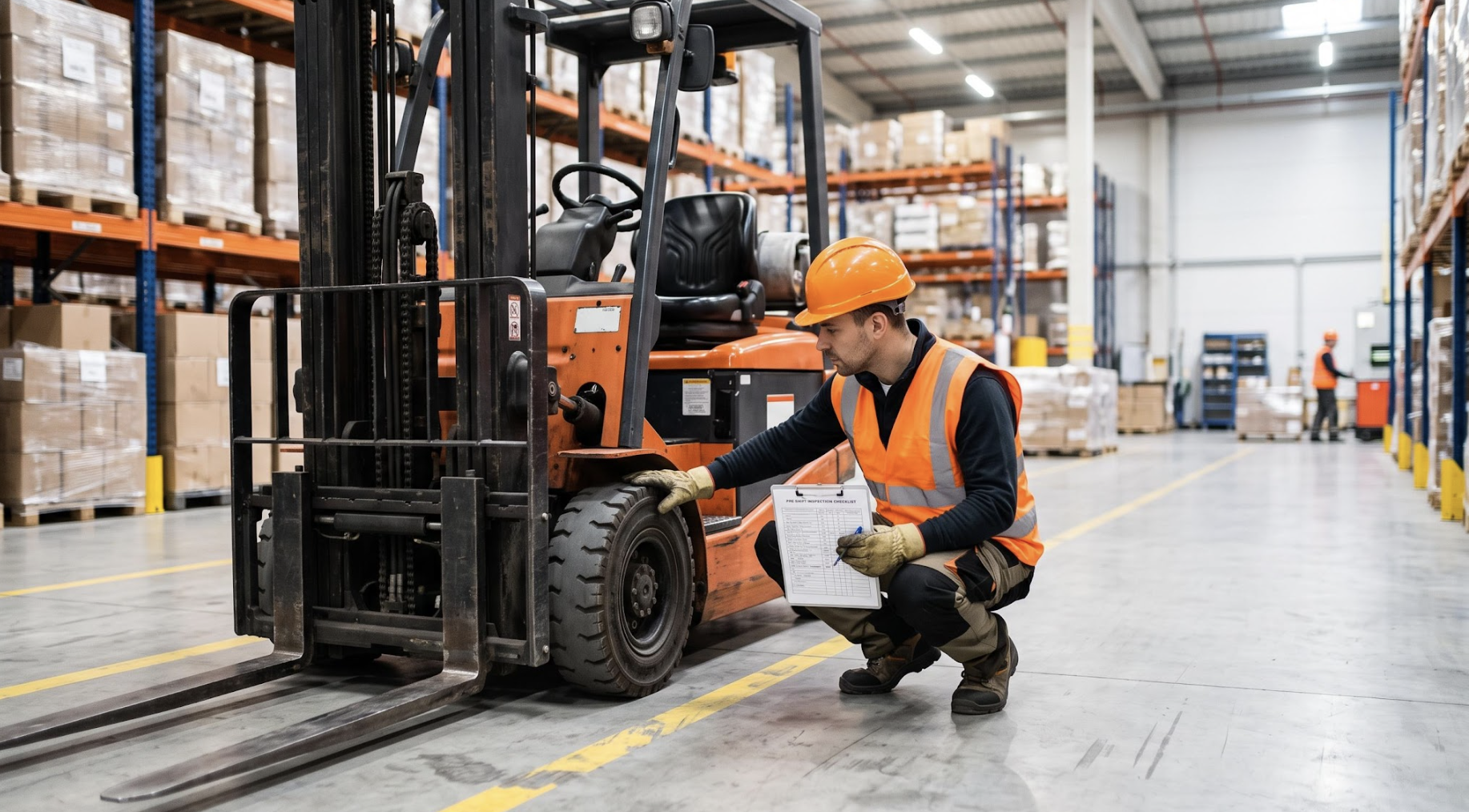
Why Daily Forklift Inspections Matter
Forklifts are involved in roughly 20,000 workplace injuries every year in the United States, and many of those incidents are serious enough to put an employee out of work for days or weeks. Behind almost every one of those numbers is a forklift that was put into service with a problem someone could have caught before the shift started: a hairline crack in a fork, a hydraulic hose that was already weeping fluid, a brake pedal with too much travel. The daily forklift inspection exists to catch exactly these issues before they turn into an accident.
Running through a daily inspection checklist takes a few minutes, but it does three things at once for your operation. It protects the people working around your forklifts, it protects the equipment itself from accelerated wear and unplanned downtime, and it protects your business from the fines and liability that follow an OSHA citation. If you manage a warehouse, distribution center, or any facility where a forklift moves product, this checklist is the simplest safety habit you can put in place today.
OSHA Requirements for Daily Forklift Inspections
The daily inspection requirement is not a best practice you can choose to skip when things get busy. It comes directly from federal law. Under 29 CFR 1910.178(q)(7), the Occupational Safety and Health Administration requires that every powered industrial truck be examined before it is placed in service each shift. If your forklift runs on a round the clock basis, OSHA requires that it be examined after each shift, since a truck that ran for eight hours overnight needs the same scrutiny before the next crew takes over.
The Occupational Safety and Health Administration also draws a hard line around who is allowed to operate the equipment in the first place. Only operators who have been trained and evaluated under 29 CFR 1910.178(l) are authorized to run a forklift. A daily inspection performed by an untrained employee does not satisfy the intent of the standard, so the two requirements work together: trained operators, checking the truck every shift.
Who Is Responsible for Performing the Inspection
The pre shift check is one of the operator's responsibilities, not a task handed off to a mechanic or a supervisor. The person who is about to drive the forklift is the one best positioned to notice a leak, a loose panel, or a control that feels off, since they are the one who will be relying on that equipment for the next several hours. Supervisors still play a critical role. Once a defect is logged, it becomes the supervisor's job to review the finding and act on it, whether that means scheduling a repair or pulling the truck from service entirely.
How Often Forklifts Need to Be Inspected
At minimum, every forklift needs a daily inspection before its first use in a shift. If your facility runs multiple shifts or operates continuously, OSHA requires a fresh inspection at the start of each shift rather than one check that covers the whole day. A written log is not legally mandated, but in practice it is the standard way operations demonstrate compliance if an OSHA inspector ever asks to see records. Without a log, you are relying on memory to prove the inspection happened at all.
The Two Phases of a Daily Forklift Inspection
OSHA's own framework splits the daily inspection checklist into two distinct phases. The first is a visual inspection performed with the engine off, where the operator walks around and inspects the truck for physical damage, leaks, and wear. The second is an operational check performed with the engine running, where the operator confirms that every control and safety device responds the way it should. Both phases are essential for ensuring forklift safety, and skipping either one leaves a real gap in what the inspection is supposed to catch. The two full checklists below walk through each phase in order.
Visual Forklift Inspection Checklist (Engine Off)
The visual check comes first because it catches the kind of physical damage, fluid leaks, and wear that you can spot before the forklift ever moves. Walking the truck with the engine off also removes any risk of the vehicle shifting or a component engaging while you are inspecting it closely.
Fluid Levels and Leaks
Check engine oil, water, hydraulic fluid, and brake fluid levels before anything else. Low fluid levels are often the first visible sign of a slow leak, so while you are checking the reservoirs, look over the hoses and mast chains for any signs of leaking, cracking, or unusual wear. Hydraulic hoses in particular tend to develop small cracks near their fittings, and catching that early is far cheaper than dealing with a hose failure mid lift.
Tire Condition
Tire condition and pressure directly affect how stable a load is once it is raised, so this step matters more than it might seem. Check that tires are properly inflated and inspect them for wear, cuts, or gouges. A damaged tire changes how the forklift handles under load, and that is not something you want to discover in the middle of a lift.
Forks and Retaining Pins
Look closely at the forks themselves for cracks or bends, since either one compromises how much weight the fork can safely carry. Confirm that the top clip retaining pin and heel are properly seated. A fork that is not fully secured to the carriage can shift or come loose entirely once weight is applied, so this is not a step to rush through.
Mast, Chains, and Load Backrest
Check the mast for proper alignment and inspect the chains for correct tension. OSHA specifically recommends using a stick rather than your hands when checking chain tension, since hands inside a mast assembly are at risk if the chain moves unexpectedly. While you are in this area, confirm the load backrest extension is secure, since it is what keeps a raised load from tipping backward toward the operator.
Overhead Guard, Finger Guards, and Safety Decals
Confirm the overhead guard is intact and that finger guards are properly in place, since both are safety devices designed to protect the operator from falling objects and pinch points. Check that warning decals and the capacity nameplate are legible and match the forklift's actual model and any attachments currently mounted. If the nameplate does not match the current configuration, the listed capacity may no longer be accurate for safe operation.
Operator Manual, Seat Belt, and Cab Condition
Confirm the operator manual is on board and still legible, since it contains the manufacturer's instructions for that specific model. Test that the seat belt functions correctly, as it is one of the most basic safety devices on the truck. Finally, check that the operator compartment is free of grease, tools, and other debris that could interfere with the pedals or controls once you start the engine.
Operational Forklift Inspection Checklist (Engine On)
With the visual check complete, the operational check confirms that every control and safety device on the forklift actually responds the way it is supposed to once the engine is running. This is where you find problems that a visual inspection alone cannot catch, like a brake that engages late or steering that pulls to one side.
Brakes and Steering
Test the service brake for excessive travel or resistance, and check the parking brakes to confirm they hold the truck in place. Test the steering as well, making sure it responds smoothly and is properly aligned rather than requiring extra effort or overcorrection to keep the truck moving straight.
Horn, Lights, and Alarms
Test the horn, headlights, and back up alarm if the truck is equipped with one. These are the operator's main way of warning nearby pedestrians and other equipment operators that the forklift is moving, so any of them failing is a real safety gap, not a minor inconvenience.
Drive, Tilt, Hoist, and Attachment Controls
Test forward and reverse drive control to confirm smooth engagement in both directions. Check tilt control in both directions, along with the hoist and lowering control, to make sure lifting and lowering respond predictably. If the forklift has an attachment control, test that as well before relying on it during actual work.
Gauges and Hour Meter
Check the instrument monitor and oil pressure gauge to confirm the truck is reading and displaying information correctly, and note the hour meter reading. Keeping an accurate, properly working hour meter matters for scheduling maintenance on time, so a gauge that is not functioning correctly should be flagged just like any mechanical defect.
Additional Checks by Fuel Type
Beyond the general checklist above, OSHA lists extra items specific to how a given forklift is powered. The fuel system on an electric truck needs a different set of eyes than the fuel system on a propane or internal combustion model, so these checks should be treated as required additions rather than optional extras.
Electric Forklifts
Check cables and connectors for fraying or exposed wiring, confirm the battery restraints are secure, and check electrolyte levels. OSHA recommends wearing appropriate PPE, including gloves and eye protection, any time you are checking electrolyte, since it is corrosive. Also confirm the hood latch is functioning, since it keeps the battery compartment secured during operation.
Internal Combustion Forklifts
Check engine oil, the brake fluid reservoir, coolant level, air filter condition, and the belts and hoses under the hood. Inspect the radiator for any signs of damage or blockage as well. An internal combustion truck has more moving mechanical parts under load than an electric model, so this step tends to take a little longer, and it is worth the extra few minutes.
Liquid Propane Forklifts
Confirm the propane tank is properly mounted and that the restraint brackets are secure. Check that the pressure relief valve is correctly oriented, and inspect hoses and connectors for wear or damage. OSHA recommends PPE such as gloves when checking propane fittings, since a damaged connector can release gas even when the tank itself is intact.
What to Do If You Find a Defect
If any part of the daily inspection checklist turns up a defect, the correct response is the same regardless of what you found. Stop using the forklift immediately, tag it out of service so no one else attempts to operate it, and make sure the issue is reported to a supervisor and logged in writing. This is not the moment to decide the problem seems minor enough to work around for one more shift. Under 29 CFR 1910.178(q)(1), only authorized personnel are permitted to perform repairs, so even if you know how to fix the issue yourself, the correct next step is reporting it rather than attempting the repair on the spot.
Free Forklift Daily Inspection Checklist Template
If your operation does not already have a standardized way to run through these steps, a printable checklist takes the guesswork out of it. A template covering both the visual and operational items above gives every operator on your team the same structure to follow, which makes it far easier to spot when a check gets skipped and to build the kind of written log that demonstrates compliance if OSHA ever asks for one.
Benefits of Using a Daily Forklift Inspection Checklist
Meeting the OSHA requirement is the baseline reason to run this checklist every shift, but the habit pays off in ways that go beyond simply staying compliant.
Improved Workplace Safety
Every hazard caught during an inspection is an accident that never happens. A crack in a fork or a brake with too much play is far easier to deal with on paper during a five minute check than in the aftermath of an incident on the floor.
Reduced Downtime and Maintenance Costs
Catching wear early, whether it is a fraying hose or a tire losing tread, almost always costs less to fix than waiting until it fails during operation. A small issue addressed proactively rarely turns into an unplanned repair that takes a forklift out of service for days.
Easier OSHA Compliance
A consistent written record of daily inspections gives your business real protection if an incident does occur or an inspector shows up. Rather than trying to reconstruct what happened after the fact, you have a documented history showing the truck was checked and found safe to operate.
Frequently Asked Questions About Forklift Daily Inspections
What happens if OSHA finds a forklift was not inspected?
An uninspected forklift that was involved in an accident opens your business up to citations, fines, and significantly increased liability. OSHA treats the absence of a required inspection as a serious compliance failure, particularly when it is connected to an injury.
Can an operator skip the checklist if the forklift passed inspection yesterday?
No. OSHA requires an inspection every shift, and forklifts used on a round the clock basis need to be inspected after each shift change. A clean inspection yesterday does not account for anything that may have developed overnight or during the previous shift.
Does OSHA require a physical checklist form?
OSHA does not require documentation of daily inspections in a specific physical form. That said, a written log is the standard way operations demonstrate they are meeting the requirement, so most facilities keep one even though it is not legally mandatory.
Shop Forklifts and Maintenance Supplies at PS Janitorial
A daily inspection habit only goes as far as the equipment behind it. If your forklift is due for a replacement or you need maintenance supplies to keep an existing truck in safe operating condition, browse our new and refurbished forklifts, part of the full lineup of commercial cleaning and material handling equipment available at PS Janitorial.