Electric vs Propane Forklift: Which One Is Right for Your Operation?
If you are trying to decide between an electric forklift and a propane forklift, you already know the choice affects far more than just the sticker price. It shapes how your team works every shift, how much you spend on maintenance over the years, and whether your equipment can handle your facility's specific conditions. Electric and propane forklifts each bring real strengths to the table, and the right pick depends on your application, your budget, and the environment you operate in. This article walks you through the full comparison so you can match the right lift truck to your operation, whether you run a single indoor warehouse or a busy outdoor yard with heavy loads moving in and out all day. At PS Janitorial, we work with businesses across both fuel types every day, so we put together this guide to help you choose with confidence.
Electric vs Propane Forklift: Quick Comparison
Before diving into the details, here is a quick snapshot of how electric and propane forklifts stack up against each other.
| Category | Propane Forklifts | Electric Forklifts |
|---|---|---|
| Upfront Cost | Generally lower purchase price | Higher purchase price, includes battery and charger |
| Total Cost of Ownership | Higher over time | Significantly cheaper to operate, often paid back within about two years |
| Runtime | Continuous runtime as long as you swap tanks | Runs on a charge and loses power as the battery discharges |
| Indoor and Outdoor Use | Performs well both indoors and outdoors | Best suited to indoor use |
| Emissions | Burns cleaner than gas or diesel but still produces some tailpipe emissions | Zero emissions |
| Noise | Louder due to the internal combustion engine | Runs quieter with less vibration |
| Maintenance | Requires oil changes, filter replacements, and more frequent upkeep | Fewer moving parts and lower maintenance costs |
Keep these categories in mind as you read through the rest of the article, since your priorities in each one will point you toward the right fuel type for your business. You can browse our full forklifts inventory at any point if you want to see current electric and propane models side by side.
Which Applications Work Best for Each Forklift Type?
Industries Best Suited for Propane Forklifts
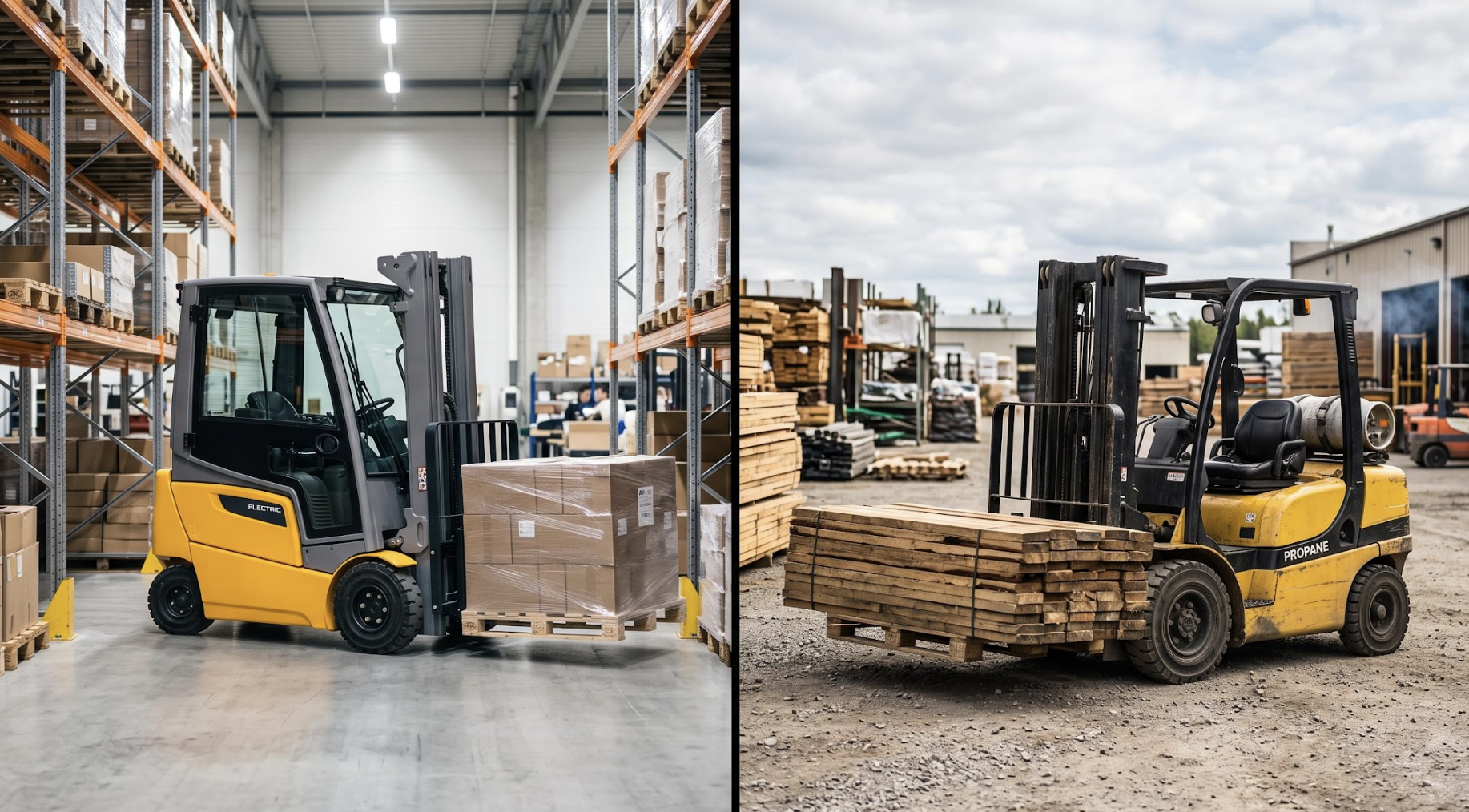
If your operation runs outdoors or handles heavy loads across rough terrain, propane models are usually your best fit. Construction sites, agriculture operations, lumberyards, recycling centers, steel and scrap yards, and large warehousing and logistics facilities all benefit from the power and flexibility of propane trucks. Propane forklifts can handle heavy loads, deliver high torque, and hold up well in outdoor conditions where weather, uneven ground, and long distances from a home base are part of daily operations. Trucking and logistics companies also favor propane because quick refueling keeps trucks moving without long downtime between shifts.
Industries Best Suited for Electric Forklifts
If you operate indoors, in emissions sensitive environments, or in cold storage, electric forklifts are typically the better fit. Food and beverage facilities, grocery and retail distribution centers, medical and pharmaceutical warehouses, cold storage operations, and tall racking or narrow aisles warehouses all lean toward electric lifts. Since electric forklifts have fewer moving parts and produce no emissions, they are well suited to enclosed spaces where air quality and ventilation are ongoing concerns. Electric forklifts also work well in facilities where regulations demand strict emissions control.
Cost Comparison: Electric vs Propane Forklifts
Upfront Purchase Price
Propane forklifts cost less to purchase upfront, making them a more accessible option if your budget is tight and you need equipment right away. Electric forklifts run higher initially, since the price includes the battery and charger as part of the initial investment. That higher entry point is one of the main reasons many businesses weigh purchase price so heavily before looking at the bigger operating picture.
Total Cost of Ownership
While propane wins on initial price, electric forklifts tend to win on total cost of ownership. Lower fuel expenses, less maintenance, and fewer moving parts add up over the life of the equipment. Multiple sources point to a typical two year payback period, meaning the higher upfront investment in an electric forklift is often recouped within about two years of operation through lower operating costs. If you plan to keep your equipment for the long haul, this is worth factoring heavily into your decision.
Maintenance Costs
Propane forklifts require regular fluid changes much like a car, including oil changes, tune ups, and filter replacements, all of which add up over time. Electric forklifts, with fewer moving parts, cost noticeably less per operating hour to maintain than propane forklifts. Electric forklifts do not require oil changes or radiator maintenance, though they do need routine battery upkeep such as checking fluid levels on lead acid models.
Runtime and Power
Propane forklifts offer continuous runtime as long as you keep tanks on hand. Swapping an empty propane tank for a full one takes less than five minutes, which makes propane trucks a strong choice for multi shift operations that cannot afford downtime. Electric forklifts, on the other hand, lose power as the battery discharges and traditionally need a full charge and cooldown cycle between shifts. That said, newer lithium ion battery technology has changed the game, allowing electric forklifts to take advantage of opportunity charging, which means operators can top off the battery during breaks rather than waiting for a complete charge cycle. If your operation runs multiple shifts, it is worth evaluating whether your facility can support opportunity charging or whether propane's quick refueling makes more sense for your workflow.
Operating Environment: Indoor vs Outdoor Use
Propane forklifts perform reliably outdoors, start up well in cold weather, and hold power consistently over longer distances from a home base. This makes them a strong choice if your work environment includes outdoor yards, gravel lots, or seasonal temperature swings. Electric forklifts are best suited to indoor, climate controlled environments and generally struggle in wet or rugged outdoor conditions. If your facility has areas exposed to moisture or uneven surfaces, check the IP rating of any electric model you are considering, since this affects how well the unit resists water and dust intrusion.
Emissions and Air Quality
Electric forklifts produce zero emissions during operation, which is a major advantage for indoor air quality and worker safety. Propane forklifts burn cleaner than gasoline or diesel engines and emit lower levels of carbon monoxide than gas powered alternatives, but they still release some carbon monoxide and carbon dioxide. In enclosed spaces, this means you need proper ventilation and, in many cases, carbon dioxide monitors to keep air quality within safe limits. If your facility runs propane equipment indoors, adequate ventilation is not optional, it is a requirement for protecting your team.
Safety Considerations
Propane Safety Factors
Propane forklifts carry their own set of safety considerations. Fuel leaks in propane tanks can pose fire hazards, and OSHA requires designated storage areas for propane tanks to reduce that risk. Operating in enclosed spaces also raises the potential for carbon monoxide buildup, which is why ventilation and monitoring matter so much indoors.
Electric Safety Factors
Electric forklifts come with a different set of risks. Battery acid can cause burns during handling, and impact injuries can occur during battery changes on older lead acid models. Chargers introduce a risk of electric shock, and hydrogen gas can be released during the charging process, which is why charging areas need proper ventilation as well. On the positive side, electric forklifts reduce the risk of cold burns associated with swapping fuel sources, since there is no tank to handle.
Noise and Operator Comfort
Electric forklifts run noticeably quieter and produce less vibration than propane trucks, which can meaningfully reduce operator fatigue over long shifts. Propane forklifts, powered by an internal combustion engine, are louder and generate more vibration during operation. If your facility runs close to office space, retail floors, or other noise sensitive areas, the quieter operation of electric lifts may be an important factor in your decision.
Ergonomics and Ease of Use
Because electric forklifts do not need to accommodate a fuel tank, they tend to have shorter frames, tighter turning radiuses, and better rearward visibility. This makes them easier to maneuver in narrow aisles and tight warehouse layouts. Fewer fumes and smoother, quieter operation also contribute to less operator fatigue across a full shift, which can support better focus and safety on the floor.
Facility and Infrastructure Requirements
Each fuel type comes with its own facility requirements. Electric forklifts need a dedicated charging area with the correct voltage, proper ventilation, and safety gear such as eyewash stations to protect workers handling batteries and chargers. Propane forklifts require designated tank storage racks that meet OSHA guidelines, along with a plan for managing and replacing propane tanks as part of your daily workflow. Before committing to either option, take a close look at what your facility can realistically support, since retrofitting a building for charging infrastructure or tank storage can add unexpected costs.
How to Choose the Right Forklift for Your Business
With all of this in mind, here is a simple framework to guide your decision.
- Do you operate mostly indoors, outdoors, or both? Indoor use favors electric. Outdoor or mixed use often favors propane.
- Do you run single shift or multi shift operations? Multi shift work may favor propane's quick refueling, unless your facility supports opportunity charging for electric lift trucks.
- What matters more to you, a lower purchase price or lower long term operating costs? Propane wins on the first, electric wins on the second.
- Are there industry regulations or air quality requirements at your facility? Emissions sensitive environments generally favor electric forklifts.
- What infrastructure can your facility support? Consider whether you have space and power for a charging station or storage racks for propane tanks.
Answering these questions honestly will help you match your fuel type to your actual operating conditions rather than a general assumption about which forklift is "better."
Frequently Asked Questions
Can you use a propane forklift indoors?
Yes, propane forklifts can operate indoors and outdoors, but indoor use requires proper ventilation and, in many cases, carbon dioxide monitors to maintain safe air quality.
How long does an electric forklift battery last?
Battery life depends on the model and battery type, but most electric forklifts are designed to run a full shift on a single charge, with lithium ion batteries offering additional flexibility through opportunity charging.
How much does it cost to charge an electric forklift?
Charging costs vary based on local electricity rates and battery size, but electric forklifts generally offer lower total fuel costs than propane models due to lower per hour operating expenses.
How much propane does a forklift use per hour?
Propane usage depends on the load, terrain, and duty cycle, but most operations plan around swapping a tank roughly every shift or two, with tank changes taking less than five minutes.
Do electric forklifts perform as well as propane in cold storage?
Electric forklifts are commonly used in cold storage since they produce no emissions, though battery performance can be affected by cold temperatures, so it is worth checking manufacturer specifications for cold storage rated models.
Is propane or electric better for multi shift operations?
Propane traditionally has the edge here due to fast tank swaps, but electric forklifts equipped with lithium ion batteries and opportunity charging capabilities are increasingly able to keep up with multi shift demands.
Ready to Find Your Perfect Forklift? Shop Electric and Propane Models Today
Choosing between an electric and a propane forklift comes down to matching the equipment to your real world operation. If you need power, flexibility, and quick refueling for outdoor or heavy duty work, propane forklifts remain a dependable choice. If you operate indoors, care about air quality, or want lower long term operating costs, electric forklifts are likely the smarter investment. Either way, the right lift truck should reduce downtime, support your team, and fit the way your facility actually runs.
Browse our new and used forklift inventory to find electric and propane models suited to your operation, your budget, and your work environment.