Floor Scrubber vs Carpet Extractor: Which One Does Your Facility Actually Need?
What Is a Floor Scrubber?
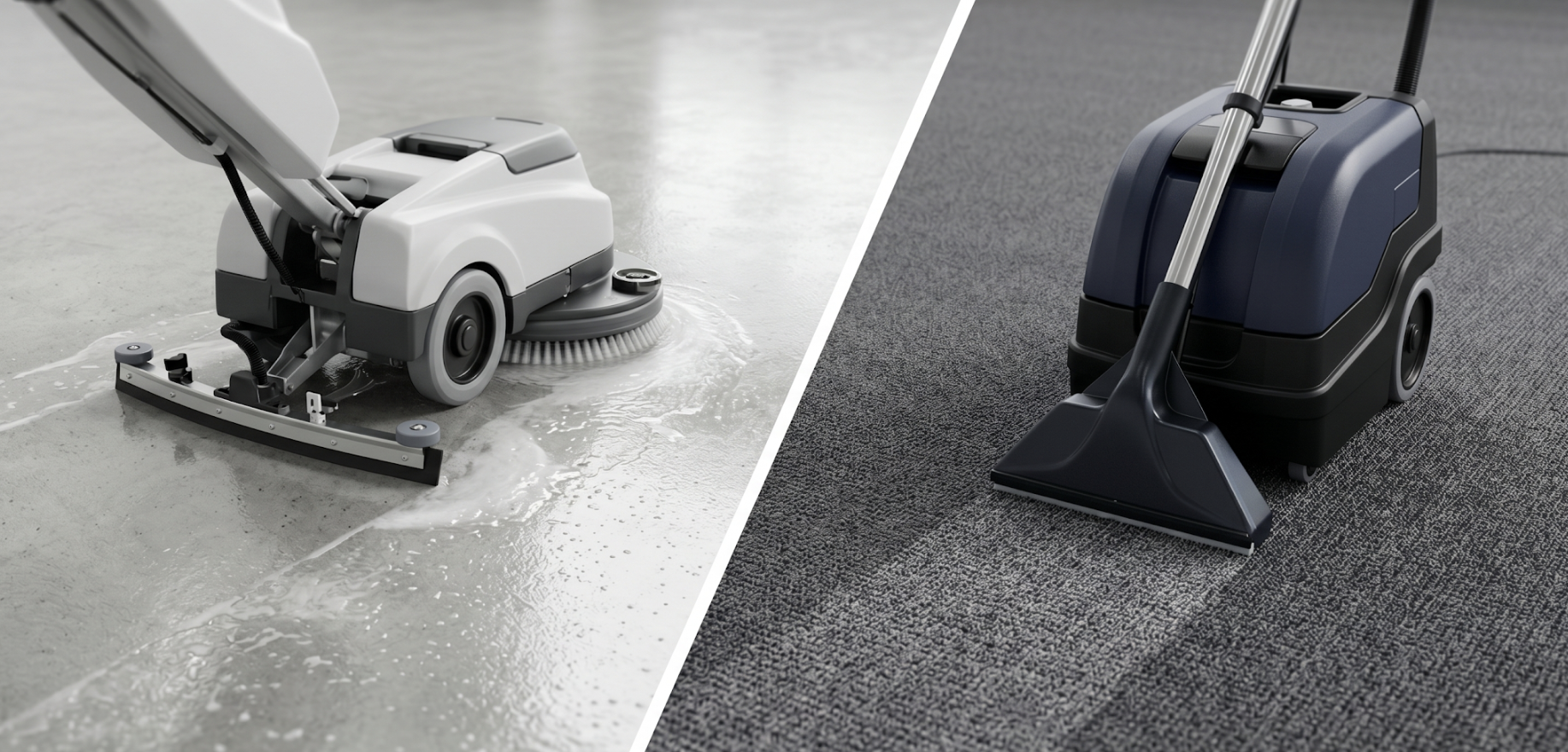
A floor scrubber is a powered cleaning machine built exclusively for hard, non-porous surfaces: concrete, tile, vinyl, and linoleum. If your facility has hard floors that accumulate grime, a floor scrubber is the workhorse designed to handle that job at commercial scale. The machine operates through a three-step process: it dispenses a water and cleaning solution onto the floor surface, scrubs with rotating brushes or pads to break up surface dirt and ground-in dirt, and then vacuums up the resulting dirty water through a rear squeegee assembly into a recovery tank. One thing worth stating clearly from the start: floor scrubbers do not work on carpet. They are purpose-built for hard-surface floor maintenance and nothing else.
How a Floor Scrubber Works
The solution tank releases a measured amount of clean water and cleaning agent directly onto the floor ahead of the scrub deck. The scrub deck, which uses either disc pads or cylindrical brushes depending on the model, applies mechanical pressure and rotation to agitate the surface and loosen dirt embedded in the texture of the flooring. Behind the scrub deck, a rubber squeegee blade channels the now-dirty water toward the recovery tank, where it is vacuumed up before it has a chance to spread or dry. The result is a floor that is nearly dry within minutes and ready for foot traffic shortly after one pass.
Common Types of Floor Scrubbers
Walk-behind floor scrubbers are sized for small to medium facilities and are maneuverable enough to handle aisles, restrooms, and break rooms. Ride-on models are built for large warehouses, distribution centers, and commercial buildings where coverage speed matters as much as cleaning quality. Both configurations are available in battery-powered and propane-powered variants, giving facility managers flexibility depending on their ventilation setup and runtime requirements.
Where Floor Scrubbers Are Used
Floor scrubbers are standard equipment in warehouses, retail stores, hospitals, schools, manufacturing facilities, and airports. Any environment with large expanses of hard flooring and consistent foot or vehicle traffic benefits from the speed and consistency a floor scrubber provides. These machines are exclusively for hard floors, and pairing the right unit to your facility's square footage and soil level is the key to keeping floors clean efficiently.
What Is a Carpet Extractor?
A carpet extractor is a machine engineered specifically for deep cleaning carpeted surfaces and upholstery. It is not a basic vacuum, and it is not a residential carpet shampooer. A commercial carpet extractor works through three distinct actions: it injects a pressurized mixture of hot or cold water and cleaning solution into carpet fibers, agitates the pile with brushes or rollers to loosen dirt and dislodge embedded dirt and dust mites, and immediately vacuums up the resulting dirty water into a separate recovery tank. The mechanism reaches deep into the carpet surface and below it, which is what separates a carpet extractor from surface-level cleaning methods that only address what sits on top of the pile.
How a Carpet Extractor Works
The spray-agitate-extract cycle is what gives commercial carpet extractors their cleaning power. The solution tank stores clean water mixed with appropriate cleaning agents; a pump pressurizes the solution and injects it into the carpet fibers. The agitation stage works the solution through the pile to break up stubborn stains, bacteria, and odors that routine maintenance with a vacuum cannot reach. Then multi-stage vacuum motors, running at significantly higher suction levels than a standard vacuum, pull the dirty water and loosened debris up from the carpet and into the recovery tank. Keeping separate tanks for clean and dirty water is what makes the process effective rather than redistributing soil back into the carpet surface.
Common Types of Carpet Extractors
Commercial carpet extractors come in four main categories. Portable or box-and-wand extractors are compact units suited for spot cleaning, tight spaces, and upholstery work. Self-contained walk-behind units are the most versatile choice for medium to large carpeted areas, combining the wand-and-hose system and the machine into a single operator-driven unit. Ride-on extractors are designed for very large facilities where a walk-behind model would be too slow. Finally, compact spotters handle small areas, upholstery, and vehicle interiors where full-size machines are impractical. PS Janitorial carries multiple models across these categories for both new carpet extractors and refurbished carpet extractors.
Cold Water vs. Hot Water Extraction
Cold water extraction handles routine maintenance and lightly soiled carpet effectively. It is the right choice for regular cleaning cycles where the carpet is not heavily soiled. Hot water extraction, which is sometimes called steam cleaning in casual conversation though the two are technically different, uses a heated solution to penetrate grease, heavy stains, and bacteria far more effectively. In high-traffic commercial environments where carpets accumulate deeply embedded dirt between cleanings, hot water models deliver superior results. They do require more maintenance due to the heating elements involved, but for heavily soiled areas or facilities where carpet care is tied directly to hygiene standards, the performance advantage is clear.
Where Carpet Extractors Are Used
Hotels, office buildings, schools, hospitals, gyms, and theaters all rely on carpet extractors to maintain carpeted floors and textile flooring. Any commercial facility where carpet experiences consistent foot traffic needs a dedicated extraction program beyond routine vacuuming. Portable extractors extend the application to clean upholstery and vehicle interiors, making them flexible tools for cleaning contractors who handle a range of surface types within a single facility or across multiple job sites.
Floor Scrubber vs. Carpet Extractor: Key Differences at a Glance
If you are evaluating both machine types as a facility manager or cleaning contractor, the comparisons below address the most important decision factors. These are not interchangeable tools. Using the wrong machine on the wrong surface produces poor results at best and equipment damage at worst. Understanding the key differences between a floor scrubber and a carpet extractor is what leads to the right equipment purchase for your specific facility.
Surface Compatibility
Surface type is the most fundamental distinction when comparing a floor scrubber vs carpet extractor. Floor scrubbers are built for hard, non-porous surfaces only. Carpet extractors are built for soft-surface flooring: commercial carpet, area rugs, and upholstery. Running a floor scrubber over carpet will not clean it and risks damaging the machine's squeegee blade and brush system. Using a carpet extractor on hard surfaces is equally ineffective because the extraction process depends on carpet fibers to hold and release solution. If your facility has both surface types, you need both machines.
Cleaning Method and Depth
Floor scrubbers clean through mechanical friction: the brush or pad contacts the floor surface, the cleaning solution breaks down soil, and the squeegee system recovers everything in one pass. The process is fast and handles removing surface dirt on hard floors with high consistency. Carpet extractors work differently: pressurized solution penetrates below the carpet surface to remove embedded dirt, allergens, and bacteria that live in the pile and the backing, reaching deep set dirt that a vacuum and surface level cleaning methods simply cannot address. Both machines outperform manual mopping or vacuuming in terms of cleaning depth, but they achieve that depth through completely different mechanisms suited to completely different materials.
Water Usage and Drying Time
Floor scrubbers deposit a thin film of solution and recover it almost immediately, so the floor is typically dry within a few minutes of cleaning. This is one of the main advantages in settings with constant foot traffic. Carpet extractors inject more moisture into carpet fibers, and despite powerful suction, carpets still require 2 to 6 hours of drying time depending on the machine's suction strength, carpet thickness, and room ventilation. Heated models and high-suction commercial extractors reduce that window, but drying time is a real factor you need to account for when scheduling cleaning to minimize disruption to building occupants.
Tank Capacity and Coverage Area
Larger commercial floor scrubbers carry solution and recovery tanks of 30 gallons or more, which allows extended cleaning runs across very large facilities without stopping to refill or dump. Commercial carpet extractors typically carry between 6 and 15 gallons in separate tanks for clean and dirty water. Coverage per tank varies by machine and operating speed, but both categories offer models sized appropriately for everything from small offices to massive commercial floors. When selecting a machine, match tank capacity to the square footage you need to cover in a single shift so you are not losing time on unnecessary stops.
Power and Motor Specifications
Floor scrubbers combine scrub motors that drive brush or pad pressure with vacuum motors that power water recovery. Carpet extractors rely primarily on multi-stage vacuum systems to generate the powerful suction needed to pull water and loosened soil out of carpet fibers, along with pump motors that deliver high pressure solution through the wand or cleaning head. Both machine types are available in battery-powered and corded electric configurations, with battery models offering greater freedom of movement in facilities without convenient power outlet placement.
Maintenance Requirements
Floor scrubbers require consistent attention to scrub pads or brushes, squeegee blades, and the recovery tank. Squeegee blades wear with use and must be replaced on a regular schedule to maintain effective water pickup. Letting maintenance slip directly impacts cleaning performance. Carpet extractors require thorough cleaning of solution tanks, recovery tanks, filters, hoses, and brush heads after every use. Skipping that post-cleaning routine leads to odor buildup inside the machine and shortened equipment life. Hot water extraction models add heating element inspection to the checklist. Both machine types reward consistent care with longer service lives and more reliable performance.
Cost and Return on Investment
Entry-level commercial floor scrubbers start around $2,000 to $3,000 for small walk-behind units and scale up significantly for ride-on models. Commercial carpet extractors range from a few hundred dollars for compact portable units to several thousand dollars for self-contained walk-behind or ride-on models. Both represent a better long-term investment than outsourcing cleaning to a service or replacing carpet and flooring ahead of schedule due to poor maintenance. PS Janitorial carries both new and refurbished options across both machine categories, which is a practical way to reduce upfront cost without compromising on performance.
Do You Need a Floor Scrubber, a Carpet Extractor, or Both?
The right answer depends entirely on what types of flooring exist in your facility. There is no universal configuration that works for everyone. A facility with exclusively hard floors needs a floor scrubber. A facility with exclusively carpeted areas needs a carpet extractor. A mixed-surface facility needs both. Use the framework below to identify where you fall and what investment makes sense.
Facilities That Need Only a Floor Scrubber
Warehouses, manufacturing plants, auto dealership service bays, food processing facilities, and large retail stores with tile or concrete floors typically have no carpet at all. These environments benefit directly from the speed and efficiency of a floor scrubber. There is no need for extraction capability when the entire floor plan is hard surface.
Facilities That Need Only a Carpet Extractor
Small offices with fully carpeted floors, hotel rooms, and conference centers with no hard floor maintenance requirements should direct their equipment budget toward a quality carpet extractor matched to their square footage and soil level. Regular vacuuming combined with scheduled deep extraction cycles will keep carpet in good condition and extend its lifespan significantly.
Facilities That Need Both
Hospitals, schools, airports, large office buildings, gyms, and hotels with lobbies typically have mixed flooring throughout the building. Hard surface corridors, lobbies, and service areas require a floor scrubber; carpeted offices, guest rooms, and common areas require extraction. Running a two-machine program prevents cross-contamination between surface types, addresses all flooring correctly, and supports a consistently professional appearance throughout the facility regardless of where occupants and visitors are walking.
How to Choose the Right Machine for Your Facility
Before purchasing either machine, work through the questions below. These are the same considerations that determine whether a given unit will deliver better performance for your specific situation rather than simply checking a box.
Assess Your Flooring Types and Square Footage
Walk through your facility and inventory the floor types. How many square feet are hard floor versus carpeted? How often does each area need cleaning? High-traffic zones may need daily scrubbing or weekly extraction to keep carpets clean and hard floors in good condition. Low-traffic areas may require far less frequent attention. Getting accurate square footage figures before shopping prevents purchasing a machine that is either undersized for your cleaning schedule or oversized for what your facility actually needs.
Consider Soil Levels and Cleaning Frequency
Heavy soil, grease, and high-traffic conditions call for machines with larger tanks and more powerful motors suited to industrial settings. Light cleaning tasks in smaller spaces may allow for a more compact, portable unit. For carpet, facilities dealing with visible tough stains, persistent odors, or allergen concerns should prioritize hot water extraction capability over cold-water-only models. Matching machine power to actual soil level is what drives better performance over the life of the right equipment.
Think About Staffing and Ease of Use
Floor scrubbers are generally straightforward to operate and require minimal training for new staff. Carpet extractors, particularly box-and-wand models, have a learning curve around hose management, solution ratios, and pass speed. Self-contained walk-behind extractors are considerably easier for most operators to pick up quickly. If your facility has high staff turnover or a rotating cleaning team, ease of use should carry significant weight in your final decision. The best machine for your facility is the one your team will use correctly and consistently.
New vs. Refurbished Equipment
Quality refurbished floor scrubbers and carpet extractors from a reputable supplier have been inspected, repaired, and tested to perform at the level of new equipment at a significantly lower price point. This is a strong option for smaller facilities, budget-friendly buyers, or operators adding a second machine to an existing fleet. PS Janitorial offers refurbished models across both machine categories. You can browse the refurbished carpet extractor and refurbished floor scrubber collections directly on the site to compare options against your budget and coverage requirements.
Floor Scrubbers and Carpet Extractors Available at PS Janitorial
PS Janitorial carries both machine types in new and refurbished configurations from commercial-grade brands. The inventory spans a range of facility sizes, budgets, and cleaning requirements, which means you are not limited to a one-size-fits-all selection. Whether you are outfitting a single-location small office or sourcing equipment for a multi-site cleaning operation, the goal is to match the right machine to your actual workload.
Floor Scrubbers at PS Janitorial
The floor scrubber lineup at PS Janitorial includes walk-behind floor scrubbers and ride-on floor scrubbers suited to everything from mid-size retail environments to large industrial settings. Units vary in scrub deck width, tank capacity, and power source, so there is a configuration that fits the specific hard surface coverage and runtime you need. If you are working with a tighter budget, the refurbished floor scrubber collection is a strong place to start. Contact the PS Janitorial team directly for help matching machine specifications to your facility.
Carpet Extractors at PS Janitorial
PS Janitorial stocks portable extractors, self-contained walk-behind units, and heated models for facilities that require hot water extraction capability. Browse the full selection on the new carpet extractors page or explore refurbished carpet extractors for budget-conscious buyers who want commercial-grade performance without the new-equipment price tag.
Frequently Asked Questions About Floor Scrubbers and Carpet Extractors
The questions below cover what facility managers and cleaning contractors most commonly ask when evaluating these two machine types side by side.
Can a floor scrubber clean carpet?
No. Floor scrubbers are engineered for hard, non-porous surfaces. Running one over carpet will not produce effective cleaning results and could damage the squeegee blade and brush system. For carpet, a carpet extractor is the correct tool without exception.
Can a carpet extractor be used on hard floors?
Generally, no. Carpet extractors are designed to inject solution onto the carpet surface and into fibrous material, then recover it with suction. On hard surfaces this process is inefficient and can leave excess moisture behind. Some multi-surface machines exist, but a purpose-built floor scrubber delivers far superior results on hard floors and is worth the separate investment if you have both surface types.
How often should carpet be extracted in a commercial facility?
In high-traffic commercial settings such as office buildings, hotels, and schools, deep extraction every 3 to 6 months is a common baseline for commercial carpet cleaning alongside regular vacuuming. Facilities with heavier foot traffic, visible soiling, or hygiene requirements may need monthly extraction. Adjust frequency based on what you are actually seeing in the space rather than following a rigid calendar schedule.
How long does carpet take to dry after extraction?
Drying time typically ranges from 2 to 6 hours depending on the machine's suction power, carpet thickness, and airflow in the room. Hot water extractors with strong multi-stage vacuum systems leave carpets drier after extraction and shorten the time before the area can be reopened to foot traffic.
What is the difference between a carpet extractor and a carpet shampooer?
A carpet shampooer applies solution and scrubs the carpet surface but does not recover the dirty water as effectively, which can leave residue behind and extend drying time. A carpet extractor is the commercial evolution of that concept, using pressurized solution injection and powerful suction to deep clean carpets with less residue and faster drying times. For any commercial application, a carpet extractor is the appropriate choice over a residential-grade carpet cleaner or shampooer.