Floor Scrubber vs Steam Mop: What Is the Difference and Which One Should You Buy?
What Is a Floor Scrubber and How Does It Work?
A floor scrubber is a commercial or industrial cleaning machine built to handle the demands of high-traffic facilities. Unlike a traditional mop and bucket setup, a floor scrubber runs through a complete cleaning cycle in a single pass. A solution tank dispenses cleaning solution directly onto the floor surface ahead of the machine. Rotating brushes or pads then spin against the floor to agitate and physically break apart grime, grease, and embedded dirt. A squeegee blade at the rear channels the resulting slurry toward a vacuum intake, where a recovery tank collects all the dirty water before it can spread across the floor.
The result is a floor that is left nearly dry immediately after the machine passes over it. There is no pushing dirty water from one area to another, no wringing out a mop head into a bucket, and no leaving residue behind. It is a mechanical wet-vacuum process that cleans deeply and recovers thoroughly. For facility managers, maintenance supervisors, and commercial cleaning professionals, these are the machines that get the job done at scale.
Types of Floor Scrubbers
PS Janitorial carries floor scrubbers across several categories depending on your facility size and layout. Walk-behind scrubbers are the most common choice for mid-size commercial spaces like retail stores, schools, and office buildings. Ride-on scrubbers are built for large open areas such as warehouses, distribution centers, and large healthcare facilities where covering thousands of square feet per hour is necessary. Compact and cylindrical scrubbers are designed for tighter areas with obstacles, narrow aisles, and restrooms where a larger machine cannot maneuver.
What Is a Steam Mop?
A steam mop is a lightweight residential cleaning tool that heats water to produce steam, which is then pushed through a mop pad or floor attachment to loosen and lift dirt from hard floors. Most steam mops are designed for home use on a modest scale, offering a chemical-free way to clean sealed surfaces without detergent. They are convenient, relatively low in weight, and easy to fill and carry from room to room. However, they were not designed for commercial cleaning environments, and comparing them directly to commercial floor scrubbers reveals a significant difference in capability and scope.
How Does a Steam Mop Work?
Inside the machine, a heating element warms the water in the tank until the steaming process begins. That steam travels through a nozzle and into the mop head, which presses against the floor through a microfiber pad. The heat helps loosen dirt and bacteria, and the pad captures the debris that lifts off the surface. Because steam evaporates quickly, the floor dries within a few minutes. However, any residue that does not transfer to the pad stays on the floor surface since there is no vacuum recovery involved.
Most models include a basic water tank, a power cord, and one or two microfiber pads. Some include a grout brush attachment or carpet glider for different surface types. Many manufacturers recommend using distilled water instead of tap water to prevent mineral buildup inside the heating element over time.
Best Surfaces for Steam Mops
Steam mops perform well on sealed hardwood, ceramic tile, porcelain tile, vinyl, and linoleum. On these surfaces, the high temperature steam sanitizes effectively without harsh chemicals and leaves floors looking clean. However, the moisture and heat can cause real damage to unsealed wood, natural stone, and old or cracked tile where water can penetrate the surface or loosen grout. If you are not certain whether your flooring type is sealed, steam is a risky default. This surface sensitivity becomes a significant factor in any floor scrubber vs steam mop comparison for facilities that manage varied flooring types.
Floor Scrubber vs Steam Mop: Key Differences
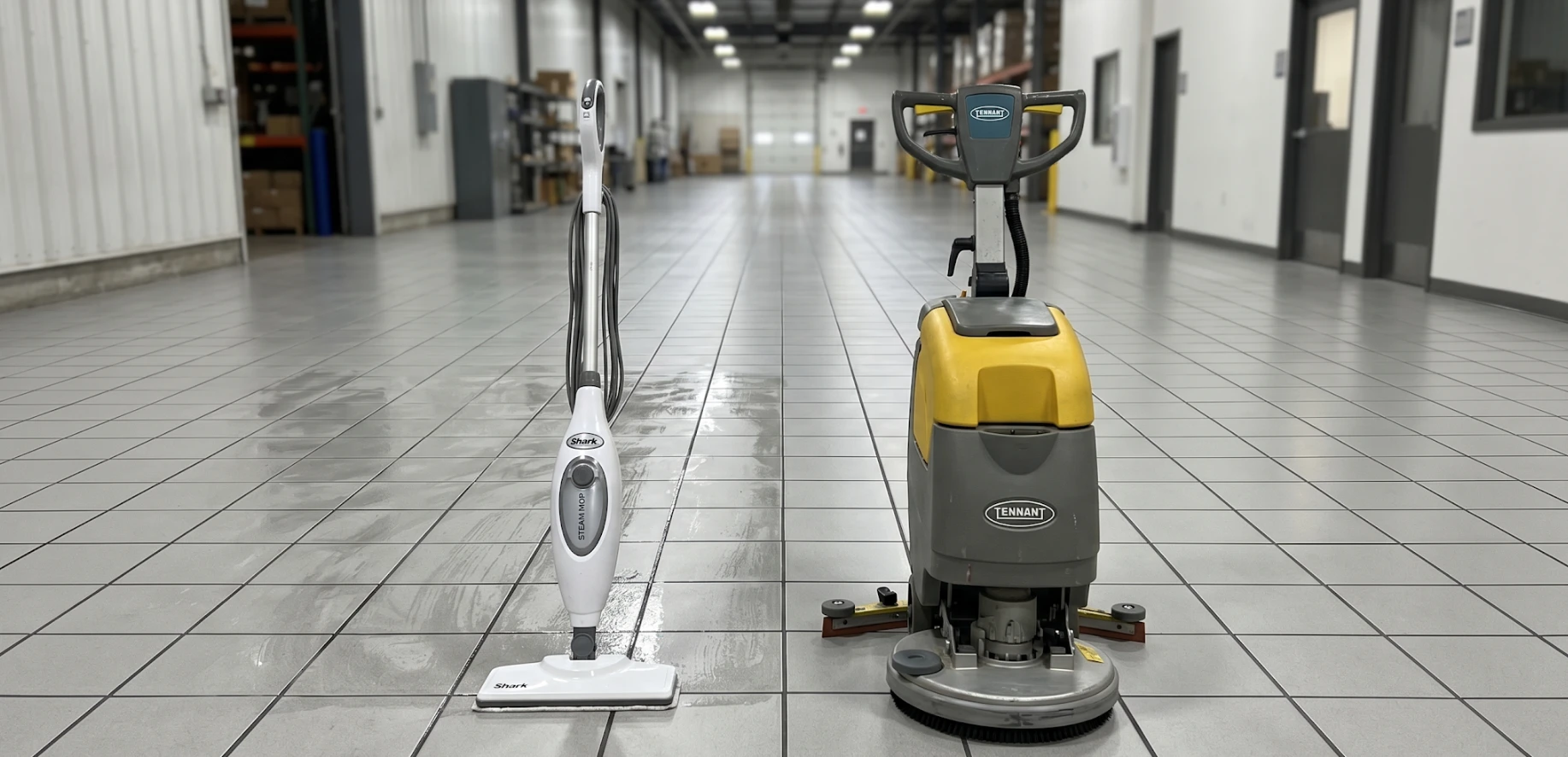
Both tools clean hard floors, but they were designed for completely different purposes, users, and environments. The key differences between a steam mop and a commercial floor scrubber are not subtle. One is a consumer product built for light residential use, and the other is industrial cleaning equipment built to maintain large facilities on a daily schedule. Here is how they compare across the categories that matter most to commercial buyers.
Cleaning Method and Power
A steam mop uses heat and vapor to loosen surface-level soil and sanitize. The cleaning performance depends on how well the microfiber pad captures what the steam dislodges. A floor scrubber uses rotating brushes or pads combined with cleaning solutions to physically scrub embedded grime off the floor surface. On textured flooring, grout, or any surface with sticky stains or heavy buildup, the mechanical scrubbing action of a floor machine reaches places that steam simply cannot.
Sanitization and Chemical Use
Steam mops operate without any chemicals at all, relying entirely on high temperature steam to kill bacteria and germs. This is a genuine advantage for households with pets or young children where avoiding chemical residue on floors matters. Commercial floor scrubbers use cleaning solutions as part of the process and depend on both chemistry and mechanical action rather than heat to sanitize. When matched with an appropriate disinfectant, a scrubber can achieve strong sanitation results, especially in facilities with heavy biological soiling, grease, or other messes that steam alone cannot neutralize.
Floor Type Compatibility
Steam mops are limited to smooth, sealed surfaces and carry real risk on porous, unsealed, or damaged materials. Commercial floor scrubbers handle a significantly wider range of flooring types including concrete, quarry tile, VCT, epoxy-coated surfaces, and textured safety flooring. Brush assemblies can also be swapped out to match the surface, making scrubbers adaptable across facilities with multiple flooring types under one roof.
Drying Time and Downtime
Steam evaporates quickly, and most steam mops leave a floor ready to walk on within one to five minutes. Commercial floor scrubbers vacuum up dirty water almost instantly as part of the cleaning pass, leaving floors touch-dry immediately. For any facility where keeping areas closed during cleaning creates operational downtime, the recovery speed of a scrubber allows you to clean and reopen spaces faster than any wet mopping method.
Coverage Area and Speed
A steam mop is practical for a kitchen, a bathroom, or a small entryway. It was not designed to cover thousands of square feet in a single session. Walk-behind commercial floor scrubbers typically clean at rates measured in thousands of square feet per hour, and ride-on machines operate at significantly higher speeds. If your facility is larger than a small retail space and your staff is currently using a spin mop and bucket or a steam mop to maintain floors, you are spending far more labor hours than necessary.
Floor Scrubber vs Steam Mop: Quick Comparison Table
Use this table as a fast reference before making your decision. The sections below go deeper on specific buyer scenarios.
| Feature | Steam Mop | Commercial Floor Scrubber |
|---|---|---|
| Cleaning Method | High temperature steam through microfiber pad | Rotating brushes or pads plus solution, vacuum recovery |
| Best Use Case | Residential light cleaning | Commercial and industrial facilities |
| Surface Compatibility | Sealed smooth surfaces only | Concrete, VCT, quarry tile, epoxy, textured flooring |
| Sanitization | Chemical-free via steam heat | Disinfectant solution plus mechanical action |
| Chemical Use | None required | Compatible cleaning solutions required |
| Drying Time | 1 to 5 minutes | Nearly dry immediately after pass |
| Coverage Speed | Hundreds of square feet per session | Thousands of square feet per hour |
| Maintenance Level | Low (wash pads, descale tank) | Moderate (rinse tanks, maintain brushes, replace blades) |
Which One Should You Buy?
The right tool depends entirely on your facility type, how frequently you clean, what flooring you are working with, and the cleaning standard you need to maintain. Here is a breakdown by buyer scenario to help you make the right call.
Choose a Steam Mop If...
You are cleaning a residential home with light foot traffic and smooth, sealed floors. Steam mops are a practical choice for households with pets or young children where avoiding harsh chemicals matters and where spot cleaning between deeper cleans is the goal. If you are looking for something lightweight that you can carry up stairs, fill quickly, and use without plugged-in equipment taking up significant floor space, a steam mop fits that use case well. Just understand clearly that this is not a commercial cleaning tool.
Choose a Floor Scrubber If...
You operate any commercial or industrial facility. Warehouses, grocery stores, schools, hospitals, restaurants, office buildings, gyms, and any other space with consistent daily traffic all benefit from a floor scrubber. If your floors see regular soiling, heavy foot traffic, or significant buildup from grease, dust, or debris, a floor scrubber is not optional. It is the standard. If your staff is currently spending significant time mopping by hand and you are not achieving a consistent cleaning result, switching to a floor scrubber will reduce labor hours and raise the quality of your floors immediately.
Can You Use Both?
In some operations, both tools have a place. A facility manager might run a floor scrubber for full daily or weekly floor maintenance across the entire building and use a steam unit for targeted sanitization in specific zones such as food prep areas, restroom surfaces, or around medical equipment. The scrubber handles the floor as a whole while the steamer addresses concentrated sanitation needs. These tools are not competitors in that scenario; they serve different functions as part of a complete floor care program.
Frequently Asked Questions
Can a steam mop replace a floor scrubber in a commercial facility?
No. Steam mops are designed for residential use and cannot match the coverage area, cleaning power, or speed that commercial facilities require. Even the most capable consumer steam mop would take an impractical amount of time to maintain a commercial floor on a daily schedule and would not clean deeply enough to meet commercial hygiene standards.
Do floor scrubbers sanitize as well as steam mops?
Floor scrubbers used with a disinfectant cleaning solution can achieve strong sanitation results. They do not use heat-based sanitization the way a steamer does, but when the right chemistry is paired with thorough mechanical scrubbing and vacuum recovery, the outcome is comparable or better for facilities dealing with heavy biological soiling or grease.
Are floor scrubbers safe for hardwood floors?
Yes, when configured correctly. Hard brush attachments should be replaced with soft pads on hardwood surfaces, and the cleaning solution used must be appropriate for wood flooring. Always check your floor manufacturer's recommendations before using any wet cleaning machine on wood, and keep solution dispensing rates low to limit moisture exposure.
How often should a commercial floor scrubber be used?
It depends on your facility. High-traffic environments like grocery stores, hospitals, and schools may need daily scrubbing. Lower-traffic offices or storage facilities may find that weekly use keeps floors in good condition. The general rule is that consistent use prevents the kind of heavy buildup that becomes significantly harder and more expensive to remove if left too long.
What is the difference between a floor scrubber and a floor buffer?
A floor scrubber cleans the floor by scrubbing with solution and recovering dirty water through vacuum. A floor buffer uses a high-speed rotating pad to polish or burnish the floor surface and restore shine to coatings like wax or finish. They serve different functions and are often used together as part of a complete floor care program where scrubbing handles cleaning and buffing handles appearance maintenance.
The Bottom Line
Steam mops are effective residential tools for light cleaning and chemical-free sanitization on sealed surfaces. They are the right product for a specific context: home use, light soiling, smooth flooring, and situations where avoiding chemicals is a priority. Outside of that context, they do not hold up.
Commercial floor scrubbers are the standard for professional floor maintenance because of their cleaning power, their ability to handle large areas quickly, and their capacity to tackle the heavy soiling that builds up in high-traffic facilities. If you manage a commercial facility and your current floor care program is falling short, a floor scrubber is the investment that changes the result.
Browse PS Janitorial's floor scrubber catalog to find the right machine for your facility size, floor type, and cleaning schedules.