Floor Sweeper vs Floor Scrubber: Do You Need One or Both for Your Facility?
Choosing the wrong floor cleaning machine is not a minor inconvenience. It is a direct hit to your labor budget, your equipment lifespan, and your facility's compliance standing. Deploy a floor sweeper where grease and biological soils are the problem and you will smear contamination across the surface rather than remove it. Send a commercial floor scrubber into a warehouse buried in dry debris and you will clog its brush deck, burn through consumables ahead of schedule, and still finish with an unsatisfactory result. The right floor cleaning equipment comes down to understanding exactly what each machine does, what it does not do, and when the situation calls for both. At PS Janitorial, we work with facility managers every day to match the right machine to the right environment. This article gives you the framework to make that call with confidence.
What Is a Floor Sweeper and How Does It Work?
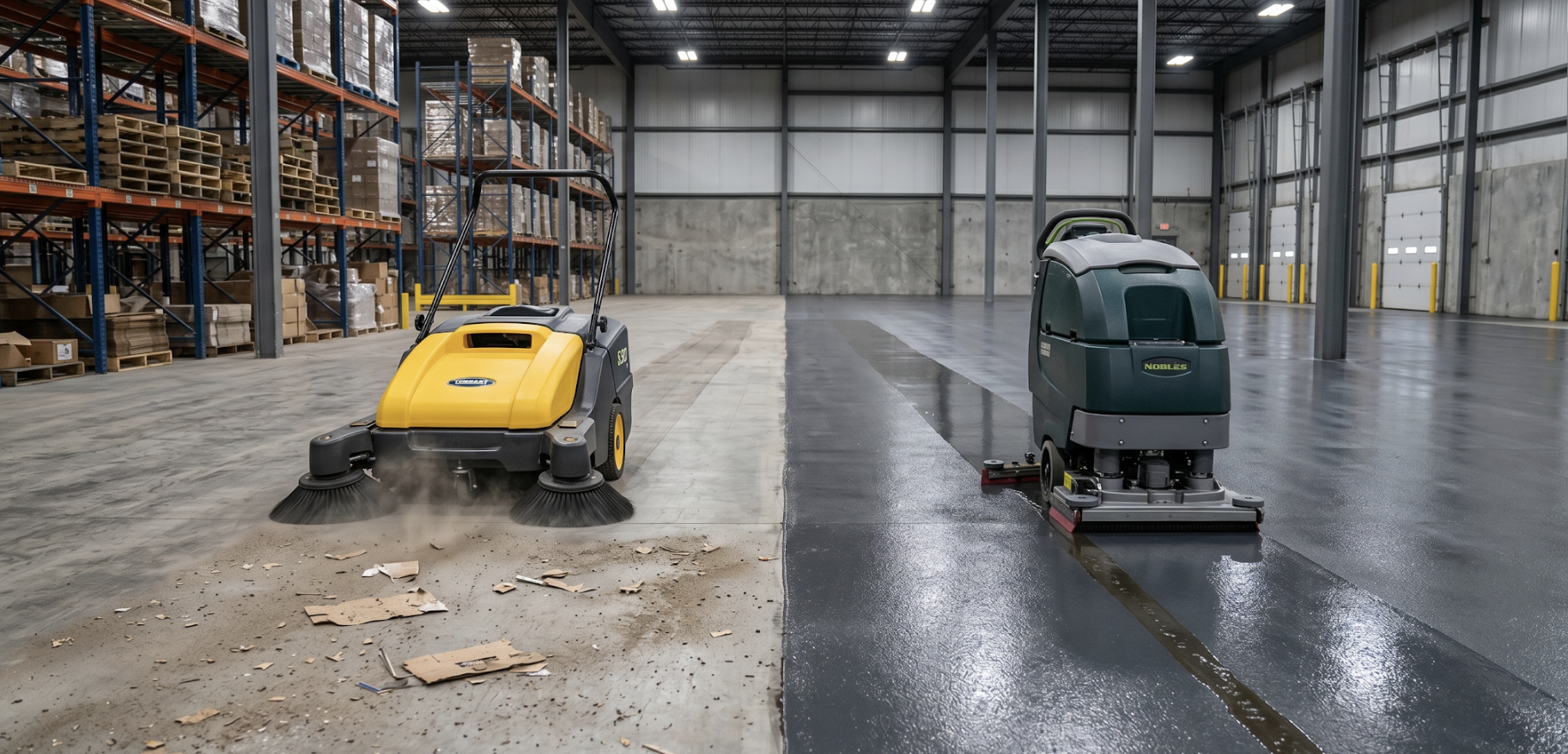
A floor sweeper uses one or more rotating brushes to sweep loose dirt and debris across the floor and channel it into an onboard collection bin or hopper. Most sweepers also incorporate a vacuum system that captures fine dust as it is disturbed, preventing it from becoming airborne and resettling elsewhere on the floor. The entire process is mechanical and dry. No water or cleaning solution is involved at any point.
Sweepers are built for speed and wide coverage. Walk-behind models are operated on foot and offer precision control in tighter environments. Ride-on sweepers allow an operator to cover significantly more ground per hour while seated, making them the preferred configuration for large-scale operations. In either format, the sweeper moves fast and leaves a visibly clear surface behind, provided the soil is the kind it was designed to handle.
What Floor Sweepers Are Best At
Floor sweepers thrive wherever loose, dry debris accumulates at volume. That means loose dirt and sand tracked in from outdoor areas, gravel scattered near dock doors, construction debris like dust and rubble, dry food particles on a production line floor, cardboard scraps in fulfillment areas, and general dust buildup on manufacturing floors. The sweeper collects this material efficiently without smearing it or requiring any drying time afterward.
Coverage area is where sweepers particularly stand out. Large open spaces with minimal obstacles, such as warehouse floors, parking lots, loading docks, and manufacturing halls, are where a sweeper produces its best return on time invested. Semi-outdoor environments and outdoor concrete surfaces are also well-suited to sweeper use, especially when a ride-on model handles the square footage.
Common Industries That Rely on Floor Sweepers
Warehousing and logistics operations use sweepers as their primary daily maintenance tool because incoming and outgoing freight generates a constant stream of dry debris. Construction and building sites use them to manage dust, particulate, and material scraps across large, unfinished surfaces. Manufacturing plants with high debris output from cutting, grinding, or packaging operations lean on sweepers to maintain clear aisles and floors between production shifts.
Parking garages require regular sweeping to remove grit, sand, and litter from the driving and walking surfaces. Agricultural facilities use sweepers in areas where grain dust, feed debris, and organic material accumulates quickly. Municipalities deploy ride-on sweepers on streets, plazas, and outdoor public surfaces where manual labor would be impractical at scale.
What Is a Floor Scrubber and How Does It Work?
A floor scrubber operates on a fundamentally different principle than a sweeper. It jets water or cleaning solution onto the floor surface in front of the brush deck, uses rotating scrub heads (available in disc, cylindrical, or orbital configurations depending on the application) to agitate and lift soil from the surface, and then recovers the dirty water through a rear squeegee system into an onboard recovery tank. The result is a floor that is clean and nearly dry in a single pass, which is one of the defining advantages of a commercial floor scrubber over traditional wet mopping.
Like sweepers, scrubbers come in walk-behind and ride-on configurations. Walk-behind scrubbers give operators close control over smaller areas or zones with obstacles. Ride-on scrubbers scale up the cleaning capability significantly, with larger solution and recovery tanks, wider scrub paths, and the ability to maintain productivity across tens of thousands of square feet per shift.
What Floor Scrubbers Are Best At
The floor scrubber works where surface contamination has bonded to the floor and mechanical agitation with cleaning chemistry is required to lift it. Spills, grease, scuff marks, ingrained grime, and biological soils all require a scrubber to achieve a genuinely clean result. In facilities where sanitation standards are a compliance requirement or a safety concern, the scrubber is not optional.
Floor surface type matters here. Sealed concrete, tile, vinyl, epoxy-coated floors, and other hard floor surfaces respond well to scrubbing action, provided the right brush or pad is selected. Cylindrical brushes work well on rough or textured surfaces. Disc systems with the appropriate pad are better suited for smoother, more uniform hard floors. Matching the pad to the surface protects the floor coating and produces better cleaning results.
Common Industries That Rely on Floor Scrubbers
Healthcare facilities require a floor scrubber to meet hygiene standards that a sweeper cannot address. Pathogen control, spill response, and general sanitation on smooth hard floors all call for wet chemical cleaning. Food and beverage processing operations face grease, moisture, and organic residue that require regular scrubbing, often multiple times per shift. Grocery and retail environments use walk-behind scrubbers to maintain hard floor surfaces in food departments and high-traffic aisles throughout operating hours.
Schools and universities rely on floor scrubbers to maintain gymnasium floors, hallways, and cafeteria surfaces where foot traffic and food debris create grime that accumulates daily. Hospitality operations, including hotels and conference centers, use scrubbers to maintain lobbies, corridors, and kitchen service areas to the appearance standard their guests expect. Pharmaceutical and laboratory environments require a deep clean to strict hygiene protocols where a sweeper has no role.
Floor Sweeper vs Floor Scrubber: Key Differences Side by Side
Understanding the distinction between these two machines on paper is useful, but a direct side-by-side comparison makes it easier to map each one to your own situation. Here is how they stack up across the factors that matter most for facility decision-making.
Cleaning Method
A floor sweeper collects dry material through mechanical brush action and captures airborne particles with a vacuum system. Nothing wet touches the floor. A commercial floor scrubber applies water or cleaning solution to the surface, scrubs with rotating brushes or pads, and recovers the resulting dirty water into an onboard tank. The cleaning method determines which machine gets the job done for a given soil type. If the surface needs chemistry and agitation to become clean, the sweeper will not reach that standard regardless of how many passes it makes.
Type of Soil and Debris
Sweepers handle bulky debris, loose particulate, and dry accumulation. The collection bin fills up with material that was sitting on top of the floor. A scrubber addresses wet, greasy, sticky, or fine soils that have bonded to the surface itself. A sweeper deployed on a greasy or wet floor will push that contamination around rather than collect it, leaving a streaked and still-contaminated surface behind.
Floor Surfaces
Both machine types work on hard floors, but the conditions on that surface matter. Sweepers perform well on dry hard surfaces but are not appropriate for floors that are wet or chemically contaminated. Scrubbers are highly adaptable across sealed concrete, tile, vinyl, epoxy, and similar hard floor surfaces. The key variable on a scrubber is whether the brush type and squeegee material are correctly matched to the floor. Natural rubber squeegees perform better on rough surfaces, while gum rubber is more effective on smooth, uniform floors.
Speed and Coverage Area
When covering large areas, a sweeper operates faster than a scrubber. The dry collection process has fewer mechanical variables and no tank management requirements during operation. For facilities where the primary concern is dry debris accumulation across large spaces, a sweeper completes the job in less time. For facilities where sanitation is the goal, a scrubber is the only tool that achieves the required result, and the time investment is simply part of meeting that standard.
Labor and Maintenance Requirements
Sweeper maintenance is straightforward. Empty the collection bin, inspect and clear the rotating brushes, and the machine is ready for the next run. A scrubber adds complexity: fill the solution tank before each use, dump and rinse the recovery tank after each use, and maintain the brushes, squeegee blades, and pads on a regular schedule. Both machine types deliver meaningful labor savings compared to manual sweeping or manual mopping at any significant scale. For a deeper look at keeping your equipment running at its best, review these floor scrubber maintenance tips.
Cost Considerations
Walk-behind sweepers represent the most accessible entry point in terms of purchase price. Ride-on configurations cost more but deliver a return through labor savings that justifies the investment in larger facilities. Floor scrubbers sit at a similar or slightly higher price range depending on configuration and brush deck type. The more productive framework for evaluating cost is total cost of ownership, including consumables, maintenance labor, and how well the machine is matched to its actual use case. A machine deployed outside its designed purpose wears faster and cleans less effectively, which inflates the real cost regardless of the sticker price.
Walk-Behind vs Ride-On: Choosing the Right Configuration
Selecting the right machine type (sweeper or scrubber) is only the first decision. Choosing between a walk-behind model and a ride-on model is equally consequential for the efficiency and cost-effectiveness of your cleaning program. Both floor sweepers and floor scrubbers are available in each configuration, and the right choice depends on your facility's physical layout and the scale of the work. For a full breakdown of how these two configurations compare specifically for scrubbers, see our guide on walk-behind vs ride-on floor scrubbers.
When to Choose Walk-Behind
Walk-behind machines are the right choice for smaller facilities, areas with tight spaces, narrow aisles, and any zone with frequent obstacles or irregular layouts. They are more maneuverable, easier to store in compact facilities, and give the operator precise control over where and how the machine moves. They are also more affordable up front, which makes them appropriate for facilities where the cleaning area does not justify the investment in a ride-on unit. The trade-off is operator effort. Walk-behind units require sustained physical engagement over large areas, and for cleaning tasks that exceed a comfortable walking distance per shift, fatigue becomes a productivity variable.
When to Choose Ride-On
Ride-on units are built for large open spaces where the cleaning distance per shift exceeds what a walk-behind model can cover efficiently. Warehouses, distribution centers, big-box retail floor areas, and large manufacturing halls are the environments where a ride-on machine earns its higher cost. These units carry larger solution and recovery tanks, reducing the frequency of fill and dump cycles. Operator fatigue is largely eliminated. At scale, the labor savings of a ride-on machine compared to a walk-behind or manual alternative are substantial and measurable in hours per week.
Do You Need Both a Sweeper and a Scrubber?
This is the central question, and it deserves a direct answer rather than a conditional one. Some facilities genuinely need both machines. Others can meet their cleaning needs with a single well-chosen unit. The answer depends on what your floor actually accumulates and what outcome you are required to achieve.
If your facility produces heavy dry debris AND has contamination, grease, or sanitation requirements, running both machines in sequence is the correct approach. Sweep first to remove the bulk debris, then scrub to sanitize. This two-step workflow also protects each machine. Running a floor scrubber over a floor loaded with bulky debris clogs the brush deck, fills the recovery tank with suspended solids before the job is done, and produces incomplete results. Sweeping first gives the scrubber a clean substrate to work against, which extends the life of brushes, pads, and squeegees and delivers better cleaning results per pass.
Facilities That Benefit from Running Both
Food and beverage manufacturing plants are the clearest example. Dry ingredient dust, packaging debris, and organic residue from processing all coexist on the same floor. A sweeper handles the dry accumulation; the scrubber handles the grease, moisture, and biological soils. Large manufacturing operations with both cutting debris and fluid contamination follow the same logic. Schools with high-traffic hallways, cafeteria spaces, and gymnasium floors often run both machines because different zones have different soil profiles. Mixed-use facilities that serve both warehouse and food preparation functions need both tools to cover the full range of cleaning demands.
The Case for a Combination Sweeper-Scrubber
If your facility has moderate dry debris and moderate grime rather than extreme levels of either, a combination machine may be the most practical option. These units sweep and scrub in a single pass, reducing the total time spent on floor cleaning and eliminating the need to operate two separate machines. The footprint is smaller than owning two dedicated units, and the operational simplicity of running one machine rather than two has real value in environments where staff manage multiple tasks.
The trade-off is upfront cost. Combination units cost more than either a standalone sweeper or a standalone scrubber. That cost is offset by the labor savings from consolidating two cleaning passes into one, and by not having to maintain two separate machines. For facilities with versatile but not extreme cleaning demands, a combination machine is a cost-effective middle ground.
How to Choose the Right Machine for Your Facility
Now that you understand what each machine type does and where it excels, here is a practical framework for matching the right floor cleaning machine to your specific facility.
Assess Your Soil Type and Volume
Start with the floor itself. What type of material accumulates on it, and how fast does it build up? If your primary issue is loose, dry debris that collects throughout the day, a sweeper belongs in your program. If your floors show grease, staining, spills, or any contamination that does not broom or vacuum away, a scrubber is required. If both soil types are present in meaningful quantities, a combination approach is the right call from the start.
Measure Your Square Footage and Layout
Facility size and physical layout determine the configuration, not just the machine type. Measure your total cleanable floor area and map out the physical constraints: aisle widths, presence of ramps, doorway clearances, dead-end zones, and where your dump station is located. Narrow aisles and frequent obstacles point toward a walk-behind or ride-on machine with a compact turning radius. Open, unobstructed spaces point toward wider cleaning paths and ride-on configurations for efficiency.
Consider Your Floor Surface Type
Rough concrete, sealed concrete, epoxy coatings, tile, and vinyl each respond differently to cleaning equipment. Rough or textured surfaces require cylindrical brushes or coarser pads to reach into the surface profile. Smooth sealed surfaces do better with disc systems and softer pads that will not abrade the finish. Squeegee selection on a scrubber matters too. Match the squeegee blade material to your surface texture to ensure complete water recovery and floors safe from residual moisture.
Factor in Labor Costs and Cleaning Frequency
Build a simple estimate of how many labor hours per week currently go toward floor cleaning and what that labor costs at a fully loaded hourly rate. Mechanized equipment almost always recovers its cost through labor savings faster than most buyers expect. The higher the current labor investment, the faster the payback period on the right equipment. Use this calculation to support the internal business case for the investment.
Account for Maintenance and Total Cost of Ownership
Beyond the purchase price, budget for the consumables your machine will use: brushes, pads, squeegee blades, filters, batteries or battery service, and cleaning solution. Assign maintenance responsibility clearly so that scheduled tasks get done, minor issues get caught before they become repairs, and the machine stays in peak operating condition. A well-maintained machine at a higher purchase price nearly always costs less over five years than a neglected lower-cost unit.
Quick Reference: Which Machine Is Right for Your Situation?
Use this scenario map to identify the best starting point for your facility. A warehouse with heavy forklift traffic and constant cardboard and packaging debris needs a ride-on sweeper or a combination machine with adequate debris capacity. A hospital corridor with smooth vinyl flooring and daily foot traffic needs a walk-behind scrubber running an appropriate pad for that surface type. A food processing plant with both dry ingredient dust and wet floor conditions from wash-down procedures needs either a combination machine or both a sweeper and a scrubber used in sequence. A parking structure with outdoor debris, grit, and litter across a large paved area needs a ride-on sweeper. A school with long hallways and a gymnasium needs walk-behind scrubbers in areas that see food traffic and spill exposure, supplemented by sweeping in high-debris zones.
Shop Floor Sweepers and Floor Scrubbers at PS Janitorial
PS Janitorial carries a full range of floor sweepers, commercial floor scrubbers, and combination machines suited to facilities of every size and cleaning profile. Whether you are equipping a single-shift warehouse operation, a food-service environment with sanitation requirements, or a large-scale mixed-use facility, the right floor cleaning equipment is available with the configuration and specifications to match your space and your soil type.
Our team can help you identify the best machine for the job. Browse our full selection of floor cleaning machines, or contact us directly to get a recommendation matched to your specific situation.