How Much Can a Forklift Lift? Why the Capacity Plate Number Is Not the Whole Story
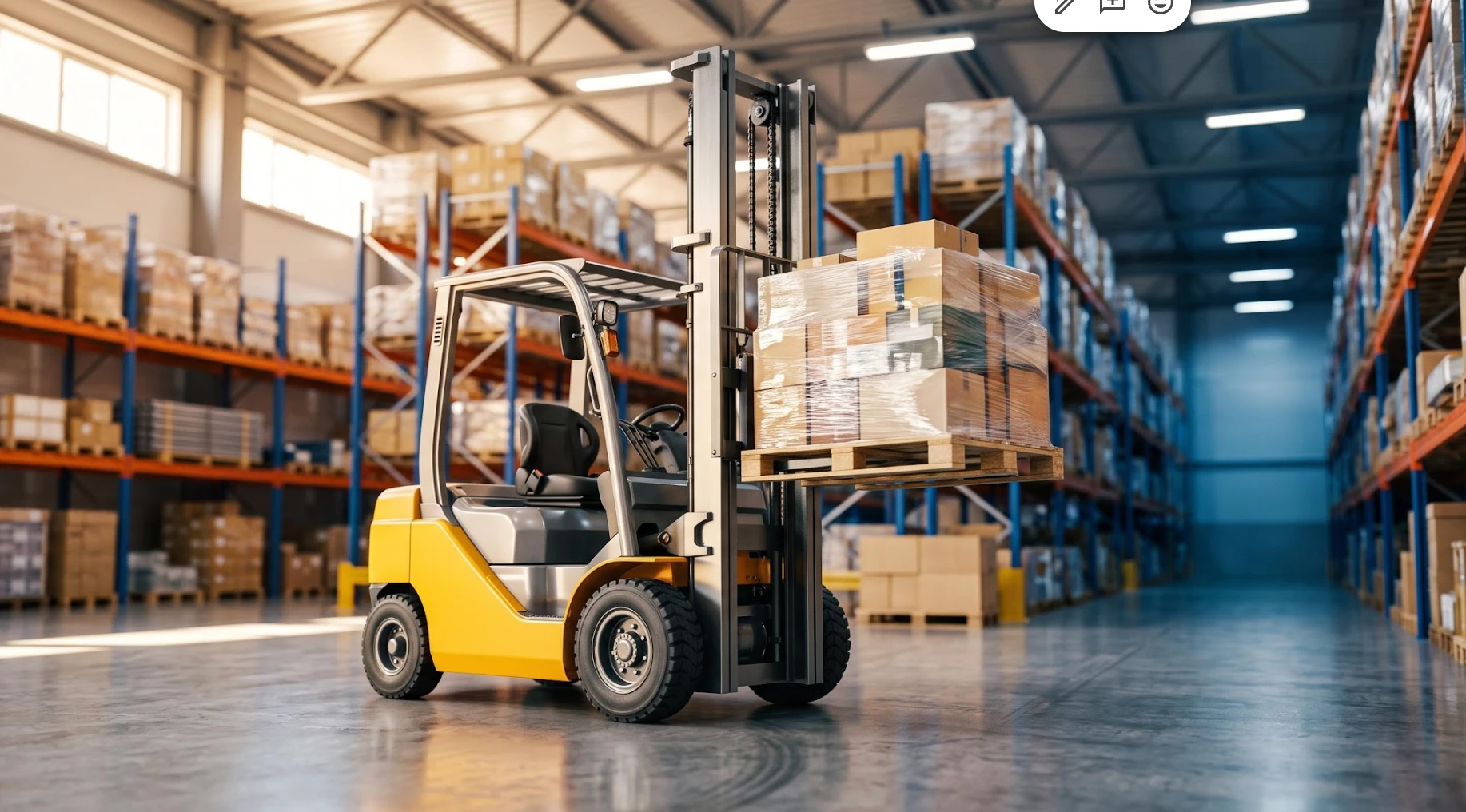
How much can a forklift lift? Most warehouse forklifts lift roughly 3,000 to 17,500 lbs, and heavy duty models go far higher, with the largest common units rated up to 125,000 lbs. That is the number you will see on spec sheets and in equipment listings.
The number on the capacity plate is a ceiling under ideal conditions, not a promise. Raise the forks, add an attachment, carry a long load, or run worn tires, and the weight your truck can safely handle drops. This guide from PS Janitorial covers typical forklift capacity by type, the gap between rated and actual capacity, how load center and balance work, how to read your data plate, and how to size the right forklift for your operation. If you are shopping as you read, you can browse our forklifts at any point.
How Much Can a Forklift Lift? The Short Answer
Typical warehouse forklifts lift between 3,000 and 17,500 pounds, and the average standard industrial forklift sits in the 3,000 to 5,000 pound range. Heavy duty forklifts handle 10,000 to over 100,000 pounds, and the largest forklift capacity on record is 198,000 lbs, verified by Guinness World Records.
| Forklift Category | Typical Rated Capacity |
|---|---|
| Warehouse forklift | 3,000 to 17,500 lbs |
| Heavy duty forklift | 10,000 to over 100,000 lbs |
| Rough terrain forklift | Roughly 5,000 to 12,000 lbs for most models |
| Largest ever recorded | 198,000 lbs |
Those are headline ratings, and the weight a forklift can safely lift on your floor is often lower.
Typical Forklift Capacities by Type
Forklift capacity depends on the type of truck, its power source, and its tires. A compact electric truck built for tight aisles is engineered for a very different job than a diesel truck built for a lumber yard.
| Forklift Type | Rated Capacity Range |
|---|---|
| Electric 3 wheel | Roughly 2,000 to 4,500 lbs |
| Electric 4 wheel | Roughly 3,000 to 12,000 lbs |
| Stand up rider | Roughly 3,000 to 6,000 lbs |
| Reach truck | Roughly 2,500 to 4,500 lbs |
| Order picker | Roughly 2,500 to 3,000 lbs |
| Internal combustion counterbalance | 3,000 to 17,500 lbs |
| Rough terrain | Roughly 5,000 to 12,000 lbs |
Warehouse Forklifts (Electric and Internal Combustion)
Most indoor forklifts land between 3,000 and 5,000 pounds, which covers standard pallet work in a warehouse. Counterbalance trucks lift more than trucks without a counterweight because the mass at the rear of the truck offsets the load on the forks. Trucks like reach trucks and order pickers skip the big counterweight to save space in narrow aisles, so their capacity is lower for their size.
Heavy Duty and High Capacity Forklifts
Capacity climbs past 20,000 lbs in the heavy duty class, and the largest common internal combustion pneumatic models are rated up to 125,000 lbs. High capacity forklifts can lift over 70,000 pounds, and the heaviest machines are built for the toughest jobs.
- Industries that need them: steel, lumber, ports, construction, automotive, and marine.
Rough Terrain Forklifts and Telehandlers
Rough terrain forklifts use large pneumatic tires and are built for construction sites, lumber yards, and shipping yards where the ground is uneven. Telehandlers add a telescopic boom, which gives you reach and height that a vertical mast cannot match. The tradeoff is that capacity drops as the boom extends, because the load moves farther from the front axle.
Rated Capacity vs Actual Capacity
This is the core idea of the page. Every forklift has two numbers, a rated capacity and an actual capacity, and only one of them matters on the floor.
What Rated Capacity Really Means
Rated load capacity is the maximum theoretical weight a forklift can lift under standard conditions. Those conditions are a 24 inch load center, no attachments, and a specific lift height. Change any of them and the rating no longer applies as written.
Why Actual Capacity Is Often Lower
Take a 3,000 lb truck. Install a sideshifter, and its capacity can be derated to 2,700 lbs. The sideshifter makes the carriage thicker, which pushes the load farther from the fork face and shifts the load center forward. The truck did not get weaker. The same weight now sits farther out, and the forklift's actual load capacity falls to keep the truck stable.
How a Forklift Stays Balanced
A little physics makes every derating factor in this article easier to understand, so this part stays short.
The Seesaw: Counterweight, Fulcrum, and Load
Think of a forklift as a seesaw. The rear counterweight sits on one side, the load on the forks sits on the other, and the front axle is the pivot point. As long as the weight on the rear side wins, the truck stays planted.
The Stability Triangle and Why Height Matters
The truck and load share a combined center of gravity. As you raise a load, that center of gravity shifts forward and up, leaving less room before the truck tips. This is why forklift capacity decreases as lifting height increases, and why a load that is safe at ground level can be unsafe at the top of the mast.
What Is Load Center and Why It Changes Capacity
Load center is the horizontal distance from the vertical face of the forks to the load's center of gravity. It is the single most important number after weight itself.
The standard is 24 inches because a typical pallet is 48 inches long, and a uniform load on it centers 24 inches from the fork face. Standard ratings assume that distance. A longer load pushes the center of gravity farther out, so the load center grows and capacity shrinks.
The reason is load moment, which is weight multiplied by its distance from the front axle. The same weight placed farther out creates a larger load moment, and the truck can only resist so much. Load moment increases as load center distance increases, so capacity has to come down to compensate.
7 Factors That Reduce a Forklift's Real Lifting Capacity
Any one of these can pull usable capacity below the plate rating, and several often stack up on the same lift.
1. Lift Height
Higher lift means less capacity. If you work with racking, check the capacity at the height of your top beam, not the rating at the bottom of the mast.
2. Attachments
Attachments add weight and push the load center forward, which cuts the forklift's net capacity. Sideshifters, clamps, and fork positioners all do this to some degree.
3. Load Length
Long loads increase the load center beyond the 24 inch rating. Lumber, pipe, and oversized crates all fall into this category.
4. Load Distribution
Uneven or off center loads shift the center of gravity, and weight distribution within the load directly affects stability. Place the heaviest part closest to the fork face and keep the load centered between the forks.
5. Tire Type and Size
Cushion tires sit low and suit smooth indoor floors, while pneumatic tires handle rough ground. Dual tires and wider treads widen the stance of the truck and can improve stability. Tire size is listed on the data plate because it is part of the capacity calculation, so swapping tires without checking the plate can put the truck outside its rating.
6. Battery Weight (Electric Forklifts)
On an electric truck, the battery is part of the counterweight. A battery lighter than the plate requires can reduce capacity and create a safety risk, so always match the battery to the minimum weight listed.
7. Worn Forks and Tires
Fork heel wear reduces capacity, and a commonly cited rule of thumb is that a 10 percent loss in blade thickness can cut fork capacity by about 20 percent. Worn tires hurt stability. Inspect both regularly and replace them at their wear limits.
How to Read a Forklift Capacity Plate
The plate, also called the data plate or nameplate, is the final word on what your truck can handle. If a spec sheet, a salesperson, and the plate disagree, the plate wins.
- What the plate lists: model and serial number, fuel type, installed attachments, tire size, battery weight requirements, and lifting capacities.
Where to Find the Plate
The plate is usually mounted in the operator's compartment, where it can be seen from the seat. OSHA requires that nameplates and markings stay in place and legible, and that they be updated when a modification changes capacity.
Reading Load Center, Lift Height, and Capacity Columns
Most plates pair a diagram with a table. Letters on the diagram mark the measurements, such as load center and lift height, and the matching table columns give the capacity for each. Read across to find the combination that matches your lift. As load center and lift height increase, the listed capacity goes down.
Here is a generic example for illustration only. Your plate will carry its own numbers.
| Condition | Load Center | Capacity |
|---|---|---|
| Standard rating, no attachment | 24 inches | 3,000 lbs |
| Same truck, longer load | 30 inches | About 2,400 lbs |
| Same truck with sideshifter installed | 24 inches | 2,700 lbs |
How to Calculate Your Forklift's Actual Capacity
When your load center is longer than the rating, you can estimate the new capacity in the field. Divide the rated load center by the actual load center, then multiply by the rated capacity.
- Start with a 5,000 lb truck rated at a 24 inch load center.
- Measure your actual load center. In this example it is 28 inches.
- Divide 24 by 28 to get about 0.857.
- Multiply 0.857 by 5,000 lbs. The result is about 4,285 lbs.
This formula is an estimate. The data plate and manufacturer guidance always govern, and if you are anywhere near the limit, get the derated figure from the manufacturer or your dealer.
What Happens When You Exceed Forklift Capacity
Overloading is the fastest way to turn a routine lift into an incident, and the damage is not limited to the load.
Tip Overs
When the combined center of gravity leaves the stability zone, the truck tips. Tip overs are a leading cause of forklift injuries and fatalities.
Loss of Steering
On an overloaded counterbalance truck, the rear steer tires can lose contact with the ground. Without traction at the rear, you lose steering control.
OSHA Citations and Fines
Overloading and poor material handling practices can lead to citations. As of 2026, the maximum OSHA penalty is $16,550 per serious violation and $165,514 per willful or repeated violation. OSHA fines are assessed per violation, so several citations from one inspection can add up fast.
OSHA Rules and Safe Loading Practices
OSHA's powered industrial truck standard comes down to a few plain requirements. Handle only loads within the rated capacity. Keep the nameplate in place and legible. Handle only stable or safely arranged loads, and use caution with off center loads that cannot be centered. Adjust for long or high loads that may affect capacity, and operate trucks with attachments as partially loaded trucks when they are not carrying a load.
- Place the heaviest part of the load against the carriage.
- Tilt the mast back while traveling.
- Keep the load low to the ground.
- Never travel with the load elevated.
- Stop if the rear wheels lift.
How to Choose the Right Forklift Capacity for Your Operation
Capacity is only one part of sizing. The goal is to match the machine to the load, the space, and the surface, so you end up with the right forklift capacity for the work you actually do.
Start With Your Heaviest Load, Not Your Average
Size for the worst case and leave headroom. A truck that only just handles your heaviest pallet will be over capacity the first time that pallet is a little longer or a little higher than usual.
Factor In Lift Height, Attachments, and Load Shape
Each of these reduces usable capacity, so check the derated number at your real conditions, not the headline number.
Check Dimensions, Aisle Width, and Turning Radius
Compare forklift dimensions against your standard aisle widths, doorways, and ceiling height. A forklift that lifts the load but will not fit the aisle or the dock door is the wrong forklift, and operator comfort matters too when the truck runs a full shift.
Indoor vs Outdoor Use
Cushion tire electric and internal combustion trucks suit smooth indoor floors. Pneumatic tire trucks are the better fit for rough outdoor ground.
Buying a New or Used Forklift: Capacity Checks Before You Commit
Before you buy, confirm the data plate is legible and matches the installed attachments, battery, and tires. A plate that does not match the truck in front of you is a red flag.
Ask for the derated capacity at your real load center and lift height, not just the headline rating. That one question tells you whether the truck fits your work.
If you want help narrowing down a truck, contact our team with your load weight, lift height, and load center, and we will point you to the right capacity.
Frequently Asked Questions About Forklift Capacity
How much weight can a forklift lift?
Most forklifts lift between 3,000 and 17,500 pounds. Heavy duty models handle 10,000 to over 100,000 pounds.
How do I find my forklift's weight capacity?
Check the data plate on the truck. It lists the rated capacity along with the load center, lift height, and attachment details that apply.
Why can my forklift lift less than the number on the plate?
The headline number assumes ideal conditions. Attachments, lift height, load center, load shape, and wear can each reduce what the truck can safely lift.
Does lifting higher reduce forklift capacity?
Yes. As the load goes up, the combined center of gravity moves forward and up, leaving less margin before the truck tips, so the allowed weight drops.
How much can a 5,000 lb forklift actually lift?
It depends on load center and lift height. At a 24 inch load center it can lift 5,000 lbs, but at a 28 inch load center the formula above gives about 4,285 lbs.
What is the largest forklift capacity ever recorded?
Guinness World Records lists three counterbalance trucks built in 1991 that can lift loads up to 90 tonnes, or 198,000 lbs, at a load center of 2.4 meters. They use TV cameras and a remote control device to help the driver, and they were built to handle pipeline construction.