How to Clean Floors in a Facility That Uses Heavy Oils and Lubricants
Why Oil and Lubricant Buildup Is a Serious Facility Problem
If your facility uses heavy machinery, hydraulic systems, or any kind of lubricated equipment, oil and grease on your floors is not just a housekeeping issue. It is an operational liability. The Occupational Safety and Health Administration (OSHA) holds employers accountable for slip and fall hazards, and oily residue on industrial floors is one of the most frequently cited causes of preventable workplace injuries. One unchecked spill zone can expose your operation to regulatory fines, workers' compensation claims, and the kind of incident documentation that follows a facility for years.
Beyond the immediate safety risk, oil saturation degrades floor surfaces over time. Concrete is porous, and when oil seeps into it repeatedly without proper cleaning, it weakens the slab structure, accelerates cracking, and makes future cleaning progressively harder. Once oil bonds into porous or damaged concrete, routine cleaning agents will not pull it out. You are looking at resurfacing or coating replacement, both of which cost significantly more than consistent maintenance.
There is also the contamination spread problem. Forklifts and other equipment move through your facility all day. Their tires pick up oil from one area and deposit it across every surface they travel. What started as a localized spill near a machine becomes a hazard distributed across the entire plant floor before your next cleaning window.
The cost math is straightforward. Proactive cleaning on a regular basis is always cheaper than accident remediation, floor resurfacing, or an OSHA citation.
Where Oil and Grease Tend to Accumulate in a Facility
Knowing where contamination originates lets you build a cleaning program that addresses problems before they spread. Most facilities have predictable hotspots, and ignoring any one of them undermines the effectiveness of everything else you do.
Around Machinery and Equipment
Hydraulic systems, lubricated bearings, gear housings, and mechanical components drip during normal operation. These are not malfunction events. They are the natural byproduct of machines doing their job. Even minor drips accumulate across a full shift, and because these areas are often close to the machine base or tucked under equipment frames, the buildup goes unnoticed until the floor around the machinery becomes genuinely dangerous. These zones need daily attention, not weekly.
Loading Docks and Vehicle Traffic Zones
Loading docks are some of the most contaminated areas in any facility, and they are often the least scrutinized. Vehicles idle and park in these zones, leaking fluids onto the concrete while they sit. Equipment tires then track that contamination into the broader facility. By the time oil from the dock shows up in the middle of your production floor, the source of the problem is rarely obvious. Treat loading areas as primary contamination zones regardless of how clean they appear on a given day.
Maintenance Bays and Toolrooms
Anywhere equipment is serviced, lubricated, or repaired will see a much higher concentration of deliberate lubricant use than the rest of your facility. These spaces require their own cleaning protocols. Using the same approach you apply to general floor maintenance in a maintenance bay is not sufficient. The volume and variety of lubricants used in these areas, combined with the frequency of use, means contamination accumulates faster and with greater variety than anywhere else on your floor plan.
Drains and Low-Drainage Areas
Cracked flooring and areas where drainage is poor trap oil rather than allowing it to be removed effectively during routine cleaning. Over time, oil seeps into grout lines and cracks and bonds to the substrate in a way that surface cleaning cannot address. Addressing drainage infrastructure, including clearing blocked floor drains and repairing cracked concrete, is part of a complete floor care strategy, not a separate facilities project. If liquid cannot drain, it stays on the surface and gets spread by foot traffic and equipment. For a deeper look at how to approach different concrete surface types, our guide on how to clean concrete floors indoors covers sealed, polished, and unsealed variants in detail.
Understanding the Types of Oils and Lubricants You Are Dealing With
Not every lubricant behaves the same way on a concrete or tile surface. Hydraulic fluid is thinner and spreads quickly, making it more likely to travel into cracks and adjacent areas before anyone notices it. Machine oil and gear lubricant are heavier and tend to stay where they land, but they penetrate porous surfaces more aggressively over time. Cutting fluid, used in machining operations, is often mixed with water and creates a slick residue that is harder to spot on a wet floor. Heavy grease is the most viscous and does not spread far on its own, but it is also the hardest to break down with standard cleaning chemicals.
The type of contamination you are dealing with directly determines which products and methods will work and which will fail. A degreaser formulated for light kitchen grease will not cut through industrial gear lubricant. Understanding what your machines use, and what ends up on your floors as a result, is the starting point for choosing the right cleaning agents.
What You Need Before You Start Cleaning
Rushing into a cleanup without the right equipment and safety measures in place creates new hazards. Every cleaning session should start with a checklist review before anyone touches the floor.
Personal Protective Equipment
Workers handling industrial degreasers and oily surfaces need chemical-resistant gloves before they begin, not latex or standard rubber gloves but gloves rated for petroleum-based chemicals. Footwear matters as much as gloves. Non-slip boots or shoes rated for wet and oily surfaces are required. Eye protection is necessary any time degreaser is being applied, particularly in spray form. In enclosed spaces like maintenance bays or toolrooms, respiratory protection may also be needed since degreaser fumes can build up quickly without adequate ventilation.
Wet Floor Signage and Area Isolation
No cleaning should start until the work zone is blocked off. Use cones, caution tape, and wet floor placards to keep workers and equipment out of the area during and after cleaning. This is not a formality. Employees moving through a facility do not expect a wet floor in the middle of operations and often do not notice signage unless it physically redirects their path. Keep the area cordoned off until the floor is completely dry, which in a low-ventilation space can take significantly longer than it appears.
Spill Absorbents and Dry Cleanup Materials
Applying liquid cleaner directly to a heavy oil spill without removing the bulk of the contamination first is ineffective. The liquid degreaser dilutes in the oil rather than acting on it, and you end up pushing contaminated mop water around rather than removing the problem. Granular sorbent, absorbent floor sweep, and absorbent pads are designed to lift the majority of the oil mechanically before any wet cleaning begins. Do not skip this step.
Industrial Degreaser
Standard household cleaners and light commercial products are not formulated to break down heavy industrial oils. When selecting a commercial degreaser, look for products specifically rated for petroleum-based lubricants. PS Janitorial carries a Super Strength Degreaser Concentrate formulated for exactly these conditions, including automotive shops dealing with oil, grease, and brake dust. It is designed to go directly into the solution tank of an auto scrubber, making it a natural fit for the machine-based workflow described below. Equally important is using the correct dilution ratio for your floor type. On raw unsealed concrete, you can typically use a stronger concentration because the surface is not at risk from the product. On sealed or painted concrete, a more moderate dilution protects the coating. On waxed surfaces, use the mildest concentration recommended and verify compatibility with the floor finish before applying broadly.
Cleaning Equipment
Your equipment options scale with the size and severity of the problem. A stiff-bristle scrub brush is appropriate for isolated spots and tight spaces where a machine cannot reach. Walk-behind floor scrubbers are the right choice for medium to large areas, combining chemical dispensing, brush agitation, and dirty water recovery in a single pass. For high-square-footage facilities with frequent oil contamination across large zones, a ride-on scrubber reduces labor significantly and ensures consistent results across the full factory floor.
Step-by-Step: How to Clean Oil and Grease Off Facility Floors
This is the procedural core of the process. Each step is presented in order so facility staff can follow through from initial spill response to final drying. Skipping or rushing any step is the most common reason a floor remains slick or re-contaminates quickly after cleaning.
Step 1: Contain the Spill or Problem Area
The first action after identifying a spill is isolation. Block off the affected zone immediately. Do not attempt to hose down the area or mop without absorbent pre-treatment first. Spreading the oil thinner across the floor makes the contaminated surface area larger and significantly increases the time and materials required to clean it. Respond quickly and contain before you clean.
Step 2: Apply Absorbent Material
Spread granular absorbent or lay absorbent pads over the entire contaminated area. Allow adequate dwell time, typically five to fifteen minutes depending on the volume and viscosity of the oil, for the material to soak up as much contamination as possible. Once saturated, sweep up the absorbent material and dispose of it properly before moving to any liquid cleaning step. Do not mix the collected absorbent back into the general waste stream without confirming disposal requirements.
Step 3: Apply Industrial Degreaser
Apply the degreaser at the correct dilution for your floor type. Do not rush the dwell time. The product needs to sit on the surface long enough to chemically break down the oil before scrubbing begins. Most commercial degreasers require between three and ten minutes of contact time to work effectively. Applying and immediately scrubbing defeats the chemistry of the product.
Step 4: Scrub with a Floor Scrubber or Stiff Brush
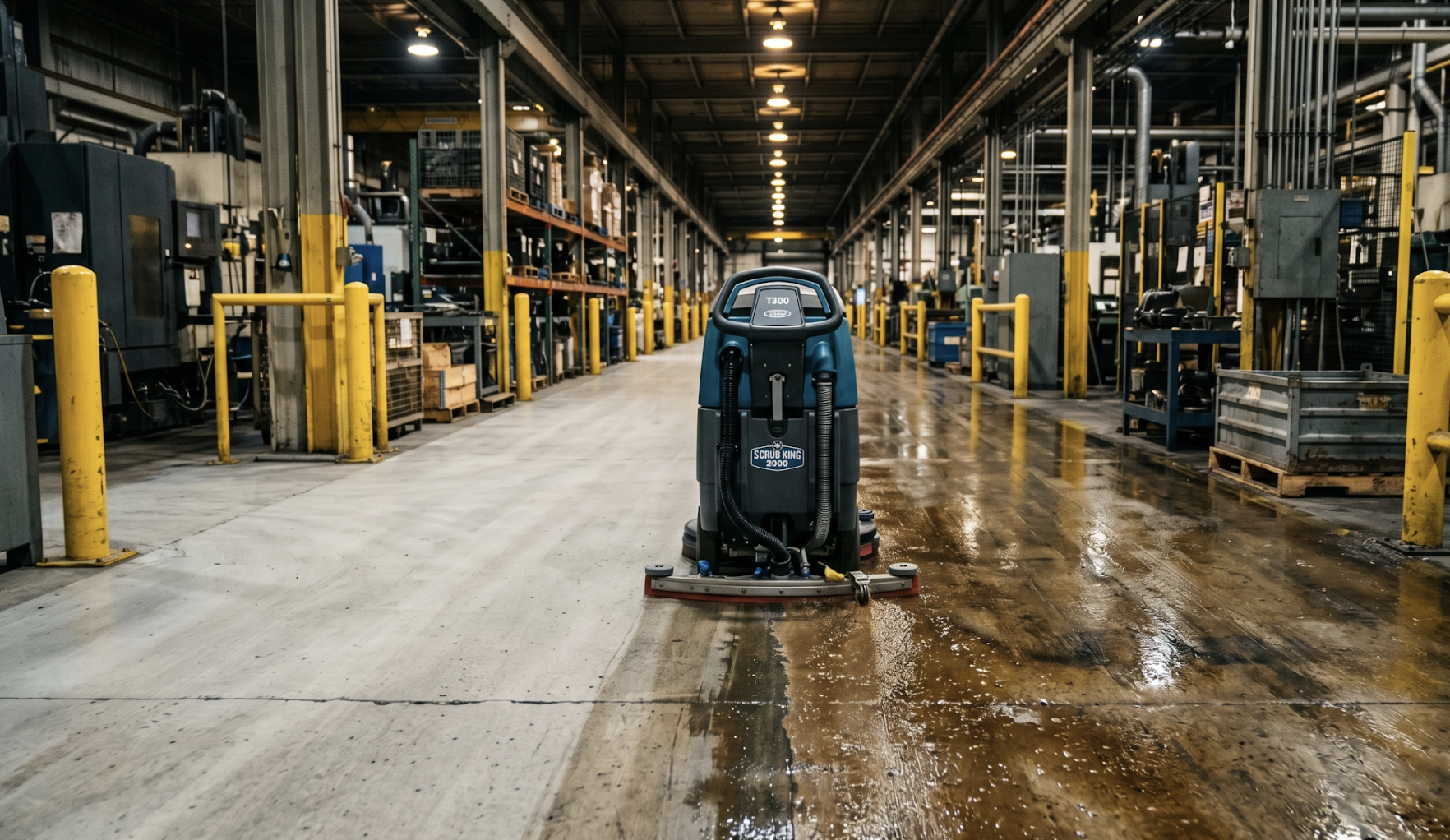
For large areas, a walk-behind floor scrubber is far more effective than manual scrubbing. The combination of chemical delivery, rotating brush pressure, and built-in recovery means you are agitating the broken-down oil and pulling it off the surface in the same pass rather than spreading it around. For isolated stains or spots in tight areas, a stiff brush with manual effort is appropriate.
Step 5: Rinse and Remove Residue
Residual degreaser or emulsified oil left on the surface after scrubbing leaves the floor nearly as slippery as the original contamination. Rinsing thoroughly is not optional. The squeegee and recovery system on a quality floor scrubber pulls dirty liquid off the floor rather than pushing it around. If you are rinsing manually, remove the dirty water completely rather than letting it air dry in place.
Step 6: Allow the Floor to Dry Completely
A significant portion of post-cleaning slip incidents happen because workers return to a recently cleaned floor before it has fully dried. Use fans to accelerate drying and keep the area blocked off until the surface is completely dry to the touch. In humid conditions or enclosed spaces with limited airflow, drying time can extend well beyond what it looks like on the surface. Err on the side of caution.
Choosing the Right Floor Scrubber for Oil-Heavy Environments
Not every floor scrubber performs equally in environments with heavy oil and grease contamination. The features that matter most in this context are brush pressure and rotation speed, since you need mechanical agitation strong enough to work degreaser into the floor surface; chemical compatibility of the solution tank and scrubbing deck, since industrial degreasers can degrade components not designed for them; and squeegee blade quality, since oily water is harder to recover cleanly than ordinary dirty water.
Tank capacity is also a practical consideration. A small tank forces you to stop and refill frequently in a large facility, which disrupts the cleaning process and extends total cleaning time. For facilities with widespread oil contamination, a walk-behind scrubber with a larger solution tank or a ride-on machine may be worth the investment over a smaller unit that requires multiple fill cycles to cover the same area. If budget is a factor, refurbished floor scrubbers from brands like Clarke and Tennant offer reliable performance at significantly lower cost than new units. If you are still working out which machine type fits your space, our breakdown of walk-behind vs. ride-on floor scrubbers gives a direct comparison based on floor size, workload, and budget.
Degreaser Dilution Guide by Floor Type
Using the wrong dilution is one of the most common mistakes in industrial floor cleaning. Too weak and the product will not cut through heavy oil buildup. Too strong on coated surfaces and you risk damaging the floor finish or leaving a residue that attracts more dirt.
For raw unsealed concrete, a concentrated dilution of roughly 1:4 to 1:8 degreaser to water is typically appropriate for heavy buildup. For sealed or painted concrete, a moderate dilution of 1:10 to 1:20 protects the coating while still providing effective cleaning. Epoxy-coated floors require careful product selection; confirm the degreaser is compatible with the epoxy coating before use, and use a conservative dilution in the range of 1:15 to 1:25. Waxed surfaces are the most sensitive and should be cleaned with the mildest appropriate dilution, with the product spot-tested before full application. For heavily saturated problem spots on unsealed concrete where routine dilutions are not cutting through, direct application without dilution may be necessary, followed by thorough rinsing. For a broader reference on cleaning cement and concrete surfaces, see our ultimate guide to cleaning cement floors.
Preventative Habits That Reduce Oil Buildup Between Cleanings
Cleaning up contamination after it has spread across the floor is always harder and more time-consuming than preventing the buildup from reaching that level. The daily and weekly habits below help keep oil and grease from accumulating between scheduled deep cleans.
Use Drip Trays and Absorbent Pads at Leak Points
Placing drip pans or absorbent mats directly beneath machinery that drips during normal operation is one of the most cost-effective preventative measures available. The key is sizing them to cover the realistic drip zone and changing or refreshing them before they become saturated and overflow onto the floor. A soaked drip tray provides no protection.
Include Floor Checks in Shift Changeover Routines
Assigning zone responsibility to shift leads, along with a brief floor walkthrough at changeover, catches new spills before they spread. Documenting where spills consistently recur also helps maintenance teams identify which equipment is due for inspection or seal replacement.
Keep Equipment Maintained to Minimize Leaks
Small hydraulic leaks, loose fittings, and worn seals that go unrepaired become chronic contamination sources. When the cleaning team and the maintenance team share information about persistent spill locations, you reduce the cleaning workload and address the actual problem instead of cleaning around it indefinitely. Keeping your cleaning machines in top condition is equally important; our floor scrubber maintenance tips walk through the most common performance issues and how to resolve them before they affect your next clean.
Establish a Daily Spot-Clean Schedule
Daily attention to your highest-risk zones prevents the kind of compounding buildup that eventually requires several hours of deep cleaning to resolve. Identify your top three to five contamination-prone areas, assign them to a specific person or team, and build a brief daily check and spot-clean into existing shift operations.
How Often Should You Deep Clean Floors in an Oil-Heavy Facility
Cleaning frequency depends on contamination level, facility type, and how intensively the space operates. As a general framework: active spill zones near heavy machinery warrant daily light cleaning to remove fresh accumulation before it bonds to the surface. Most industrial facilities benefit from full-floor machine scrubbing on a weekly basis to address contamination that daily spot-cleaning misses. Quarterly or biannual deep cleaning addresses embedded oil in porous or cracked concrete that routine scrubbing does not fully remove.
Environmental conditions affect this timeline. Facilities in warmer or more humid climates see oil and grease spread more quickly because heat reduces viscosity and humidity slows drying between cleaning cycles. If your facility runs hot or sits in a high-humidity region, your cleaning schedule should be more aggressive than the general guidelines above. For facilities evaluating which electric powered floor scrubber makes the most sense for a regular deep cleaning program, PS Janitorial carries models suited to everything from tight corridors to open warehouse floors. Unsure which floor cleaning machine to buy? Contact us for expert assistance.
Frequently Asked Questions
Can I use a standard mop to clean oil off a facility floor?
A standard mop spreads oily residue rather than removing it. When a mop head saturated with contaminated mop water is pushed across the floor, it distributes a thin layer of oil across a much larger surface area. The result is a larger contaminated zone than what you started with. For small, isolated spots, absorbent pads followed by a targeted scrub with a stiff brush and degreaser are more effective. For anything covering a meaningful area of your floor, a floor scrubber with a recovery system is the appropriate tool.
What is the best type of floor scrubber for greasy industrial floors?
Prioritize brush type, solution delivery, and recovery system performance. In oily environments, you want a scrubber with stiff, chemically resistant brushes that can work degreaser into the surface under consistent pressure. The solution delivery system should be compatible with commercial degreasers. Most importantly, the squeegee and recovery system needs to handle oily water effectively. A weak recovery system leaves residue behind that keeps the floor slippery after the machine passes.
Our guide on how to choose the right industrial floor scrubber for heavy duty cleaning covers the full decision framework for facilities with demanding contamination levels.
How do I dispose of oil-saturated absorbent materials?
Oil-soaked granular absorbent and pads are typically classified as hazardous waste depending on the type of oil involved and your local regulations. Do not put them in standard dumpsters without confirming your disposal obligations. Many industrial facilities contract with a licensed waste hauler for materials contaminated with petroleum-based lubricants. Check with your local environmental or waste management authority for the requirements that apply to your specific operation.
Will degreaser damage sealed or epoxy-coated floors?
It depends on the product and the dilution. Many commercial degreasers are safe for sealed and epoxy-coated surfaces when used at the correct dilution, but highly alkaline formulations used at concentrated strengths can degrade coatings over time. Always check the product data sheet for compatibility with coated surfaces. When in doubt, spot test in an inconspicuous area before applying across the full floor. PS Janitorial's Floor Cleaner Concentrate is non-caustic and approved for use in floor scrubbers, making it a safer starting point for coated surfaces when heavy degreasing is not required.
How do I know if my floor is clean enough after scrubbing?
The most reliable test is the water break test. After rinsing, pour a small amount of water onto the cleaned surface. On a truly clean floor, the water will sheet out evenly. If the water beads up or pulls away in irregular patterns, oily residue is still present and the floor needs another pass. If the surface still feels slick underfoot after drying, additional degreaser application and scrubbing are needed before the area is safe to reopen.