Industrial Vacuum vs Floor Sweeper: Which One Is Better for Dry Debris and Dust Control?
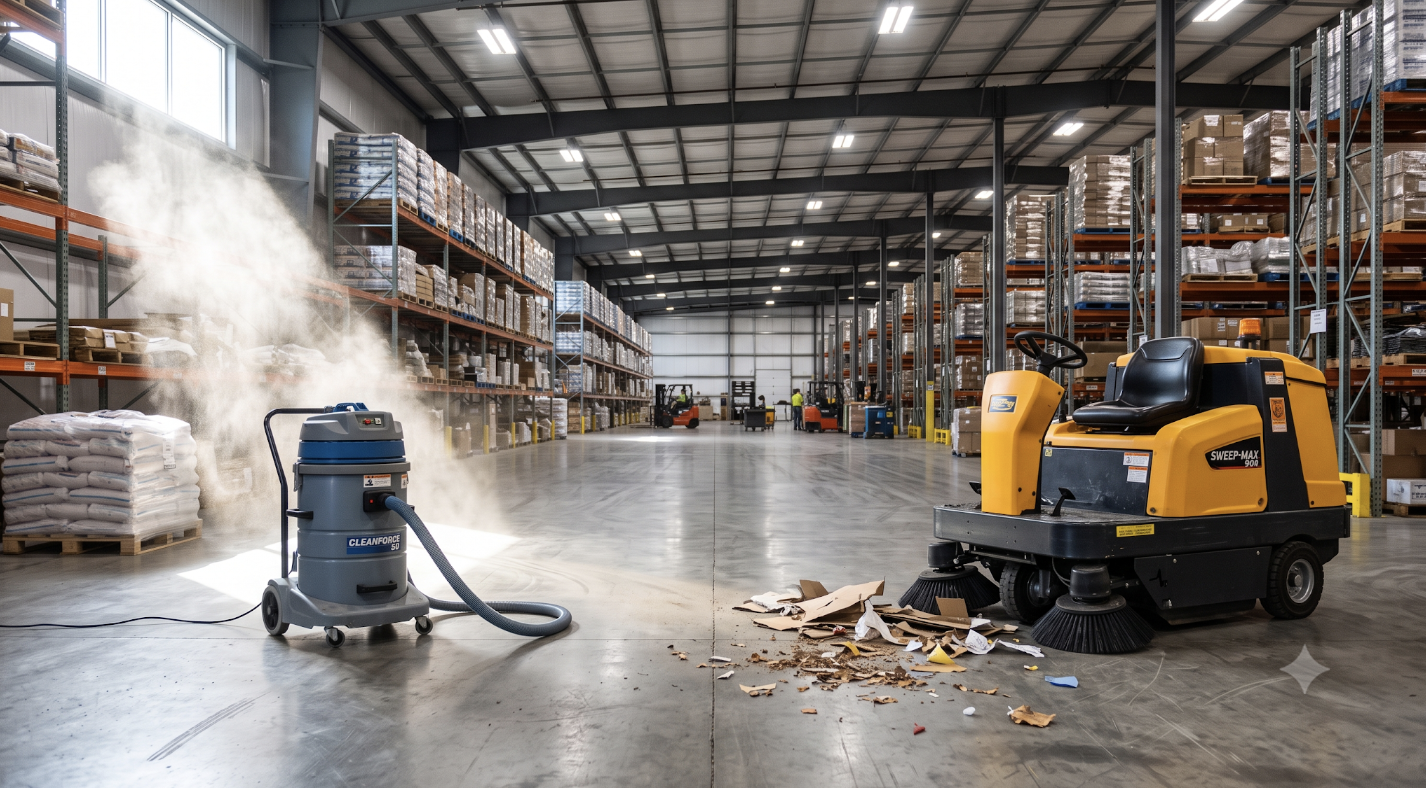
If you manage a warehouse, retail store, school, or manufacturing floor, you already know that dry debris and dust build up fast, and choosing the right cleaning equipment isn't always obvious. Should you invest in an industrial vacuum, a floor sweeper, or both? Each machine has a clear purpose, but they solve different problems. A sweeper is built to clear large volumes of surface debris quickly, while a vacuum is built to capture fine dust and airborne particles that a sweeper simply pushes around. In this guide, you'll get a full breakdown of how each machine works, where each one excels, and how to decide which fits your facility. PS Janitorial carries both categories of equipment, so whichever direction you land on, you'll find machines built for daily commercial use.
Industrial Vacuum vs Floor Sweeper: Quick Comparison Chart
| Category | Industrial Vacuum | Floor Sweeper |
|---|---|---|
| Best for debris type | Fine dust, allergens, small particles | Larger, visible debris like paper and leaves |
| Flooring compatibility | Carpet and hard floors | Hard surfaces only (concrete, tile, VCT) |
| Dust and air quality control | High, with HEPA/multi stage filtration | Limited, can stir up light dust |
| Coverage area | Best for tight or smaller spaces | Best for large, open floor areas |
| Noise level | Varies by model and filtration | Generally quieter |
| Indoor/outdoor use | Indoor only | Indoor and outdoor |
| Typical facility examples | Healthcare facilities, schools, offices | Warehouses, distribution centers, parking areas |
What Is an Industrial Vacuum?
An industrial vacuum cleaner is a heavy duty suction machine designed for continuous commercial use rather than occasional household cleanup. Compared to a standard vacuum cleaner you'd use at home, commercial vacuum cleaners are built with larger motors, higher capacity tanks or bags, and stronger filtration systems that can run for hours without losing suction. They're engineered to handle dry debris, fine particles, and in some cases wet spills, making them a versatile choice for facilities that can't afford downtime.
How Industrial Vacuums Work
The process behind an industrial vacuum is straightforward but effective. A motor draws air through a hose or wand, pulling in dirt, dust, and debris along the way. That debris gets trapped inside a bag or canister, while the air continues moving through the system. Before that air is released back into the room, it passes through a filter, often a HEPA filter or a multi stage filtration setup, that captures fine particles down to a microscopic level. This is what separates an industrial vacuum cleaner from a basic shop vac: the filtration is built specifically to trap allergens and dust rather than let them recirculate.
Key Benefits of Industrial Vacuums for Dry Debris and Dust Control
Industrial vacuums shine when the goal is air quality, not just visible cleanliness. Strong suction paired with HEPA level filtration means fine dust, paper dust, and other airborne particles get pulled out of circulation instead of stirred up. This matters in environments where allergens and respirable dust are a health concern, not just a housekeeping issue.
Vacuums also reach into tight spaces that a wider machine can't access, including corners, baseboards, under furniture, and around equipment. And unlike a sweeper, an industrial vacuum works across carpeted surfaces and hard floors alike, which makes it one of the more versatile pieces of equipment in a facility's cleaning arsenal. If your building has carpet fibers holding onto embedded dirt, a vacuum is really the only tool built to pull that out.
What Is a Floor Sweeper?
A floor sweeper is a machine built to cover large hard surface areas quickly using rotating brushes, sometimes paired with a secondary vacuum system for finer pickup. Where an industrial vacuum focuses on precision and air quality, a commercial floor sweeper focuses on speed and volume. Sweepers are common in warehouses, big box retail stores, and manufacturing facilities where the priority is clearing wide open floor areas on a daily basis.
How Floor Sweepers Work
The core mechanism is simple: rotating brushes make contact with the floor surface and lift debris up into a hopper as the machine moves forward. Some models add a secondary vacuum or filter stage to catch lighter particles, but the primary job is done by the brushes. Floor sweepers come in a few formats: walk behind units for smaller or narrower floor plans, and ride on models for large warehouses where covering ground quickly matters more than maneuverability. Power options vary too, from manual sweepers pushed by hand, to battery powered or corded electric sweepers that reduce operator effort over long shifts.
Key Benefits of Floor Sweepers for Large Area Debris Pickup
The biggest advantage of a floor sweeper is speed across large floor areas. A wide cleaning path lets one operator clear far more square footage per hour than they could with a vacuum, which directly reduces labor costs and operator fatigue. Sweepers are also better suited to bulkier, visible debris like cardboard scraps, packaging material, leaves, and paper. This is debris you can see with the naked eye, as opposed to the fine dust a vacuum is built to chase. For warehouses and distribution centers dealing with constant surface debris from pallets, shipments, and foot traffic, a sweeper can turn what would be a long manual task into quick daily cleanup.
Industrial Vacuum vs Floor Sweeper: Key Differences
Both machines remove debris, but they're engineered around different priorities. Here's how they compare across the categories that matter most when you're choosing equipment for your facility.
Type and Size of Debris
Industrial vacuums are built for fine dust, allergens, and small particulate that you'd otherwise never fully remove by sweeping. Floor sweepers are built for larger, visible debris such as paper, leaves, and packaging scraps. If your biggest daily challenge is bulk debris covering a warehouse floor, a sweeper will clear it faster. If your challenge is fine particles settling into carpet or corners, a vacuum is the better tool.
Dust Control and Air Quality
This is where the two machines differ most, and it's the deciding factor for many facilities. Vacuums equipped with HEPA or multi stage filtration actually trap airborne dust and hold onto it, improving indoor air quality over time. A floor sweeper, by contrast, tends to stir up light dust rather than filter it out of the air completely. Brushes are excellent at collecting surface debris, but without a vacuum stage, fine dust can become airborne during the sweeping process itself. If dust removal and air quality are a top concern, particularly in healthcare facilities or food and beverage production, an industrial vacuum cleaner is going to do more of the heavy lifting.
Facility Size and Layout
Sweepers are built for wide open spaces such as warehouses, parking lots, and big box store floors, where a wide cleaning path translates into real time savings. Vacuums are the better fit for tighter spaces, layouts full of obstacles like shelving and furniture, and smaller facilities where maneuverability matters more than raw coverage speed.
Flooring Type and Surface
Sweepers are generally limited to hard surfaces like concrete, tile, VCT, and epoxy floors. They're not designed for carpeted areas and can actually struggle or cause wear on softer surfaces. Vacuums, on the other hand, work across both carpet and hard floors, which makes them the more flexible option if your facility has a mix of flooring types under one roof.
Noise Level and Operating Hours
Floor sweepers, especially electric and battery powered models, tend to run quieter than many industrial vacuums, which makes them a good fit for daytime cleaning in sound sensitive environments like schools, hospitals, and offices. Vacuum noise levels vary quite a bit depending on the model and filtration system, so if noise is a concern during business hours, it's worth checking decibel ratings before you buy.
Indoor vs Outdoor Use
Floor sweepers are built to handle outdoor surfaces as well, including gravel, leaves, dirt, and uneven ground around loading docks or parking areas. Industrial vacuums are generally indoor only tools, designed for controlled environments rather than outdoor terrain. If your cleaning needs stretch beyond four walls, a sweeper covers ground a vacuum simply can't.
When to Choose an Industrial Vacuum for Dry Debris and Dust Control
An industrial vacuum is the right call if any of the following describe your facility:
- You're dealing with fine dust or allergen concerns that impact air quality.
- Your floors are carpeted, mixed, or include areas a sweeper can't reach.
- You need to clean tight or detailed spaces around equipment, furniture, or fixtures.
- You operate in a setting where HEPA level air quality actually matters, such as healthcare facilities, schools, food and beverage production, or manufacturing environments with combustible dust concerns.
When to Choose a Floor Sweeper for Dry Debris and Dust Control
A floor sweeper makes more sense if your priorities look like this:
- You have large open hard floor areas that need regular coverage.
- You're generating a high volume of bulky surface debris on a daily basis.
- You need fast turnaround cleaning to keep operations moving without long downtime.
- You need one machine that can handle both indoor and outdoor coverage, such as loading docks, warehouse floors, and parking areas.
Can You Use Both? Building a Complete Dry Debris Cleaning Program
For many facilities, the real answer isn't choosing one machine over the other. It's using both, in sequence. The standard approach in industrial settings is to sweep first, clearing bulk debris like paper, packaging, and larger particles from the floor, then follow up with a vacuum pass to capture the fine dust and embedded particles left behind. This two step process gives you both efficient results and thorough cleaning: the sweeper handles volume and speed, while the vacuum handles the deep cleaning and air quality side of the job. If your facility deals with both heavy surface debris and dust or allergen concerns, building a program around both machines is typically the most effective long term solution, and it's a common setup across warehouses, manufacturing plants, and multi level commercial buildings alike.
Dust Control and Safety Considerations
Dust control isn't just about appearances. In industrial settings like woodworking shops, metalworking facilities, and manufacturing floors, airborne dust can pose real safety risks. OSHA maintains guidance around combustible dust, since certain fine particles can become a fire or explosion hazard when they accumulate in the air or on surfaces. Beyond combustion risk, there are also respirable dust exposure limits designed to protect workers from long term lung damage caused by breathing in fine particles day after day.
This is where filtration quality becomes a safety issue rather than just a cleanliness one. A vacuum with proper HEPA filtration captures particles that would otherwise stay airborne or resettle on surfaces, which matters both for regulatory compliance and for the health of everyone working in the building. If your facility handles wood dust, metal particulate, or other fine industrial byproducts, investing in equipment with genuine high efficiency filtration should be treated as a safety decision, not just a purchasing preference.
Frequently Asked Questions
Is an industrial vacuum the same as a shop vac?
Not exactly. A shop vac is built for occasional, lighter duty use, while an industrial vacuum cleaner is designed for continuous commercial operation, with a larger capacity, stronger suction, and more advanced filtration, often including HEPA filters, that a standard shop vac doesn't offer.
Can a floor sweeper pick up fine dust on its own?
Not effectively. A sweeper's rotating brushes are built to collect surface debris and larger particles, but without a secondary filtration or vacuum stage, fine dust and airborne particles often get missed or stirred into the air rather than captured.
Which machine is better for warehouses with concrete floors?
For daily maintenance and bulk debris on concrete floors, a commercial floor sweeper is typically the more efficient choice. If your warehouse also deals with fine dust or air quality concerns, pairing it with an industrial vacuum for periodic deep cleaning rounds out the program.
Do I need both a sweeper and a vacuum for my facility?
It depends on what your facility handles day to day. If you're managing both large volumes of surface debris and fine dust or allergen concerns, using a sweeper for daily maintenance and a vacuum for deeper, more detailed cleaning is generally the most complete approach.
Find the Right Dry Debris and Dust Control Equipment at PS Janitorial
The right choice really comes down to what your facility deals with most. If speed, labor savings, and coverage across large floor areas are the priority, a floor sweeper is built for that job. If fine dust, allergens, and air quality are the bigger concern, especially across carpeted areas or tight spaces, an industrial vacuum is the tool that delivers.
PS Janitorial carries a full lineup of dry debris and dust control equipment, along with floor buffers and floor scrubbers to round out a complete floor care program. Browse our equipment categories to compare models, or contact our team directly and we'll help you match the right cleaning equipment to your facility's debris type, floor types, and cleaning frequency.