Propane Floor Scrubber vs Battery Floor Scrubber: Which One Is Right for Indoor Use?
What Is a Propane Floor Scrubber?
A propane floor scrubber is a combustion-powered floor cleaning machine that runs on liquid propane gas. The engine drives the scrubbing deck and propulsion system, making these machines capable of sustained, high-output cleaning across massive facilities. Cleaning deck sizes typically range from 28 to 36 inches on ride-on models, and engine output is sized for continuous heavy-duty cleaning across concrete warehouse floors, distribution centers, and large industrial facilities. Because propane engines produce combustion byproducts including carbon monoxide, these machines are built around the assumption of adequate airflow. They are not a viable default for enclosed spaces without confirmed mechanical ventilation.
What Is a Battery-Powered Floor Scrubber?
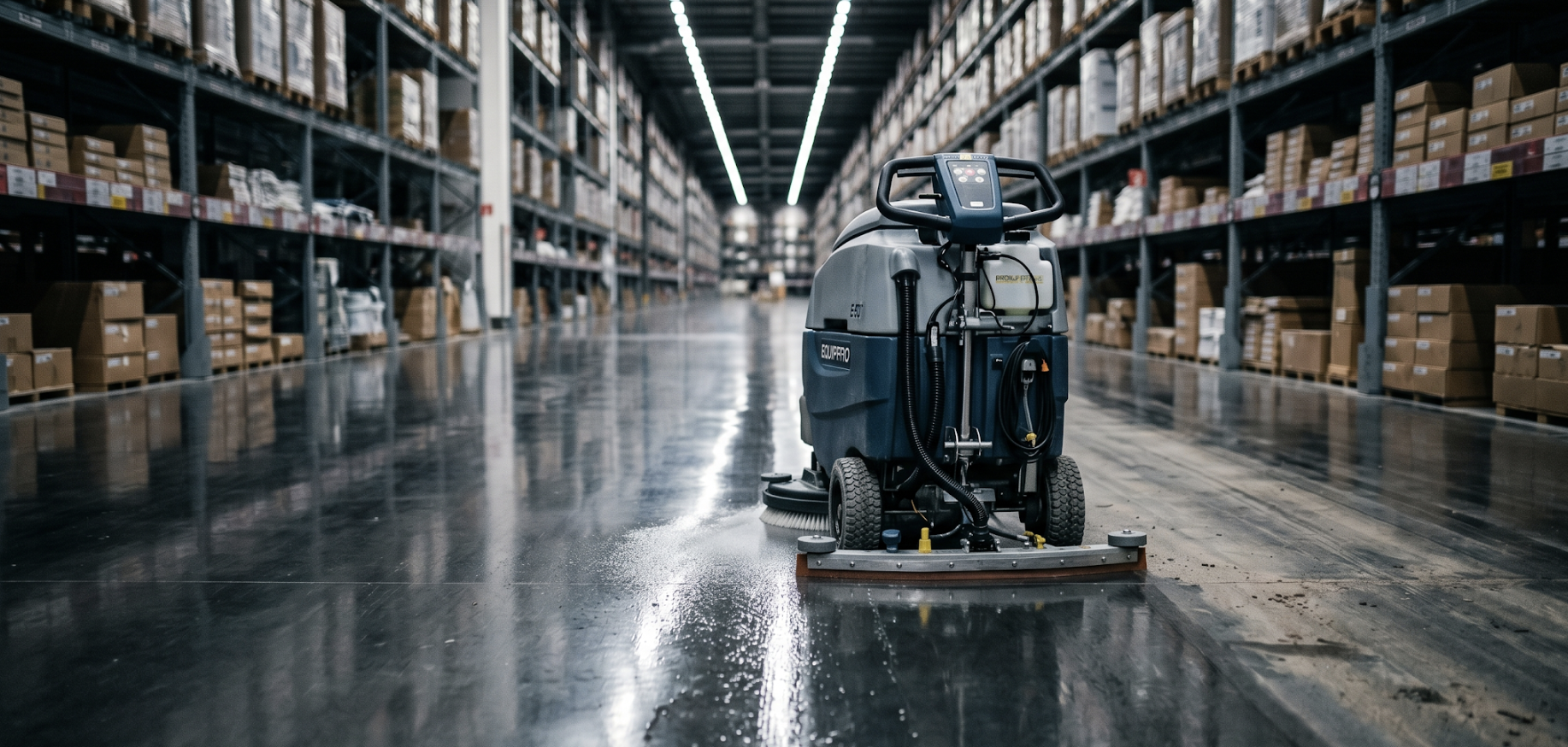
A battery floor scrubber is a self-contained floor cleaning machine powered by a rechargeable battery pack. The machine carries a solution tank that delivers cleaning water and chemical to the brush deck, and a recovery tank that collects the dirty water through an integrated squeegee system. No power cord, no fuel tank, no combustion.
Battery powered floor scrubbers come in three battery types. Lead-acid (wet cell) is the traditional option, offering a runtime of roughly 2.5 to 3.5 hours per charge. AGM batteries deliver similar runtime with zero off-gassing and no distilled water maintenance. Lithium ion batteries push runtime to 3 to 5 hours, recharge in 2 to 3 hours, and support opportunity charging during breaks. Battery scrubbers are the standard choice for commercial offices, schools, hospitals, retail stores, and any enclosed or occupied indoor environment.
The Core Difference: Indoor Air Quality and Emissions
If you are cleaning indoors, emissions are the single most important factor in this comparison. Propane powered machines produce carbon monoxide as a byproduct of combustion. In an enclosed space, CO accumulates quickly to dangerous levels.
OSHA's permissible exposure limit for CO is 50 parts per million as an 8-hour time-weighted average. Facilities using propane equipment indoors are required to maintain ventilation systems capable of keeping CO concentrations below this threshold throughout the cleaning operation. Confirming this in practice requires air quality monitoring, mechanical ventilation calculations based on cubic footage and CFM ratings, and documented compliance procedures. Most facility managers operating in occupied or semi-enclosed buildings are not equipped to meet this standard reliably.
Battery powered scrubbers produce zero emissions at the point of use. There is no combustion, no CO exposure risk, and no ventilation requirement tied to the machine itself. For virtually every indoor cleaning environment, zero emissions operation is not just a convenience but a safety and compliance baseline.
Propane vs Battery Floor Scrubber: Head-to-Head Comparison
The right floor scrubber for your operation depends on your facility type, cleaning environment, ventilation infrastructure, and how many shifts you run per week. The sections below break down each decision factor directly.
Cleaning Power and Coverage
Propane machines generally deliver wider cleaning paths and more aggressive scrubbing pressure, which is why they remain common in heavy industrial applications with thick grease, compacted dust, and large open concrete floors. For that category of soil on that scale of facility, the output difference is meaningful.
For standard commercial indoor soils, including dust, food-grade residue, light tracked-in debris, and routine foot traffic buildup, battery powered models deliver more than sufficient cleaning power. Walk-behind battery scrubbers typically cover 5,000 to 20,000 square feet per charge. Mid-range self-propelled models extend to 30,000 square feet or more. Ride-on battery scrubbers designed for massive facilities can exceed 50,000 square feet per charge. On quality units, downward brush pressure remains consistent throughout the charge cycle, so cleaning efficiency does not drop off near the end of a run.
Runtime and Operational Continuity
Propane has a real operational advantage in multi-shift environments: a tank swap takes a few minutes, and the machine returns to service immediately. There is no waiting for a recharge cycle. For facilities running two or more back-to-back shifts, propane powered equipment sidesteps the battery charging gap entirely.
Battery lead-acid models require 8 to 10 hours to fully recharge, which makes them difficult to run across consecutive shifts without a second battery pack. Lithium ion batteries change the math significantly. A 2 to 3 hour recharge window means a lithium ion machine can be charged between shifts, and opportunity charging during lunch or break periods further extends effective runtime. Facilities running two shifts with lithium ion battery scrubbers typically resolve the continuity problem by keeping one additional battery on a charger during each operational period.
Upfront Cost and Total Cost of Ownership
Propane machines carry a higher initial cost due to engine complexity and the additional systems required for fuel delivery and combustion management. Battery machines vary widely by battery type. Lead-acid models have a lower upfront cost but require battery replacement every 3 to 4 years and ongoing maintenance. Lithium ion models carry a higher initial investment but battery replacement intervals stretch to 6 to 8 years, and the reduced maintenance burden adds up over time.
On the fuel and energy side, propane costs fluctuate with market prices, while electricity costs for battery charging are comparatively low and stable. Factoring in battery replacement cycles, electricity costs, and reduced maintenance labor, battery powered scrubbers deliver a lower total cost of ownership for most indoor facilities over a 5 to 10 year window.
Maintenance Requirements
Propane floor scrubbers require engine-level maintenance: oil changes, air filter replacement, spark plug service, carburetor maintenance, and periodic propane system inspections. This is a real time and cost commitment that requires either a dedicated equipment technician or a service contract.
Lead-acid battery scrubbers require regular distilled water top-ups, equalization charges, and terminal cleaning to prevent sulfation and extend battery life. AGM batteries and lithium ion batteries are essentially maintenance free on the battery side. Beyond normal machine upkeep such as brush replacement, squeegee inspection, and tank cleaning, there is no battery-specific maintenance routine. For facilities without dedicated equipment staff, the reduction in maintenance requirements is a significant operational benefit.
Noise Levels
Propane engines run loud. In a large warehouse after hours, that is manageable. In a school during the day, a hospital hallway, or a retail store with customers on the floor, it is not.
Battery scrubbers operate at roughly 65 to 72 dBA, comparable to normal conversation. That quiet operation makes day cleaning practical in virtually any setting. If your team cleans while the building is occupied, battery is not just a preference but a functional requirement. Propane is best suited for after-hours cleaning in industrial facilities where noise is not a limiting factor.
Maneuverability and Operator Experience
Walk-behind and self-propelled battery scrubbers are designed to handle tight spaces, multi-room layouts, doorways, elevator access, and multi-floor cleaning routes. The absence of a power cord eliminates cord management entirely, removes trip hazards, and means your cleaning staff is never limited by the location of power outlets.
Self-propelled battery models significantly reduce physical strain on long shifts compared to push-behind corded machines or operator-paced propane equipment. Ride-on propane scrubbers are engineered for wide-open floor plans where turning radius and speed matter more than maneuverability. If your facility has columns, partitions, small spaces, or multiple floors, battery powered models are the practical choice.
When a Propane Floor Scrubber Makes Sense
Propane does have legitimate applications. The conditions that make it appropriate are specific and non-negotiable.
Propane floor scrubbers are suitable for large, well-ventilated or open-air industrial environments such as outdoor distribution yards, covered loading docks with substantial natural airflow, and large industrial warehouses with certified mechanical ventilation systems. Before propane is a viable option, the following conditions need to be confirmed:
- The facility's ventilation system meets OSHA CFM thresholds for the cubic footage of the space.
- Air quality monitoring is in place to verify CO concentrations remain below 50 ppm during machine operation.
- The space is either unoccupied during cleaning or large enough that air dilution prevents unsafe concentration buildup.
- Facility management is prepared to maintain documentation of ventilation compliance.
If your facility meets all of those conditions, propane offers real productivity advantages for heavy industrial soils on large concrete floors. If even one condition is uncertain, battery is the safer and more defensible choice.
When a Battery Floor Scrubber Is the Right Choice for Indoor Use
Battery powered scrubbers are the right floor cleaning machines for the full range of occupied indoor environments: commercial offices, grocery stores, schools, hospitals and clinics, retail floors, food processing plants, gyms, enclosed warehouses, and any multi-floor building. Zero emissions operation means no ventilation requirements tied to the machine. Quiet operation keeps cleaning during business hours practical. No power cord means no cord length constraints, no electrical outlets required along the cleaning path, and no trip hazards for staff or visitors.
Lithium ion battery models have largely closed the runtime gap that once made propane the default for demanding schedules. For most facilities, a lithium ion floor scrubber running on an opportunity charging schedule provides effective coverage across a standard operating day without interruption.
Choosing the Right Battery Type for Your Facility
Lead-acid (wet cell) batteries are the budget entry point. Lower upfront cost, proven battery technology, and widely available replacement units make them the right choice for facilities that can commit to regular battery care and do not mind the longer recharge window. Expect roughly 500 to 700 charge cycles before battery replacement.
AGM batteries eliminate the off-gassing concern of wet cell lead-acid and require no distilled water maintenance. They are the practical middle option for indoor facilities where battery maintenance time is limited and off-gassing in a confined charging area is a concern. Charge cycles are comparable to wet cell lead-acid.
Lithium ion batteries deliver the highest uptime, the fastest recharge, and the lowest long-term ownership cost for high-use operations. With 1,500 to 3,000 charge cycles before replacement, a lithium ion battery pack can last the life of the machine. For any facility running daily cleaning shifts, lithium ion is worth the higher initial investment.
Key Factors to Consider Before You Buy
Before selecting a floor scrubber, work through this checklist:
- Facility square footage determines the minimum tank capacity and run time you need per shift.
- Floor surface type matters for brush and pad selection: concrete, tile, vinyl, epoxy, terrazzo, sealed wood, and rubber each pair with specific tooling.
- Ventilation quality is non-negotiable if propane is under consideration.
- Number of cleaning shifts per week determines whether you need lithium ion or whether lead-acid is sufficient.
- Outlet availability and locations affect where battery charging happens and how your charging workflow is structured.
- Team size and cleaning staff experience influences whether a walk-behind, self-propelled, or ride-on model is the right format.
- Day cleaning vs. after-hours cleaning determines how much noise tolerance you have and which machine type fits your operating schedule.
No single spec is the whole answer. The right floor scrubber matches your facility's actual operating conditions.
Propane vs Battery Floor Scrubber: Which One Should You Buy?
For indoor use in any occupied or semi-enclosed space, battery powered is the right answer in virtually every scenario. The emissions and noise profile of propane disqualifies it from most indoor applications before any other factor comes into play. Battery technology has matured to the point where runtime, cleaning power, and total cost of ownership are all competitive or superior for standard commercial cleaning needs.
Propane belongs in specific outdoor or heavily ventilated industrial settings where the conditions outlined above are confirmed and documented. Everywhere else, battery scrubbers run cleaner, quieter, and at a lower operational cost over time.
Browse PS Janitorial's battery floor scrubbers and propane floor scrubbers to compare specific models matched to your facility size and cleaning requirements.
Frequently Asked Questions
Below are answers to the most common questions PS Janitorial receives when facility managers are deciding between propane and battery floor scrubbers.
Can you use a propane floor scrubber indoors?
Only in facilities with sufficient mechanical ventilation that meets OSHA guidelines for CO exposure limits (50 ppm as an 8-hour time-weighted average). This requirement disqualifies most occupied spaces, multi-floor buildings, and any environment where ventilation capacity cannot be confirmed and monitored. Battery scrubbers produce zero emissions at the point of use and carry no equivalent restriction, making them the safe default for indoor cleaning operations.
How long does a battery floor scrubber run on a single charge?
Lead-acid and AGM models typically run 2.5 to 3.5 hours per charge. Lithium ion models extend that to 3 to 5 hours depending on machine size and usage intensity. Lithium ion units also support opportunity charging, so topping off during a lunch break or shift change can extend effective runtime across a full workday without a complete recharge cycle.
What type of floors can a battery floor scrubber clean?
Battery floor scrubbers handle concrete, ceramic and porcelain tile, vinyl composition tile, epoxy-coated floors, terrazzo, sealed wood, and rubber flooring. Brush or pad selection determines suitability for different floor types and soil levels: cylindrical brushes for uneven or heavily soiled concrete, disc pads for smoother surfaces and light-duty daily cleaning.
Are propane floor scrubbers more powerful than battery models?
Propane machines often deliver more raw torque, particularly on ride-on scrubbers built for industrial-scale use. For most commercial indoor soils, however, the cleaning performance difference is not operationally meaningful. Battery scrubbers equipped with cylindrical brush decks match or exceed propane performance on standard hard floor soils, and they do so without the emissions, noise, and ventilation requirements that propane introduces.
How much does a battery floor scrubber cost?
Compact walk-behind battery scrubbers at the entry level typically range from $2,000 to $5,000. Mid-range self-propelled models run from $5,000 to $15,000 depending on tank capacity, battery type, and deck size. Ride-on battery scrubbers for larger facilities start around $15,000 and scale upward based on configuration. Lithium ion battery versions carry a premium at each tier. Contact PS Janitorial directly for a quote matched to your facility size and cleaning needs.